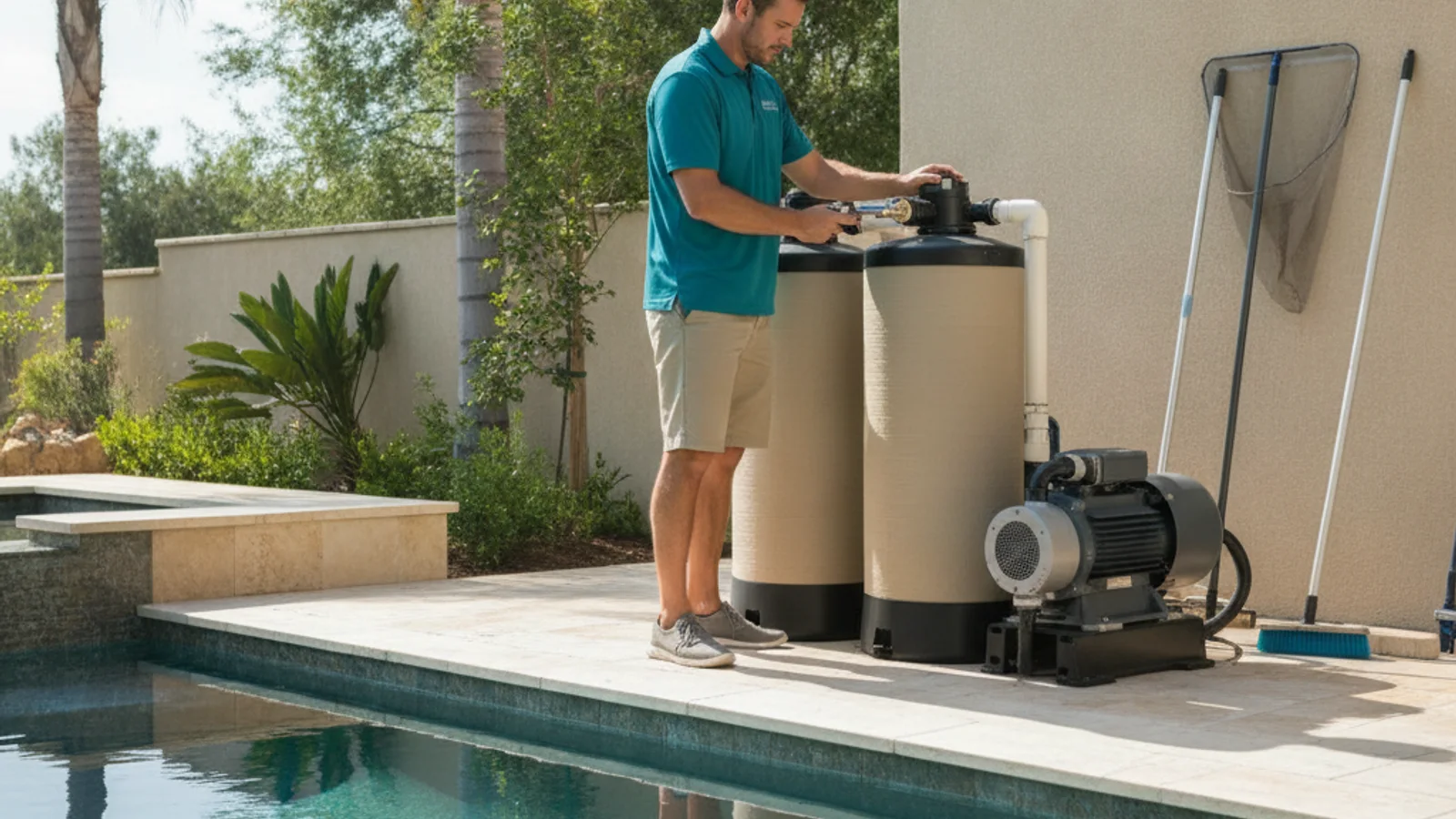
Compare Pentair, Hayward, and Jandy (Fluidra) equipment models with the unit already on your pad. None of the three is a clear winner across every category. Record the model already on the pad, describe any visible issue, and ask a licensed independent pro what a quote covers for the pump, filter, heater, or salt system already on the pad. Request written warranty and care instructions, and discuss a repair versus replacement assessment for what is already installed.
How should you choose pool equipment for a San Diego pool in 2026
The best pool equipment brands for San Diego in 2026 share three traits: Title 20 compliance, strong parts availability through local supply houses, and a warranty program that a licensed pool repair pro can actually process. Pentair, Hayward, and Jandy all check those boxes. Smaller or budget brands sometimes undercut them on sticker price, but a pool repair pro in our network will often flag those as a false economy, since replacement parts can take weeks to arrive and warranty claims get routed through overseas support lines instead of a local distributor. For a pool that’s going to sit in a San Diego backyard for the next decade, buying into a brand with local service depth usually pays off faster than the small savings on the equipment itself.
What makes a pool pump brand worth choosing in 2026
A pool pump brand is worth choosing in 2026 if it offers a true variable-speed motor, meets Title 20 efficiency standards, and has a local dealer network for parts. Pentair’s IntelliFlo line and Hayward’s TriStar and MaxFlo VS pumps are the two most common variable-speed families installed across San Diego County right now, with Jandy’s VS FloPro a close third on pools already running Jandy automation. A HomeGuide general US planning range is about $800 to $2,000 installed, or about $700 to $1,600 for the unit alone. That is general US planning guidance, not a brand or San Diego rate. The actual quote comes after a licensed independent pro discusses and assesses the job. Ask whether the quoted pump fits the existing plumbing and whether it will work with the controls already on the pad.
Which pool filter brands hold up best in San Diego’s water
Cartridge filters from Pentair and Hayward hold up best against San Diego’s moderately hard water, since cartridges don’t rely on a sand bed or DE powder that scales faster in higher-mineral water. HomeGuide’s general US planning range for filter replacement is about $250 to $1,700. That is general US planning guidance, not a company or local rate. Ask what work the filter quote covers. Sand filters remain the lower-upfront option among common filter types. DE filters deliver the clearest water of the three types but need more hands-on maintenance and are increasingly hard to find installers for, since fewer new pools spec them. Most pool equipment specialists in our network default to cartridge for new installs and reserve sand or DE recommendations for pools where the plumbing already favors one type.
Are heat pump heaters or gas heaters the better buy for 2026
Heat pumps and gas heaters can both be a fit, depending on how often you heat and how quickly you want the water to warm. A HomeGuide general US planning range puts an installed heat pump at about $2,000 to $6,000 and a natural gas or propane heater at about $1,500 to $4,500. Those figures are general US planning estimates, not company or local rates. Gas heaters still make sense for pools heated only occasionally or for households that want fast, on-demand heat rather than the slower, steady warm-up a heat pump delivers. Pentair’s UltraTemp and Hayward’s HeatPro lines are the two most-installed heat pump brands locally, and both integrate with either manufacturer’s automation system without much friction.
What to ask about salt chlorine generator brands
Salt systems add salt to generate the chlorine a pool needs. On a Pentair salt generator, a new cell assembly can be ordered when the cell is worn. Record the generator model from the unit or its documentation, then compare what a quote includes, such as the generator, salt, and labor, and whether a pump or filter replacement is part of the job. Ask whether the generator is sized for the pool, and request written warranty and care instructions. Homeowners converting from traditional chlorine should read through our salt water conversion service page before choosing a cell size.
What should you look for in pool automation and smart controls
Look for an automation system that natively controls every major component on the pad, not just the pump, since that’s where brand mismatches cause the most frustration. Pentair’s IntelliCenter and Hayward’s OmniLogic both handle pump, heater, salt cell, and lighting from a single app, but neither talks natively to the other brand’s hardware without a universal controller layered on top. For a straightforward pad with one brand throughout, either system works well and ties into Apple HomeKit or Google Home with minor setup. For a mixed pad built up over multiple repairs across different years, a universal controller is usually worth the added cost, since it saves the homeowner from running two separate apps to manage one pool.
Is it better to match brands or mix equipment on an aging pad
Matching brands isn’t mechanically required, but it does simplify automation and warranty tracking on an aging pad. Pumps, filters, and heaters from any major brand connect through standard PVC plumbing, so a cracked Hayward filter can sit next to a Pentair pump without issue. The complication shows up when a homeowner wants remote control or scheduling, since a Pentair app generally won’t operate a Hayward salt cell without a universal controller bridging the two. A pool equipment specialist in our network can look at what’s already on the pad and recommend whether a brand-matched replacement or a universal controller makes more sense for the specific mix of gear installed over the pool’s lifetime.
A dead pump or a heater that won’t fire is usually the first sign it’s time to weigh repair against replacement, and that decision often comes down to the age of the rest of the pad. A pool equipment repair visit can diagnose whether a single component failed in isolation or whether the whole pad is nearing the end of its service life together. Spa and hot tub owners facing the same brand questions on a smaller system can get comparable guidance through our spa and hot tub connections, and a pad that’s failing outright, with no circulation and green water forming fast, usually calls for emergency pool service rather than a scheduled equipment quote.
Frequently asked questions
How should I choose pool equipment for a San Diego pool in 2026?
There isn’t one brand that beats every other across the board. Record the model already on the pad, describe any visible issue, and ask a licensed independent pro what the quote covers. Request written warranty and care instructions, and discuss whether repair or replacement fits the equipment you have.
Are heat pump pool heaters worth it in San Diego for 2026?
Heat pumps and gas heaters can both be a fit, depending on how often you heat and how quickly you want the water to warm. HomeGuide’s general US planning ranges cited in this article are for planning only, not a San Diego or brand quote, and a licensed independent pro provides the actual quote after discussing and assessing the job. Gas heaters still make sense for pools that need fast, on-demand heating for occasional use.
How much does new pool equipment cost in 2026?
HomeGuide’s general US planning range for a variable-speed pump is about $800 to $2,000 installed, or about $700 to $1,600 for the unit alone. Filter replacement planning is about $250 to $1,700. Installed heater planning ranges include about $1,500 to $4,500 for natural gas or propane, about $2,000 to $6,000 for a heat pump, and about $2,500 to $6,500 for solar. These are separate component examples for general US planning, not a full equipment pad total. Ask for an itemized quote for the specific equipment after a licensed independent pro discusses and assesses the job.
Do variable-speed pumps actually save money in San Diego?
Yes. A variable-speed pump moves the same water at a lower speed for far less power, because draw falls much faster than flow does, which is why it beats the single-speed motors still running on pre-2010 pads. Efficiency rules also govern what a replacement pump may be, so ask the specialist which requirement applies before parts are ordered.
Should new pool equipment match the brand already on the pad?
Matching brands isn’t required mechanically, since pumps, filters, and heaters connect through standard PVC plumbing regardless of manufacturer. It matters most for automation. A smart controller from one brand generally won’t run another brand’s salt cell or heater natively, so mixed pads often need a universal controller to keep everything talking to each other.
Not sure whether your current pad needs a repair, a brand-matched replacement, or a full upgrade? Call (858) 400-4598 and our network will connect you with an equipment specialist serving San Diego who can look at what’s installed and give you a straight recommendation.
Need professional help in San Diego County?
Refresh Pool Pros connects you with a licensed specialist for any service in this post.