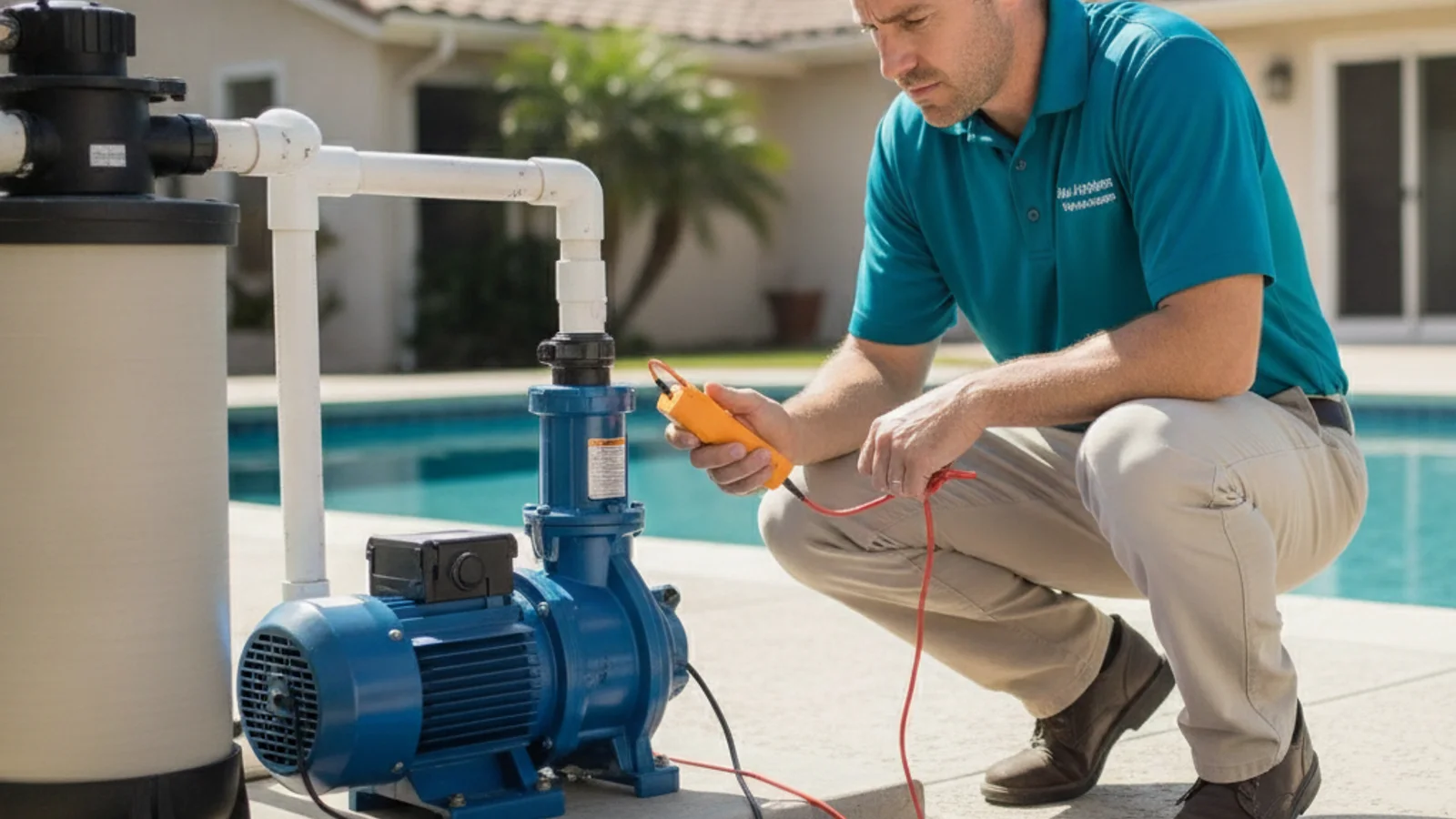
Hayward pool pump repair in San Diego depends on whether a licensed pro can swap a single part like a shaft seal, capacitor, or bearing set, or whether the motor needs replacement. HomeGuide lists a general U.S. planning estimate of $50 to $650 for pool pump repair, not a Hayward-only or seal-only quote. HomeGuide lists $800 to $2,000 installed for a variable-speed pump, a general U.S. planning estimate, not a Hayward-specific quote. Prices vary, and the matched independent pro gives the actual quote after assessing the pump. Common issues include leaking seals, dead capacitors, worn bearings, tripped breakers, or a motor that hums but won’t turn. Knowing which one you’re looking at determines whether a licensed pool repair pro quotes a part repair or a replacement.
Why do Hayward pumps fail so often in San Diego
Hard water and long run times wear down Hayward pump seals. Inland pads more often show scale at the seal plate. Coastal zip codes carry a second stressor: salt air corrodes pump housings, unions, and electrical connections faster than inland heat alone would. This page does not publish a hardness number by district.
What are the five most common Hayward pump problems
The five failures that account for most Hayward pump service calls are a leaking shaft seal, a blown capacitor, worn bearings, a tripped or nuisance-tripping breaker, and a motor that hums without spinning.
Leaking shaft seal. Water pooling under the pump housing, especially right where the motor meets the wet end, points to a worn mechanical seal. This is the single most common Hayward repair call in the network. A pro swaps the seal kit to address the leak at the shaft. Ask what the visit includes and whether a return trip is needed.
Blown run capacitor. A pump that hums for a second, then shuts off or won’t start at all, often has a failed capacitor rather than a dead motor. Capacitors are small parts, but a technician still needs to confirm it’s the capacitor and not the motor windings behind it before replacing anything.
Worn bearings. A grinding or squealing noise that gets louder over days or weeks means the motor bearings are failing. Left alone, worn bearings eventually seize the shaft and take the whole motor with them. Ask the matched independent pro which part failed and whether repair or replacement fits its condition.
Tripped breaker. A Hayward pump that trips its breaker every time it starts usually has a short somewhere in the motor windings, often from long-term moisture intrusion around a failed seal. This is a case where the seal problem and the electrical problem showed up together, and a repair pro checks both rather than just resetting the breaker and walking away.
Motor hums but won’t spin. If the shaft turns freely by hand but the motor won’t start under power, the start capacitor or the start switch inside the motor housing is the usual suspect. If the shaft won’t turn by hand at all, the bearings have likely seized, which points toward replacement instead of repair.
When does it make sense to repair versus replace a Hayward pump
A licensed independent pro should inspect the pump before treating repair or replacement as the cheaper path. Record the pump model, describe leaks, noise, priming, and breaker trips, and request a written quote that compares repairing the failed part with replacing the unit, including warranty and care terms.
If the current pump is a single-speed model, ask the matched independent pro whether a variable-speed replacement belongs in the written quote next to a repair, and what energy use, warranty, and care terms would apply to this pad. Actual electricity rates and actual run hours change that comparison, so use the quote after inspection rather than a generic savings figure.
What should you ask on a Hayward pump repair visit?
On a repair visit, note the pump model and describe the leak, noise, or start-up problem. Ask the licensed independent pro what they will inspect, which tests they will run on the motor, capacitor, and seal, and whether a return trip is needed if a part is not on hand.
If the pump needs more than a single-part fix, ask whether the pool equipment quote should also cover the filter and heater after the pro assesses the pad. If you see air in the lines, a dropping water level, or a pump that will not hold prime, describe those symptoms and ask a pool leak detection specialist to assess that separately.
Does a bad pump ever point to a bigger pool problem
Yes, a pump that keeps losing prime or straining under load sometimes signals suction from a leak elsewhere in the plumbing, not a pump-only failure. Air bubbling from the return jets, a pump that won’t hold prime after priming correctly, or a water level dropping faster than evaporation accounts for are all signs worth a proper pool pump repair diagnosis before assuming the pump itself is at fault. Chasing pump symptoms without checking the plumbing behind them means paying for a repair that doesn’t actually fix anything.
Homeowners converting to a salt system around the same time as a pump repair should also loop in a salt water conversion specialist, since salt cells and pump sizing interact and it’s worth sequencing that work together rather than paying for two separate service calls.
What to do when a Hayward pump fails in San Diego
Ask the matched independent pro how soon they can inspect a dead pump and what would delay a repair. Describe a pump that is not circulating, and ask whether emergency pool service is the right match. San Diego homeowners from Pool Service in San Diego and surrounding areas can call in to get matched with a specialist for a repair or replacement quote.
Frequently asked questions
How much does Hayward pool pump repair cost in San Diego?
HomeGuide lists a general U.S. planning estimate of $50 to $650 for pool pump repair, not a Hayward-only or seal-only quote. Ask the matched independent pro which part failed and whether repair or replacement fits the pump’s condition. HomeGuide lists $800 to $2,000 installed for a variable-speed pump, a general U.S. planning estimate, not a Hayward-specific quote. Prices vary, and the matched independent pro gives the actual quote after assessing the pump.
What should I note before a Hayward pump repair or replacement assessment?
Note what you see and hear around the pump: where water collects, how it starts, whether the breaker trips, any new noise, and whether it holds prime. Include the pump’s age if you know it. Share those notes with the matched independent pro so the pro can inspect the unit and quote repair or replacement from that assessment.
Is it cheaper to repair or replace a Hayward pool pump?
Whether repair or replacement costs less depends on the failed part and the pump’s condition after a licensed independent pro inspects it. Record the pump model, describe leaks, noise, priming, and breaker trips, and ask for a written quote that compares repairing the failed part with replacing the unit, including warranty terms.
Why does my Hayward pump make a loud grinding or squealing noise?
Grinding almost always means the bearings are worn and metal is contacting metal inside the motor housing. Squealing points to the same bearing wear at an earlier stage, or occasionally a slipping belt on older two-speed models. Ask the matched independent pro which part failed and whether repair or replacement fits the motor’s condition.
Can I fix a leaking Hayward pool pump myself?
A shaft seal swap needs the right kit and a depressurized pump. San Diego hard water often scales the seal plate, which makes a clean reseat harder. Ask a matched independent pro to quote the seal versus a motor replacement, including warranty terms.
How long does a Hayward pool pump usually last in San Diego?
How long a Hayward pump runs in San Diego depends on run hours, hard water and scale, and how much salt air reaches the pad before a motor-level failure makes replacement the better call. Coastal salt air corrodes housings and fittings faster in beach-adjacent neighborhoods, while inland heat and hard water accelerate seal and bearing wear, so either end of the county tends to shorten that window slightly.
If your Hayward pump is leaking, tripping breakers, or making a noise that wasn’t there last week, don’t wait for it to seize. Call Refresh Pool Pros at (858) 400-4598 and we’ll connect you with a licensed pool repair specialist in our San Diego network for a repair or replacement quote.
Need professional help in San Diego County?
Refresh Pool Pros connects you with a licensed specialist for any service in this post.