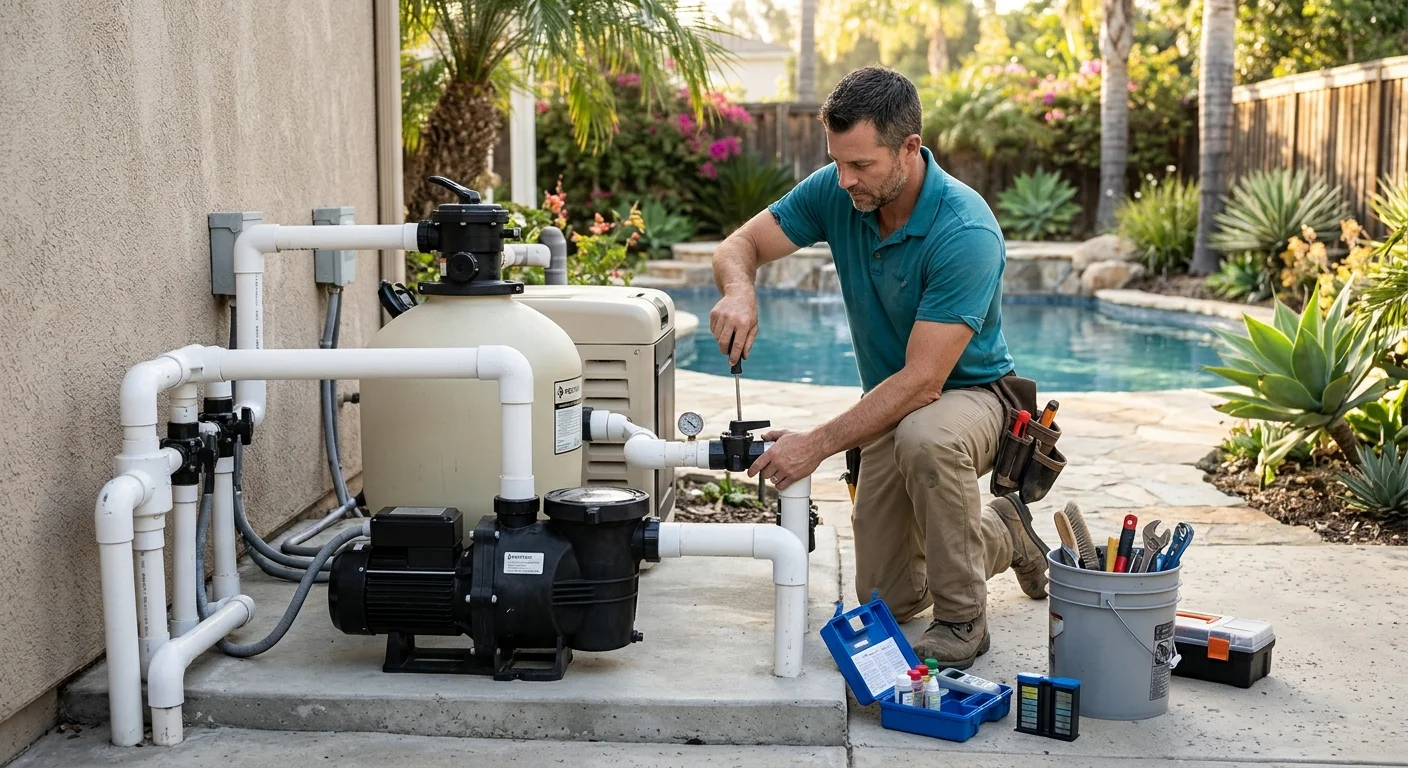
Pool equipment repair in San Diego is the work on the pad: pump, filter, heater, valves, salt cell, and controls. A humming pump in Clairemont, a heater that will not ignite in Point Loma, or a multiport dripping in El Cajon is that work. It is not plaster or the buried line. San Diego pools run year-round, so this gear does not get a winter off.
What pool equipment repair covers on a San Diego pad
The pad is the slab beside the house or down the side yard. On most San Diego County lots it holds a pump, a filter tank, a heater or heat pump, valves, and often a salt chlorinator and an automation panel. Pool equipment repair means naming which piece failed, why it failed, and whether a part swap will hold.
A coastal pad in Ocean Beach or Coronado sits in salt air, so unions and heater cabinets corrode faster. An inland pad in Escondido, Santee, or Carmel Valley sits hotter and drier. Carmel Valley is a City of San Diego community inland of Del Mar, and those canyon lots run the gear harder. South Bay pads in Chula Vista and National City add hard water scale on heaters and salt cells. Check your district’s current water quality report, or start at the San Diego County Water Authority. We do not publish hardness numbers.
This work does not cover the shell, the deck, or the underground pipe. A wet pad can be a union leak, a cracked filter tank, or water from under the slab. The licensed specialist traces that before ordering parts. Standing water around the equipment is a diagnosis, not a reason to keep the pump running.
If you searched pool equipment repair near me, you are pointing at this pad. Pool equipment installation and upgrades is the path when the right call is a new unit. For how a quote gets built after the diagnosis, see our pool equipment repair estimate guide.
Pumps, filters, heaters, and valves as separate jobs
Treat them as separate jobs. They fail for different reasons, and one failure often takes out the next.
The pump is the usual first call: hums and will not start, leaks at the shaft or lid, will not prime, or screams. A pump can be repaired. Motors, shaft seals, impellers, lid o-rings, capacitors, and unions are common service items. The specialist still checks the rest of the pad. A starved pump from a clogged skimmer or a closed valve will burn a new seal the same way it burned the old one.
The filter is a different job. Cartridge tears, DE grids, sand laterals, cracked tanks, stuck multiports, and bad gauges show up as cloudy water or a wet slab. Hard water loads San Diego filters year-round. Cleaning is maintenance. A cracked tank or a failed multiport is repair work.
Heaters and heat pumps fail at igniters, pressure switches, thermistors, control boards, fans, and gas valves. A no-fire can be a closed valve, a dirty filter starving flow, or a true heater fault. Coastal salt air eats cabinets. Inland heat makes the unit cycle more. Gas work on that cabinet is not a homeowner project.
Valves and actuators sit in the middle. A leaking valve or a dead actuator looks like a pump problem until someone opens it. Automation, salt cells, and lights get blamed for circulation faults they did not cause. Ask the specialist to name the failed component, not “the equipment.” Pool equipment repairs that mix a pump seal, a heater board, and a salt cell into one vague line are how the same pad fails twice.
Repair versus replace, without a price
Repair is the right call when one part failed and the rest of the unit is sound. Replace is the right call when the housing, heat exchanger, or motor will not hold another part, or when a motor swap falls under California’s replacement-motor rule.
We do not publish a price list. We do not treat “half the cost of new” as a code. Those figures depend on the brand, the model, and what the licensed pro finds on site. Ask for both options on paper: repair this part, or replace the unit, with parts and labor split. What drives pool equipment replacement cost walks through those drivers. The website cannot bid the job.
If the work is a replacement dedicated-purpose pool pump motor of 0.5 horsepower or more, manufactured on or after July 19, 2021, California requires a variable-speed replacement motor (CCR Title 20 section 1605.3(g)(6)). The California Energy Commission states that, including sell-through of models certified before that date. It is not a mandate to pull every single-speed pump in La Mesa or Carlsbad this week. The matched pro tells you whether your motor is in scope.
Age alone is not a statute. A heater with a dead igniter can be a part. A heater with a rusted heat exchanger is often a unit. Photograph the model and serial labels before anyone visits so the specialist can bring the right part. We do not publish bill-savings percentages. Your run schedule and utility rate decide that.
Licensed electrical and gas work on the pad
Some pad work is mechanical: unions, valves, o-rings, grids. Some of it is electrical or gas. Those are not always the same visit, and they are not DIY.
Pump motors, time clocks, automation boards, and lights are electrical. Heaters add gas valves and venting, or they are heat pumps on a dedicated circuit. A gas odor at the pad is an SDG&E issue first. Use SDG&E’s gas emergency line, or 911 if you cannot get to fresh air. Do not keep cycling the heater.
We match you with licensed independent pool specialists. We do not hold a contractor license, pull the permit, or do the physical work. Confirm the specialist on the CSLB license lookup. Unlicensed contracting is a misdemeanor under Business and Professions Code section 7028. The small-job exemption in Business and Professions Code section 7048 applies only when the whole contract is under $1,000 for labor, materials, and everything else, the work is casual or minor, and no building permit is required. That $1,000 threshold is effective January 1, 2026. Splitting a job to stay under that number does not create an exemption. Anyone who advertises as a contractor loses the exemption at any price.
Whether your pump, heater, or panel swap needs a permit or a bonding inspection could not be confirmed against the current City of San Diego building code. Ask the licensed pro, then confirm with the City of San Diego Development Services Department, the city’s building department. Other cities and unincorporated county areas have their own counters. A City of San Diego answer does not cover a Lakeside or Encinitas pad. Manufacturer warranties on new motors and heaters often require installation by a licensed contractor. This site does not issue that warranty.
What belongs in a written estimate
A verbal “fix the pump” is not an estimate. Get the diagnosis in writing: the failed part (shaft seal, capacitor, igniter, multiport, salt cell, actuator), the likely cause including anything upstream, and repair versus replace as two lines for a pump, heater, or filter tank. Split parts and labor. Call out permit, electrical, or gas scope, or write that none applies pending the building department. Write the test before leaving: prime, filter pressure, return flow, heater ignition, and any automation schedules overridden during the repair.
Down payments on home improvement contracts in California may not exceed $1,000 or 10 percent of the contract amount, whichever is less, under Business and Professions Code section 7159.5. On a large replacement, the cap is $1,000, not 10 percent of the job. That is the statute, not a brand policy.
Warranty language should name the pro’s labor warranty and the part manufacturer’s warranty as separate items. Refresh Pool Pros does not warranty the work. The matched specialist does, on their paperwork. If the quote is still vague, walk the repair estimate checklist with the specialist on the pad.
When to call us
Call when the pad is leaking, the pump will not prime, the heater will not fire, or a valve is stuck and the water is turning. That is licensed pool equipment service, not a chemistry tweak. Call us at (858) 400-4598 and we’ll connect you with a licensed local pool specialist.
Frequently asked questions
Can a pool pump be repaired?
Yes. A licensed specialist can replace a motor, shaft seal, impeller, lid o-ring, capacitor, or union when the rest of the pump is sound. They should still check valves and suction so the new part does not fail the same way.
What does pool equipment repair cover in San Diego?
The pad: pumps, filters, heaters, valves, salt systems, and controls. It does not cover plaster, tile, or buried pipe. Coastal salt air and inland heat change what fails first.
When should I replace pad equipment instead of repairing it?
When the housing, heat exchanger, or motor will not hold another part, or when a replacement pump motor falls under California's variable-speed motor rule. Ask for repair and replace as two written options. We do not publish a price cutoff.
Does pool equipment repair need a permit in San Diego?
It depends on the job, and a blanket rule could not be confirmed here. Ask the licensed pro, then confirm with the City of San Diego Development Services Department or your city's building counter.
What should a written pool equipment repair estimate include?
The failed part, the likely cause, repair versus replace, parts and labor split, any permit or gas and electrical scope, and the test run before the specialist leaves.
Need professional help in San Diego County?
Refresh Pool Pros connects you with a licensed specialist for any service in this post.