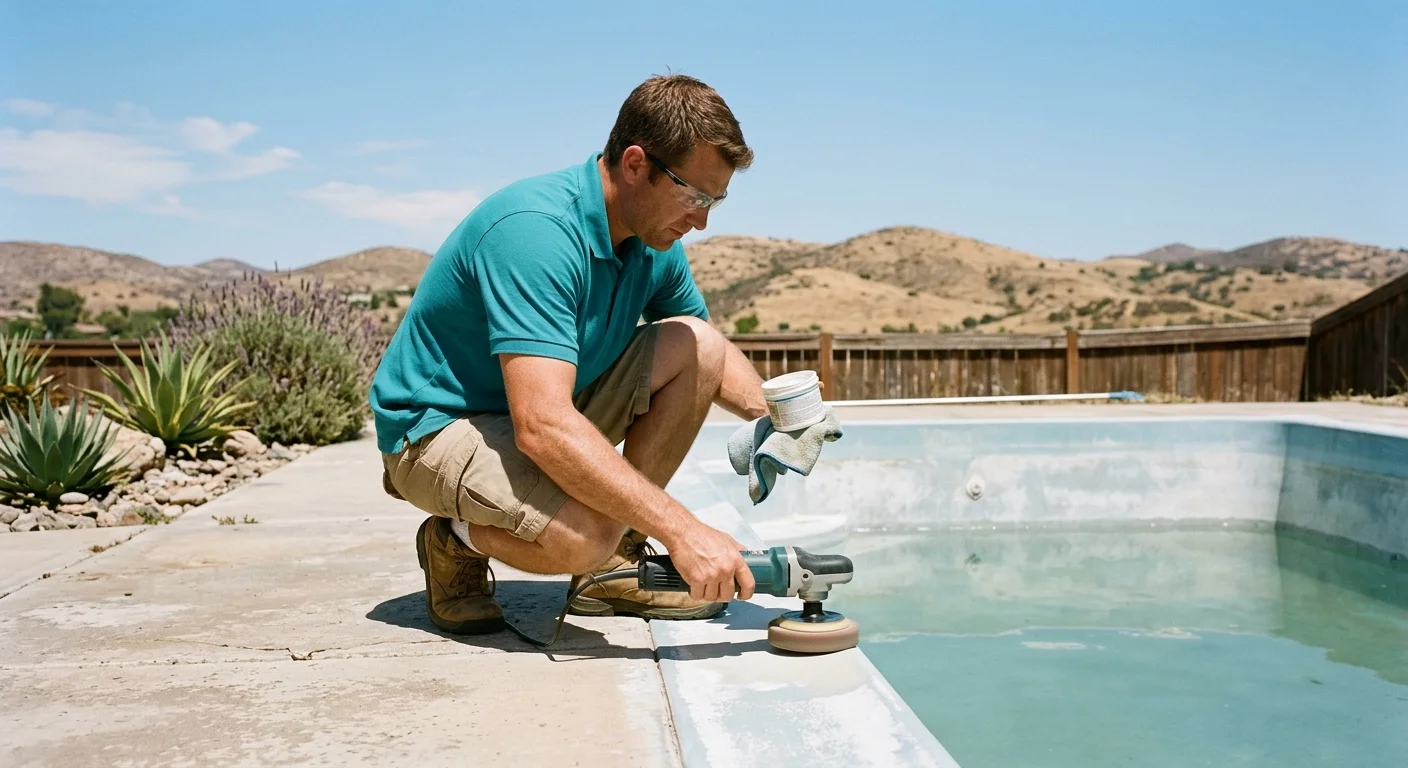
A chalky gelcoat on the shallow bench is how a lot of Poway fiberglass pools start to talk. Inland sun sits on that shell all afternoon. Then you notice a blister on the step or a hairline at the corner. This is repair of an existing fiberglass shell in a Poway yard. It is not a new install, and it is not plaster work on gunite.
Why Poway fiberglass fails differently from gunite
Gunite and shotcrete pools are a concrete shell with a plaster, pebble, or aggregate face. When that face fails, a specialist chips it and recasts it. A fiberglass pool is a factory-molded tub. Color and the waterproof skin live in the gelcoat. When that skin fails, you are not resurfacing concrete. You are working the laminate.
Poway is inland North County. The marine layer that cools Encinitas and Solana Beach often burns off before it reaches the hills around Lake Poway, Twin Peaks, and Green Valley. Afternoon sun on a west-facing yard along Pomerado Road or Espola Road heats the water and the exposed beam. Gelcoat expands and contracts with that heat. Concrete mass does not move the same way. Hairline movement that plaster can hide shows up on fiberglass as a star crack, a white fracture at a step nose, or a blister at the waterline.
Older tract homes in Stoneridge, Garden Road, and Old Poway often got a one-piece shell set into a hillside cut. The shell is rigid. Soil on a slope, a tight setback to a retaining wall, and a spa on the same pad all put point loads the factory mold was not shaped around. Gunite is built in place and can be thickened at those spots. A molded shell cannot. That is why a Poway fiberglass pool conversation starts with the shell, not with a plaster bid.
If you are still sorting materials, our fiberglass versus plaster versus pebble guide covers how the three surfaces differ. Stay on this page when the shell is already in the ground and it needs work.
Blisters, fading, and stress cracks in inland sun
Fading is the first thing most Poway owners notice. Gelcoat that started as a deep blue or gray goes chalky on the shallow bench and the tanning ledge. Inland UV plus hot, still air does that. Fade by itself is cosmetic. It starts to matter when the chalk comes off on your hands, or when the color change tracks a field of blisters.
Blisters are raised bubbles in the gelcoat. They show up on steps, benches, and the first few feet of the wall. Some feel dry. Some weep. Skip the lab story about what is trapped under the film. What you can see is enough: a blister you can press, a cluster that keeps growing, or a blister that has already popped and left a raw spot. Those need a licensed pool specialist looking at the laminate, not a bottle of polish.
Stress cracks look like hairlines at corners, at the step radius, and where the shell meets a skimmer or a light niche. On a hillside lot off Scripps Poway Parkway, the ground shifts a little with wet winters and dry summers. The shell is a single piece. Stress collects where the shape changes. A surface crack that does not weep is a different job than a crack that opens when the pool is full. The matched pro has to tell those apart on site.
Watch the waterline tile and the mastic too. Those are not the shell. They fail in the same heat, and they get blamed for a leak that is actually in the laminate. If the water drops and the auto-fill runs, treat that as a leak question and inspect the shell in the same visit.
Keep the water in range. The CDC healthy swimming pages cover water that is safe to swim in. Wild pH and a neglected sanitizer will stain and etch a gelcoat face faster in a hot inland yard than they will under coastal fog.
What a pool pro can patch versus a full shell job
A small, isolated chip on a step nosing, a single blister that has not spread, or cosmetic fade on an otherwise tight shell is often a fiberglass pool patch. The specialist sands, fills, and recoats the gelcoat in a matching color as close as the remaining finish allows. Color match on a faded inland shell is never perfect. Ask to see a test patch in the same light as your backyard, not under a shop lamp.
A cluster of blisters, a crack that tracks through a corner, or a soft spot in the laminate is a bigger call. The pro may grind back to sound glass, rebuild the layers, and recoat. That is still fiberglass pool repair in Poway on the shell you already have. It is not a new pool.
A full shell job means the molded tub itself is done: widespread delamination, movement you can see, or damage you cannot isolate. Replacing a one-piece shell is excavation, plus crane or slide access, plus a new unit. Many Poway yards cannot take a crane without pulling fencing, a trellis, or a side-yard gate. That access question belongs in the first site visit.
We do not publish a price list, and we do not quote how long a shell or a patch will last. The matched licensed pro prices the work after looking at your pool. On a home improvement contract, California law caps the down payment at one thousand dollars ($1,000) or 10 percent of the contract amount, whichever is less. Look the contractor up on the CSLB license lookup before you sign.
Confirm with the City of Poway whether your specific repair needs a permit. We could not confirm a published city rule that names gelcoat patches or shell replacement on their own. Call the city’s building counter and ask, then let the licensed specialist pull what the city requires. Unlicensed contracting is a misdemeanor unless an exemption applies. Work under one thousand dollars that is casual and does not need a permit can be exempt. Splitting a job to stay under that number does not count, and anyone who advertises as a contractor loses the exemption.
If a permit is issued for construction or remodel of a pool at a private single-family home, California Health and Safety Code section 115922 requires at least two of seven drowning prevention safety features. It is two of seven, not a blanket fence rule on every existing pool. The full list of seven was not verified here. Ask the city and the pro what applies to your permit.
Poway yards, access, and older tract installs
Poway lots are not Encinitas lots. You get more dirt, more slope, and more distance from the street. A fiberglass shell that arrived on a flatbed in the 1980s or 1990s often sits behind a narrow side yard on Community Road, Midland Road, or a cul-de-sac off Twin Peaks. The original install used that gap. The people who repair it still have to.
Older tract shells came in a handful of factory shapes. Steps in one corner, a built-in bench, sometimes a small spa tab. Those shapes are why patches at the step radius show up so often. They are also why a grind-and-coat plan can fail if the laminate behind the gelcoat is tired. The specialist has to feel the shell, not just look at the color.
Hillside homes near Lake Poway and the Blue Sky Ecological Reserve often have retaining walls a few feet off the beam. That wall is load, and it is access. Equipment pads get tucked into a cut, with the pump and filter on a tight pad. A shell repair does not always mean touching the pad. If the specialist finds a related leak at a fitting, that belongs in the same pool repair visit so the patch is not sitting over a wet joint.
HOA tracts exist in parts of Poway. Gate codes, parking, and work-hour rules are local, not a county standard. Confirm those with your association. We do not speak for them.
Decomposed granite and granite cobble sit under a lot of these yards. They drain fast when dry and they move when a wet winter saturates a slope. That soil story is why a Poway fiberglass crack at a corner is not the same as a coastal hairline in a gunite spa. Tell the pro which side of the yard is uphill. Santa Ana winds push hot, dry air across the same inland bowl. Waterline scum and faster evaporation are chemistry issues. They are not a reason to ignore a blister field that showed up the same summer.
How this differs from plaster resurfacing
Plaster resurfacing is a gunite job. You drain, chip the failed finish, recast plaster or pebble, and start a cure. Fiberglass repair is laminate work. There is no chip-out of a cement finish because there is no cement finish. If someone bids you a plaster resurface on a fiberglass pool, the bid is for the wrong pool.
You also do not convert a fiberglass pool into a plaster pool as a casual upgrade. The structure is different. Use the fiberglass, plaster, and pebble comparison when you are choosing a surface. Use this page when the shell you already own is blistered, faded, or cracked. A San Diego fiberglass pool patch is still shell work even when the quote is written next to a plaster recast for a neighbor’s gunite pool.
A gelcoat refinish can look glossy again. It will not turn a structurally tired shell into a new one. A plaster recast will not seal a fiberglass blister field. Keep the two jobs in their own lanes so the quote you get is for the pool in your yard.
San Diego County is not one climate. Coastal gunite with salt air and fog is a different wear pattern than inland fiberglass with all-day sun. That is why a Poway page has to exist next to a coastal repair post, and why swapping the city name would break the advice.
When to call us
Call when blisters spread, a crack weeps, the gelcoat powders off, or a prior patch has failed. Refresh Pool Pros does not repair shells. We match you with a licensed local pool specialist who does. Call us at (858) 400-4598 and we’ll connect you with a licensed local pool specialist.
Frequently asked questions
Can a fiberglass pool in Poway be patched, or does the shell have to come out?
A licensed specialist can often patch an isolated chip, blister, or hairline on the gelcoat. Widespread delamination, a soft laminate, or a crack that weeps is a different job. That call is made on site in your Poway yard, not from a photo alone.
Is fiberglass pool repair the same as plaster resurfacing?
No. Plaster resurfacing is a new cement finish on a gunite shell. Fiberglass pool repair is work on the molded shell and its gelcoat. A plaster bid on a fiberglass pool is the wrong scope.
Does the City of Poway require a permit for fiberglass pool repair?
We could not confirm a City of Poway rule that names gelcoat patches or shell replacement. Ask the city's building counter about your specific job, and have the licensed pro pull whatever permit the city requires.
Why do inland Poway fiberglass pools fade and blister?
Poway sits inland of the marine layer. Afternoon heat and sun stay on the water and the gelcoat. Fade, chalking, and blister clusters show up on steps, benches, and shallow water. The matched pro still has to inspect the laminate, not just the color.
Does Refresh Pool Pros repair fiberglass pools?
No. We match Poway homeowners with licensed independent pool specialists. The specialist inspects, quotes, and does the work. Check that license on the CSLB site before you sign.
Need professional help in San Diego County?
Refresh Pool Pros connects you with a licensed specialist for any service in this post.