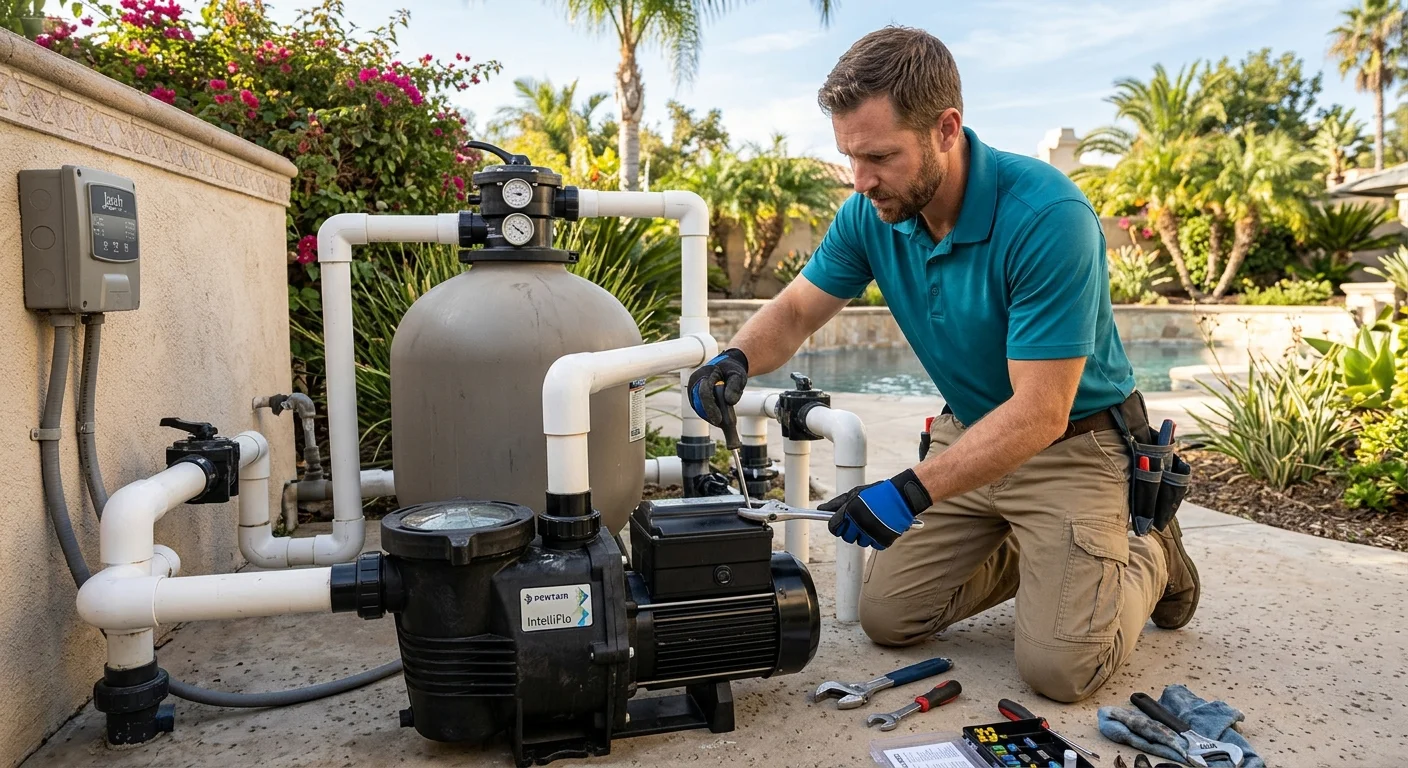
The motor on a San Diego equipment pad is the part that turns the impeller. When it fails, the wet end can still look intact. Homeowners usually notice a hum, a housing too hot to hold, or a pump that will not restart after a long run in the sun. That is a motor failure, and pool pump motor repair is a different job from a wet-end leak or a lost prime.
Motor versus wet end: two different repairs
A pool pump is two assemblies bolted together. The wet end is the plastic housing, strainer, impeller, and the path the water takes. The motor sits behind it. Windings, bearings, a capacitor, a shaft, and a cooling fan live in that housing.
If the motor is burned or locked, a new lid gasket will not spin the shaft. If the wet end is the problem, a new motor will not fix a cracked housing or a packed impeller. The specialist you are matched with starts by naming which half failed. Mixing those jobs is how people replace the wrong part.
That split is local, not generic. Pads along Imperial Beach, Coronado, Pacific Beach, and Encinitas sit in salt air. Moisture collects on the motor vents and the rear bell. Pads in El Cajon, La Mesa, Santee, and inland Escondido sit in hotter, drier air, often against a west-facing block wall. A coastal motor may fail from corrosion at the vents. An East County motor may trip on heat after a long filter cycle. Same county, different stress on the same housing.
This page stays on the motor. Prime, baskets, and seals are wet-end work, and they belong with pool pump repair in San Diego. A hum with no spin has its own walkthrough in pool pump humming, not running. Circulation that is down for any reason still routes through pool repair.
Power to the motor is electrical work. You can confirm the breaker and the nearby disconnect are on. Opening the wiring compartment, discharging a capacitor, or lifting the motor off the wet end is work for a licensed specialist. Confirm that person through the CSLB license lookup. California’s contractor exemption applies only when the aggregate contract is under $1,000, effective January 1, 2026, and no building permit is required. Splitting a job to stay under that figure does not create an exemption. The matched pro confirms what applies to the motor on your pad.
Humming, heat, and a motor that will not restart
A pool pump motor not working rarely fails with no clues. The common pattern on a San Diego pad is a short hum, a click, then nothing. Heat at the rear of the housing is the other tell. After a long cycle on a hot afternoon in Mission Valley or Chula Vista, the thermal protector opens and the motor sits dead until it cools. Then it tries again. That loop is a warning, not a schedule.
Some motors have a thermal overload button on the rear of the housing. It is not on every motor, and it is not a repair. If a button is there and the motor has tripped, one cool-down is information. If it trips again, leave it off. Repeated resets cook the windings.
A silent motor can still be a motor problem. No sound also means no power at the unit, a failed switch, or a control that never sent the run command. The specialist checks voltage at the motor, not only at the panel. Wiring facts get confirmed on site. Do not assume the pad is at a given voltage because the house panel is. The pro meters it.
Coastal nights can leave the pad wet. Inland afternoons can leave the motor too hot to touch. Both show up as a motor that will not restart. Neither one, by itself, names the failed part. Capacitor, bearings, and windings are the next tests.
Do not spin the shaft by hand with power on. If the shaft is locked with power off, that is useful for the pro. If it turns freely with power off and still will not start, the problem is often electrical inside the motor.
When circulation stops, the pool is no longer being filtered. The CDC’s healthy swimming guidance is about keeping water safe. A dead motor is how a clear pool turns dull under San Diego sun. Kill the power at the breaker if the motor is cycling on heat. Then get a licensed specialist on the diagnosis.
Bearings, windings, and capacitors a pro tests
The three parts that actually fail inside most pool pump motors are the capacitor, the bearings, and the windings. A specialist tests them in that order because the capacitor is the common miss, and a burned winding is the one that ends the motor.
The capacitor stores a charge and gives the motor the shove it needs to start. A weak capacitor often sounds like a hum that dies. The housing may not be hot yet. Capacitors hold a charge after power is off, which is why the capacitor cover stays closed until a pro is on site. The specialist discharges it, then tests it with a meter. A swollen or leaking can is already a fail.
Bearings are the mechanical wear item. Grinding or screeching is often a bearing. Water that reached the motor from a failing shaft seal is a common path, but the seal itself is wet-end work. Once water is in the motor, the bearings are the motor repair. A noisy bearing that is still spinning is a motor on borrowed time. Waiting until it locks can damage the shaft and the impeller.
Windings are the copper coils. Heat, age, and a locked rotor burn them. A burned winding often smells like hot insulation. A resistance test is how the pro confirms it. You cannot reset a burned winding. That motor is done as an electrical machine.
The specialist also checks amperage against the nameplate, looks at the fan and vents, and inspects the bonding lug. None of those readings belong in a blog as invented numbers. The nameplate on your motor is the source for horsepower, voltage, and frame. The pro reads that plate on the pad, then decides whether repairing one part is still honest.
Variable-speed units add a drive. Error codes on a Pentair, Hayward, or Jandy control are not always a dead motor. They can be the drive, the wiring, or a sensor. Brand-specific pump pages on this site cover those families. This page stays on the motor itself: if the drive is commanding a run and the motor will not turn, the motor is in play.
Matching a replacement motor to the pump
You cannot grab any motor and bolt it to the wet end. The replacement has to match the pump. The nameplate is the map: manufacturer, model, horsepower, service factor, RPM, frame, voltage, and amps. The pro copies those values from the old motor, then confirms the wet-end fit, the shaft, and the mounting.
Voltage and rotation get confirmed on site. A dual-voltage motor wired wrong will fail again. Bonding gets reattached. Those are not guesses from a photo. If a wiring detail cannot be read clearly, the specialist traces it before the new motor is energized.
California has a separate rule when the job is a replacement motor, not a repair of the old one. The California Energy Commission states that replacement dedicated-purpose pool pump motors with a dedicated-purpose pool pump motor total horsepower greater than or equal to 0.5 hp, manufactured on or after July 19, 2021, shall be variable-speed replacement dedicated-purpose pool pump motors. That is CCR Title 20 section 1605.3(g)(6). The rule is about replacement motors manufactured on or after that date. It is not a demand that every existing single-speed motor on a San Diego pad be swapped today. Models certified compliant before that date can still be sold under the Commission’s sell-through note. The matched pro and the CEC replacement-motor FAQ are the check for whether a given motor is in scope.
Do not chase a horsepower chart from memory. The plate on the motor and the pump body are the match. A motor that is electrically larger or smaller than the wet end expects is a mismatch, even if it physically bolts on. The specialist also checks whether the wet end is worth keeping. A sound volute and impeller can take a new motor. A cracked housing is a pump replacement, not a motor swap.
Repair versus replace, without a price
A capacitor swap can return a motor that is otherwise healthy. A bearing job, sometimes called a rebuild, can too, if the windings are still good and the shaft is true. Burned windings, a scored shaft, or a motor full of water usually end in a replacement motor. There is no dollar line in this post. The quote comes from the specialist after the tests.
Age of the motor is a factor the pro will discuss. It is not a published lifespan, and this site does not invent one. Condition of the wet end, parts availability, Title 20 scope, and how the motor failed all weigh more than a round number of years. Ask whether a rebuild is still a fair bet on this motor, and whether a replacement motor on the existing wet end is cleaner than a full pump change.
A full pump change is a different job from replace pool pump motor work. Changing the whole pump means the wet end goes too. Motor-only work keeps the housing and plumbing that are still sound. If the pro recommends a full pump, that should be because the wet end failed the inspection, not because a motor part was inconvenient.
Get the diagnosis in writing: what failed, what was tested, and whether the work is a capacitor, a rebuild, a motor swap, or a pump. Ask who warranties the labor and who passes through manufacturer coverage on a new motor. Check the licence on the CSLB site before work starts. Then decide.
When to call us
When the motor hums, overheats, trips, or will not restart, stop resetting it and get a licensed pool specialist on the pad. Electrical work on the motor is not a homeowner job, and the brand does not perform it. Call us at (858) 400-4598 and we’ll connect you with a licensed local pool specialist.
Frequently asked questions
Why is my pool motor not working?
A pool pump motor not working is usually a capacitor, locked or worn bearings, burned windings, a thermal trip from heat, or no power at the motor. A licensed specialist meters voltage at the unit and tests those parts on the pad. A silent motor is not always a dead motor, and a humming motor is not always a capacitor.
Is there a reset button on a pool pump motor?
Some motors have a thermal overload button on the rear of the housing. Many do not. If yours has one and it has popped, a single cool-down is only a clue. If it trips again, leave the breaker off. Repeated resets cook the windings. The pro confirms whether your motor has a protector and whether it is still safe to run.
Can a pool pump motor be rebuilt?
Sometimes. If the windings are healthy and the shaft is true, a specialist may replace bearings or the capacitor and put the same motor back in service. Burned windings, a scored shaft, or water inside the housing usually mean a replacement motor. That call is made after tests, not from the age of the pump alone.
How is a motor swap different from changing the whole pump?
Replace pool pump motor work keeps a sound wet end and bolts a matched motor to it. Changing the whole pump replaces the housing, impeller, and motor together. The nameplate, frame, voltage, and wet-end fit have to match. Electrical work on the motor is licensed work. The specialist confirms the match and the wiring on site.
Need professional help in San Diego County?
Refresh Pool Pros connects you with a licensed specialist for any service in this post.