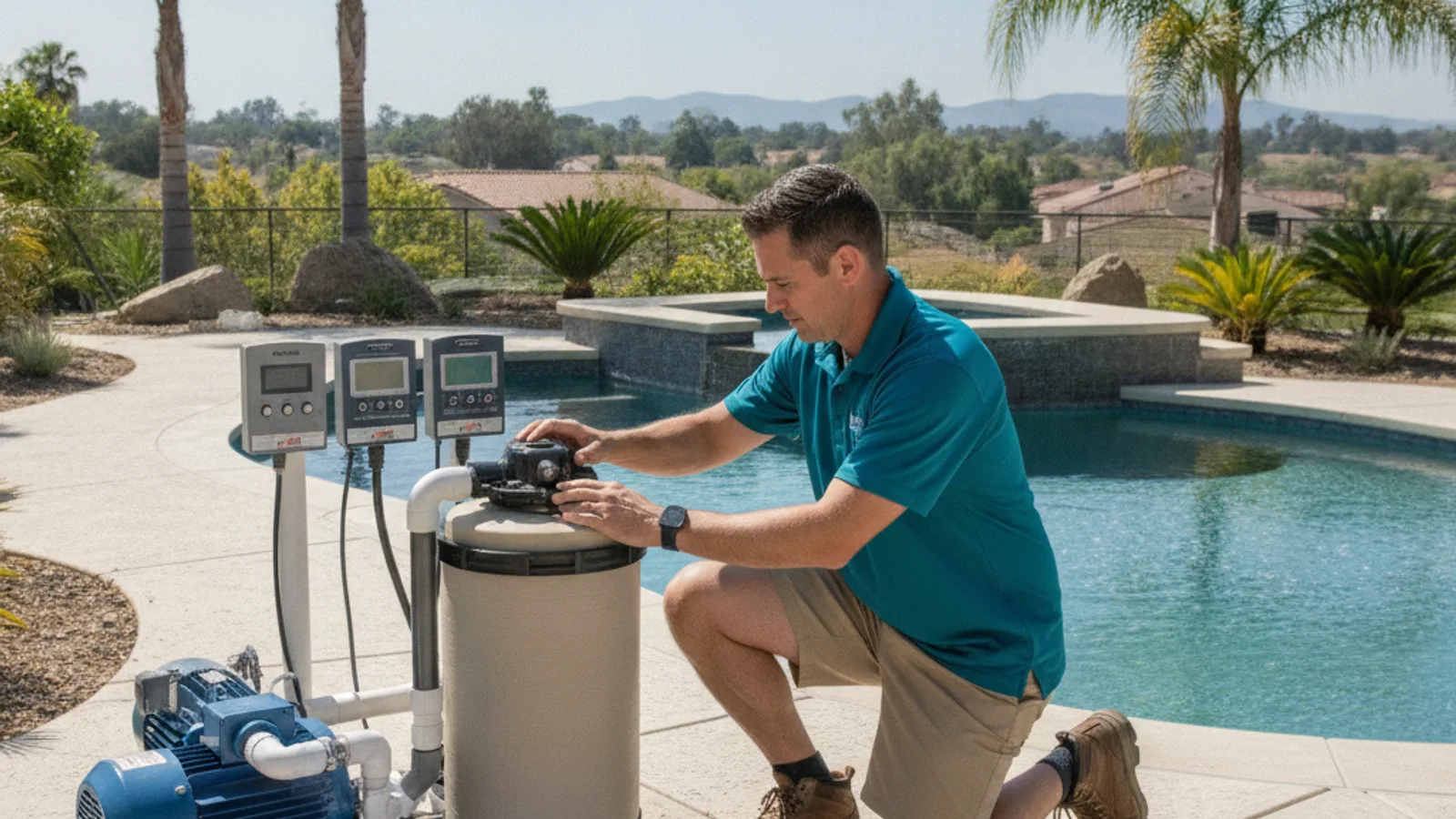
The useful comparison for San Diego homeowners is not which brand is superior. It is what is already installed on the pad, and whether mixed-brand controls need to be assessed so the system can run together. Jandy (a Fluidra brand, same parent company as Zodiac) is a third option to discuss with the matched independent pro. Record each unit’s model, describe any visible issue, and ask for a repair-or-replacement assessment plus written warranty and care terms.
Pentair vs Hayward pool equipment: what actually differs
The core difference between Pentair and Hayward pool equipment is proprietary parts and control systems, not raw performance. Both brands make variable-speed pumps that meet California’s Title 20 efficiency mandate, both make cartridge and DE filters that clean water effectively, and both build heaters that run reliably in San Diego’s mild year-round climate. Where they diverge is compatibility. A Pentair IntelliFlo pump won’t accept a Hayward filter union without an adapter, and a Pentair automation system can’t natively control a Hayward salt cell. For a homeowner comparing quotes, the brand question matters less than matching new equipment to what’s already on the pad.
Which brand has better pump technology
Pentair’s IntelliFlo line has a slight edge in variable-speed pump efficiency and smart-home integration, while Hayward’s TriStar and MaxFlo VS pumps are closer in performance and often priced a step lower. Both brands’ variable-speed pumps meet the same California energy code, and both cut electricity use dramatically compared to the single-speed pumps still common on pools built before 2010. The practical difference shows up in the app: Pentair’s IntelliCenter ties into Apple HomeKit and Google Home more smoothly, while Hayward’s OmniLogic app is solid but has a steeper learning curve for first-time users. Either pump family holds up fine in San Diego’s low-humidity climate, since heat and moisture (not brand) are what shorten motor life fastest.
What should I ask about Pentair or Hayward replacement parts
Do not assume one brand’s parts are sitting on a local shelf or on a truck. Record the pump, filter, and heater model numbers if you can read them, describe the visible issue, and ask the matched independent pro how they will source the part, what the repair-versus-replace assessment is, and what warranty and care terms apply. If circulation has stopped, describe that when you request the match rather than waiting on an assumed parts timeline.
Where Jandy fits into the comparison
Jandy sits as a strong third option, especially for pools with Jandy Aqualink automation already installed, since ripping out a working Aqualink system to switch brands rarely pencils out. Jandy’s JXi and Hi-E2 heaters are efficient and well-regarded, and its variable-speed pumps perform comparably to Pentair and Hayward’s mid-tier models. The main consideration with Jandy in San Diego is availability. Fewer local supply houses stock Jandy parts compared to the other two brands, so repair turnaround can run a bit longer for anything beyond common wear items.
How to decide which brand to install or repair
The right brand choice depends on what’s already on the equipment pad, not which name sounds more premium. If a pool already runs Pentair automation, staying Pentair for the pump and filter avoids a costly controller upgrade. If the pad is a mix of ages and brands, a licensed pool repair pro can often bridge them with a universal automation panel rather than replacing everything at once. For a full pad rebuild after storm damage or a major leak, matching one brand end to end (pump, filter, heater, and automation) simplifies future service calls and keeps warranty coverage consistent across every component. Our network connects San Diego homeowners with the pool equipment specialists who carry both Pentair and Hayward parts and can recommend the right fit for the pad in front of them.
When mismatched equipment causes bigger problems
If mixed brands share a pad and one component fails, ask the matched independent pro whether emergency pool repair is the right match and whether to repair that unit, adapt a replacement, or quote a broader upgrade. Do not treat equipment age as a cutoff. If you see water at unions or other fittings, request pool leak detection before new equipment is quoted, and describe the visible issue so detection and installation can be scoped separately.
Does equipment brand matter for a pool resurfacing project
Equipment brand has no bearing on plaster, pebble, or tile choice during a pool resurfacing project, but a resurfacing job is the easiest time to also address an aging or mismatched equipment pad since the pool is already drained. Homeowners converting to salt during a resurfacing should ask about salt water conversion timing, since a salt cell needs to match the pump’s flow rate and the automation system’s programming regardless of brand. Spa and hot tub owners weighing the same equipment questions can find comparable Pentair, Hayward, and Jandy options through our spa and hot tub service connections as well.
Frequently asked questions
How should I choose between Pentair and Hayward for a San Diego pool?
Neither brand is objectively better for San Diego’s climate or water. Record the models you can read, describe any mixed-brand controls, and ask the matched independent pro to assess compatibility and quote repair or replacement after looking at the equipment.
Can a pool tech mix Pentair and Hayward equipment on the same pad?
Yes, a mixed pad is common and works fine mechanically since pumps, filters, and heaters connect through standard PVC plumbing regardless of brand. The catch is automation. A Pentair IntelliCenter won’t natively talk to a Hayward Omni panel, so mixed pads usually need a universal controller or separate manual switches for each brand’s gear.
How much does it cost to replace a pool pump in San Diego?
HomeGuide lists a general planning estimate of $700 to $1,600 for a variable-speed pump, or $800 to $2,000 installed. Prices vary, and the company gives the actual quote after assessing the pad. Ask the licensed contractor how a variable-speed pump compares with the unit on the pad.
Do Pentair and Hayward parts fit each other’s equipment?
No, the two brands use proprietary housings, unions, and control boards, so parts are not interchangeable between them. A cracked Pentair filter lid needs a Pentair-specific replacement, and the same goes for Hayward. This is one reason pad-wide compatibility matters more than picking a single “best” component.
What’s the average lifespan of pool equipment before it needs replacing?
How long pumps, filters, gas heaters, and salt cells last in San Diego depends on equipment type, run hours, water chemistry, hard water and scale, sun and heat exposure, installation quality, and maintenance history. Inspect housings, heat exchangers, and cell plates for corrosion and wear, and ask the licensed contractor for written warranty terms. Equipment sitting outdoors under direct coastal sun or near a marine layer tends to fail sooner than shaded gear.
Not sure what’s on your pad or whether it’s worth repairing versus replacing? Call (858) 400-4598 and our network will connect you with a pool equipment repair specialist serving San Diego who can look at the equipment in person and give you a straight answer.
Need professional help in San Diego County?
Refresh Pool Pros connects you with a licensed specialist for any service in this post.