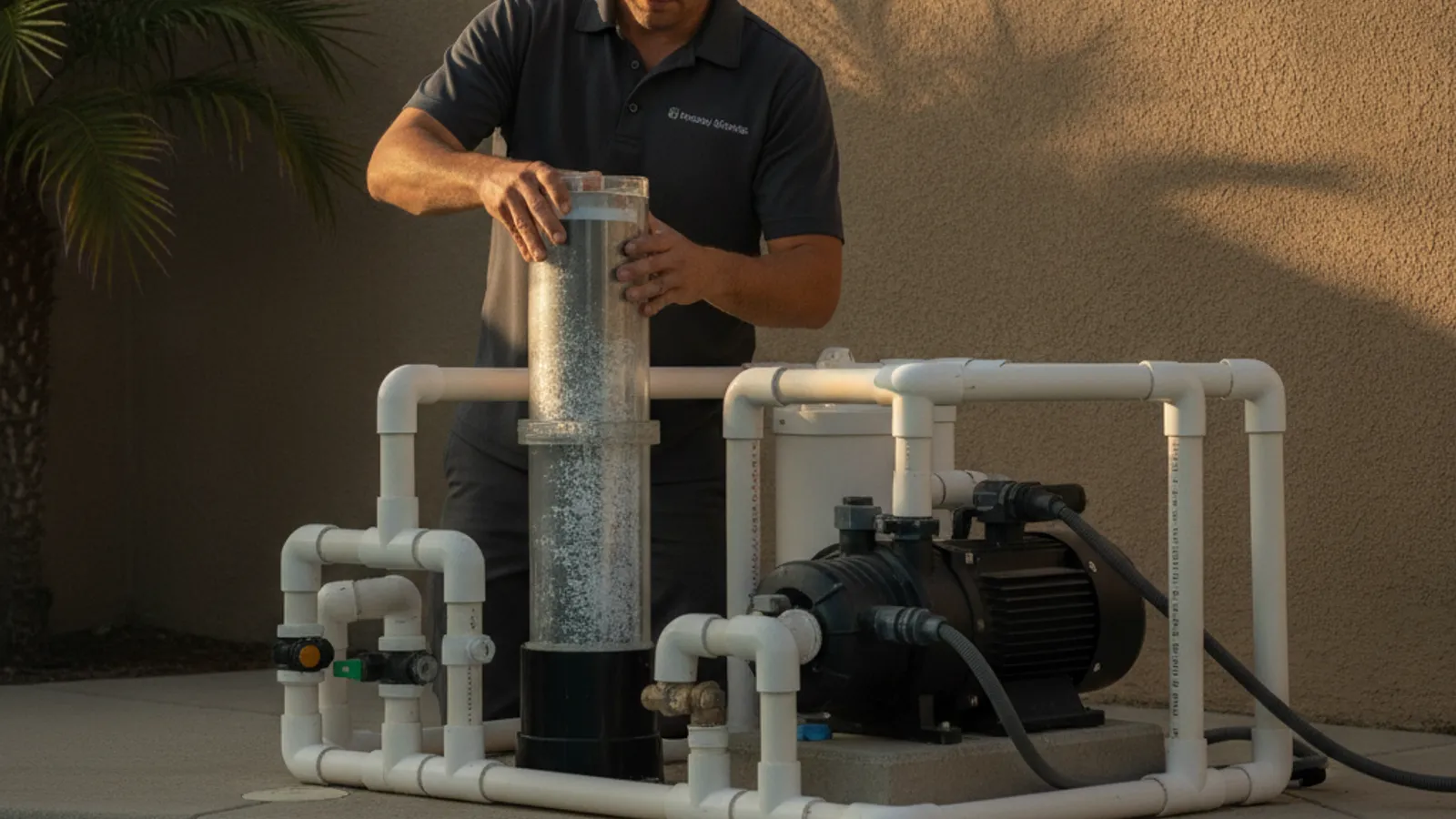
Replacing a salt cell in San Diego costs $500 to $1,100 installed, and it’s one of the most predictable repairs in pool ownership. Unlike a pump or heater that might last a decade, the cell inside a salt chlorine generator wears out every 3 to 5 years by design, and San Diego’s hard water tends to push that timeline toward the shorter end.
Refresh Pool Pros connects San Diego homeowners with vetted pool repair specialists who diagnose a failing cell versus a failing control board before quoting a fix. This guide covers what replacement actually costs, why local water makes it happen faster, and how to stretch a cell’s life.
How much does salt cell replacement cost in San Diego?
The cell itself costs $500 to $900 depending on brand and output capacity, and $700 to $1,100 installed once labor is added. Installation is usually quick, since most cells are designed to unclip from the union fitting on the plumbing line without major disassembly. If the whole salt chlorine generator has failed, meaning the control board itself, not just the cell, expect $1,500 to $2,500 for a full unit replacement.
Most of the time, homeowners only need the cell replaced. Control boards are built to outlast several cells over their lifespan, typically running 8 to 10 years before they need attention, so a board failure alongside a cell failure is the exception rather than the rule.
Cell only vs. whole generator: what’s the difference?
The salt cell is the part that does the actual work, using electrolysis to convert dissolved salt into chlorine as water passes through it. The control board is the brain that regulates power to the cell, displays output and error codes, and talks to your automation system if you have one. Cells wear out from scaling and electrode erosion. Boards fail less often, usually from age, moisture intrusion, or a power surge.
A specialist checks which part has actually failed before quoting anything. Low chlorine output with a board that still powers on and communicates normally almost always points to the cell. A board that won’t power on, throws error codes unrelated to output, or has visible corrosion points to the more expensive full-unit replacement. If your salt system issues are tangled up with other equipment problems, our pool repair network handles diagnosis across the whole pad, not just the salt cell.
Why does San Diego’s hard water wear out salt cells faster?
San Diego’s tap water carries more dissolved minerals, mainly calcium, than many other parts of the country. Every time water passes through the salt cell and gets electrolyzed, some of that calcium deposits onto the metal plates as scale. Over months, that scaling builds a coating that insulates the plates and reduces how efficiently the cell can produce chlorine, which forces the system to run longer hours to hit the same output.
This effect isn’t uniform across the county. Homes on well water or with a whole-house softener see less scaling, while homes running straight from the municipal supply in areas like El Cajon, Santee, and inland North County often see faster buildup. Coastal salt air in beach communities doesn’t directly affect the cell itself, since it’s sealed inside plumbing, but it does accelerate corrosion on nearby fittings and the equipment pad generally, which is worth having checked at the same time.
Signs your salt cell is dying
Chronically low chlorine readings, even when the salt level tests normal, are the clearest early sign. Most control panels also show an “inspect cell” or “check cell” light once output drops below a set threshold, which is your cue to pull the cell and look at the plates directly. Visible white or gray scaling coating the plates confirms scaling is the issue rather than a wiring problem.
If the pool starts turning cloudy or trending toward green even with the salt system running and the pump cycling normally, that’s usually the first symptom a homeowner notices before checking the equipment pad at all. Catching it at the “low output” stage is cheaper and easier than waiting until the pool visibly needs shocking every week.
How to make a salt cell last longer
An acid wash is the standard maintenance move. Soaking the cell in a diluted muriatic acid solution dissolves the calcium scale off the plates and restores much of the lost output, assuming the cell isn’t already too far gone. Doing this every 3 to 6 months as routine maintenance, rather than only after output has already dropped noticeably, extends a cell’s working life meaningfully in San Diego’s hard water.
Keeping salt levels within the manufacturer’s recommended range also matters. Running salt too low forces the cell to work harder for the same chlorine output, which accelerates wear the same way scaling does. A specialist can test your water and confirm your salt level is actually in range rather than just trusting the reading on an aging control panel.
Refresh Pool Pros connects San Diego homeowners with vetted salt water conversion and pool repair specialists who diagnose a scaled cell from a failed board and quote honestly on which one you actually need. If you’re weighing whether a salt system is worth the switch in the first place, our guides on salt water pool conversion cost and chlorine vs. salt water pools cover the tradeoffs beyond just this one repair.
Call Refresh Pool Pros at (858) 400-4598 to get matched with a vetted San Diego specialist who can tell you in one visit whether it’s the cell or the whole system.
Frequently asked questions
How much does it cost to replace a salt cell in San Diego?
A replacement salt cell alone costs $500 to $900, and $700 to $1,100 installed with labor. If the control board or the whole salt chlorine generator has failed rather than just the cell, expect $1,500 to $2,500 for a full unit replacement. Most homeowners only need the cell itself, since the control board typically outlasts several cells.
How long does a salt cell last in San Diego?
A well-maintained salt cell typically lasts 3 to 5 years in San Diego, on the shorter end of that range compared to areas with softer water. San Diego’s hard water accelerates calcium scaling on the metal plates inside the cell, which reduces chlorine output over time even before the cell fully fails.
What are the signs a salt cell needs to be replaced?
The most common signs are chronically low chlorine readings despite a normal salt level, an “inspect cell” or “check cell” light on the control panel, and visible white or gray scaling on the plates when the cell is removed for inspection. A pool that’s turning green or cloudy even with the salt system running is often the first symptom homeowners notice.
Why does San Diego’s water shorten salt cell life?
San Diego’s tap water carries higher mineral content than many other regions, and that calcium builds up on the salt cell’s plates every time water passes through and gets electrolyzed. The scaling insulates the plates, cutting chlorine production and forcing the system to run longer to compensate, which wears out the cell faster than it would in soft water.
Can I clean a salt cell instead of replacing it?
Yes, and it’s worth trying first. A mild acid wash, soaking the cell in a diluted muriatic acid solution to dissolve calcium scale, often restores output on a cell that’s still structurally sound. This works best when done every 3 to 6 months as routine maintenance rather than as a last resort once output has already dropped significantly.
Is it cheaper to replace just the cell or the whole salt system?
Replacing just the cell is almost always cheaper and is the right move if the control board still powers on, communicates with the cell, and shows no error codes beyond low output. A full generator swap only makes sense when the board itself has failed, since boards typically last 8 to 10 years, well beyond a cell’s 3 to 5 year lifespan.
Frequently asked questions
How much does it cost to replace a salt cell in San Diego?
A replacement salt cell alone costs $500 to $900, and $700 to $1,100 installed with labor. If the control board or the whole salt chlorine generator has failed rather than just the cell, expect $1,500 to $2,500 for a full unit replacement. Most homeowners only need the cell itself, since the control board typically outlasts several cells.
How long does a salt cell last in San Diego?
A well-maintained salt cell typically lasts 3 to 5 years in San Diego, on the shorter end of that range compared to areas with softer water. San Diego's hard water accelerates calcium scaling on the metal plates inside the cell, which reduces chlorine output over time even before the cell fully fails.
What are the signs a salt cell needs to be replaced?
The most common signs are chronically low chlorine readings despite a normal salt level, an 'inspect cell' or 'check cell' light on the control panel, and visible white or gray scaling on the plates when the cell is removed for inspection. A pool that's turning green or cloudy even with the salt system running is often the first symptom homeowners notice.
Why does San Diego's water shorten salt cell life?
San Diego's tap water carries higher mineral content than many other regions, and that calcium builds up on the salt cell's plates every time water passes through and gets electrolyzed. The scaling insulates the plates, cutting chlorine production and forcing the system to run longer to compensate, which wears out the cell faster than it would in soft water.
Can I clean a salt cell instead of replacing it?
Yes, and it's worth trying first. A mild acid wash, soaking the cell in a diluted muriatic acid solution to dissolve calcium scale, often restores output on a cell that's still structurally sound. This works best when done every 3 to 6 months as routine maintenance rather than as a last resort once output has already dropped significantly.
Is it cheaper to replace just the cell or the whole salt system?
Replacing just the cell is almost always cheaper and is the right move if the control board still powers on, communicates with the cell, and shows no error codes beyond low output. A full generator swap only makes sense when the board itself has failed, since boards typically last 8 to 10 years, well beyond a cell's 3 to 5 year lifespan.
Need professional help in San Diego County?
Refresh Pool Pros provides every service in this post. Call for a free quote.