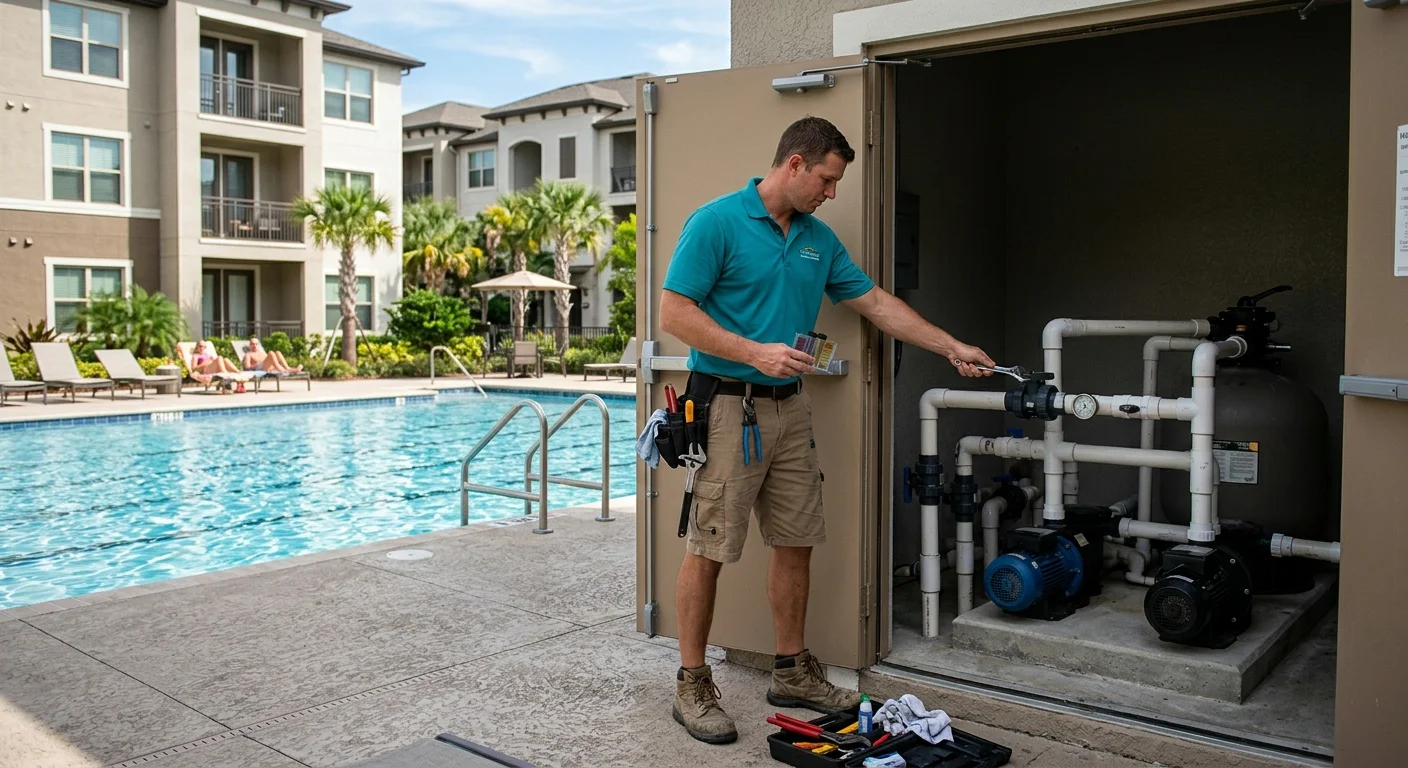
Commercial pool pipe repair starts with locating the failed line, defining its reach, and choosing between excavation, rerouting, or relining. At a San Diego HOA, hotel, or apartment complex, that decision also affects residents, guests, vendors, and property access. For the board-level contracting checklist, see HOA pool service.
The right scope should explain what failed and how the proposed method addresses it. It should also separate confirmed findings from assumptions hidden below the deck.
Why commercial plumbing fails differently from residential
The pipe itself doesn’t know whether it serves a hotel or home. The operating conditions around it are what make a commercial repair different.
A residential leak usually affects one household’s schedule. At an HOA or hotel, the same issue can cross several responsibilities. Management may need to coordinate residents, front-desk staff, maintenance vendors, and board members. The equipment room may also sit far from the suspected leak.
Start with a system map, even if the existing records are incomplete. Mark the pool, spa, equipment area, valves, deck penetrations, water features, and visible pipe runs. A licensed specialist can then isolate sections instead of treating every wet area as the source.
That matters across San Diego County. A coastal hotel near the I-5 corridor may have tight loading access and guest areas beside the pool. An inland HOA may have a large shared deck between the equipment pad and the water. A Mission Valley property may need work coordinated with several building departments or operating teams. Each layout changes the access plan.
Wet soil or water loss doesn’t identify the failed line by itself. Commercial pool leak detection can narrow the search before finished surfaces are opened. Our guide to how pool leak detection works explains the diagnostic process in more detail.
Ask for a marked repair area before approving demolition. The drawing doesn’t need to be elaborate. It should show the suspected line, test points, planned access, and remaining uncertainty.
Health department requirements that shape the repair
A commercial pool repair isn’t only a plumbing decision. The operator also needs to confirm which closure, inspection, testing, and reopening requirements apply to that property.
We couldn’t confirm a specific San Diego County code section or one universal reopening checklist from the approved source material. Don’t substitute a generic online checklist. Requirements can depend on the facility, repair scope, and authority overseeing the pool.
The California Department of Public Health public pools and spas page is a useful starting point. The property operator should also contact the applicable local authority and describe the proposed work. Ask direct questions before the repair begins:
- Does the pool need to remain closed during each stage?
- Does the proposed pipe change require a permit or plan review?
- Are inspections or test records needed before reopening?
- Who can approve a change in pipe routing or equipment connections?
- Which records must remain in the facility file?
Get the answers in writing when possible. Then place them in the project scope so the contractor and operator share the same reopening conditions.
Don’t state that relining, excavation, or rerouting automatically triggers a particular approval. That decision couldn’t be confirmed as a blanket rule. The local authority should review the actual project details.
The operator should also define who controls access, posts property notices, and communicates status. Those are management decisions, not promises a contractor should be expected to infer.
Relining versus excavation on a busy property
Relining treats an existing pipe from inside its current path. Excavation exposes the pipe so the damaged section can be accessed directly. Neither method is automatically right for every commercial pool.
A relining proposal may reduce the amount of finished surface opened. Suitability still depends on the existing pipe, bends, fittings, branches, access points, and location of the failure. The specialist should state which portion would be lined and what remains outside the scope.
Excavation can provide direct access to a failed pipe or connection. It can also affect decks, landscaping, walkways, or other finished areas. The written proposal should identify who handles opening, hauling, backfilling, and surface restoration. Don’t assume those tasks are included.
Compare both methods using the same questions:
- What evidence identifies the failed section?
- Does the plan address one defect or the complete affected run?
- Which fittings and branches are included?
- What testing will follow the repair?
- What surfaces must be opened or restored?
- What conditions could change the approved scope?
Be cautious with a proposal built around an unseen pipe route. Ask the specialist to distinguish confirmed locations from estimated ones. That makes change orders easier to evaluate if the exposed layout differs from the plan.
Broader pool repair work may be needed when the pipe failure reaches valves, equipment connections, drains, or other system components. The licensed pro should define that boundary before work starts.
For a busy San Diego property, access may drive the final choice as much as the pipe. Delivery paths, guest circulation, resident notices, and deck use should appear in the plan.
Downtime planning for HOAs and hotels
A useful downtime plan is a sequence, not an unsupported reopening date. It separates diagnosis, access, repair, testing, restoration, and operator approval.
Begin by listing which amenities are affected. The main pool, spa, water feature, deck, or nearby path may not share the same operating status. The contractor should explain what must be isolated. The operator can then write notices that match the actual scope.
Hotels should coordinate the work with front-desk and facilities teams. Those teams need one approved description of what’s closed. HOAs should decide who updates residents, vendors, and board members. Mixed messages create avoidable pressure to reopen before the planned steps are complete.
Build the schedule around checkpoints:
- Confirm the suspected line and repair boundaries.
- Confirm access and surface-opening responsibilities.
- Complete the approved pipe work.
- Record the contractor’s testing.
- Finish required surface restoration.
- Complete any inspection or reopening steps confirmed by the authority.
- Document the operator’s decision to return the amenity to service.
Don’t promise residents or guests a completion date before the contractor defines those stages. Hidden pipe routes, inaccessible fittings, or a wider failure can change the scope. The proposal should explain how those discoveries will be reported and approved.
Local logistics deserve attention too. A downtown hotel, Chula Vista apartment community, and North County HOA won’t share the same loading areas or quiet periods. Map vendor entry from nearby routes such as I-5, I-8, or I-805, then confirm where materials and removed surfaces can be handled.
Keep one person responsible for schedule updates. That person should share confirmed milestones, not guesses from an active work area.
Documentation an operator needs afterwards
A completed repair should leave the operator with more than an invoice. Good records help the next manager understand what changed below the deck.
Request a final scope showing the repaired pipe, access locations, and any routing changes. Keep before-and-after photos with labels. If the contractor performed pressure or isolation testing, ask for the recorded results and the conditions under which testing occurred.
The project file should also include:
- The signed proposal and approved change orders
- The contractor’s business name and license information
- A marked pipe map or updated site drawing
- Product and material information supplied by the contractor
- Test records and labeled photos
- Surface restoration details
- Any permit, inspection, or authority records that apply
- Written warranty terms offered by the contractor, if any
Refresh Pool Pros doesn’t perform the repair or issue a workmanship warranty. We connect property owners and operators with licensed independent pool pros. Warranty terms come from the matched contractor and should be reviewed before signing.
Verify the contractor through the official CSLB license lookup. Confirm that the license belongs to the business named in the proposal. Keep a copy of the lookup result with the contract file.
Not every item above is necessarily required by law. The exact legal and health department documentation for this repair couldn’t be confirmed from the approved source material. Ask the applicable authority what the facility must retain.
Finally, store the records where future facilities staff can find them. A clear pipe map can prevent the next diagnosis from starting with another guess.
When to call us
Call when a commercial pool has unexplained water loss, a suspected underground line failure, or a repair proposal that needs a licensed specialist’s review. Call us at (858) 400-4598 and we’ll connect you with a licensed local pool specialist.
Frequently asked questions
Is pipe relining always better than excavation?
No. Access, pipe condition, fittings, routing, and the proposed repair area all affect whether relining is suitable. A licensed pool specialist should inspect the system before recommending either method.
How should an HOA or hotel plan pool repair downtime?
Build the plan around diagnosis, access, repair, testing, surface restoration, and any reopening steps confirmed with the applicable authority. Avoid announcing a reopening date until the contractor defines those stages.
What health department rules apply after a commercial pool pipe repair?
A single San Diego County rule or reopening checklist could not be confirmed from the approved source material. The operator should check current requirements with the applicable local authority and the California Department of Public Health.
What records should the operator keep after the repair?
Keep the signed scope, contractor details, pipe map, material information, test results, photos, change orders, and any permit or inspection records that apply.
Need professional help in San Diego County?
Refresh Pool Pros connects you with a licensed specialist for any service in this post.