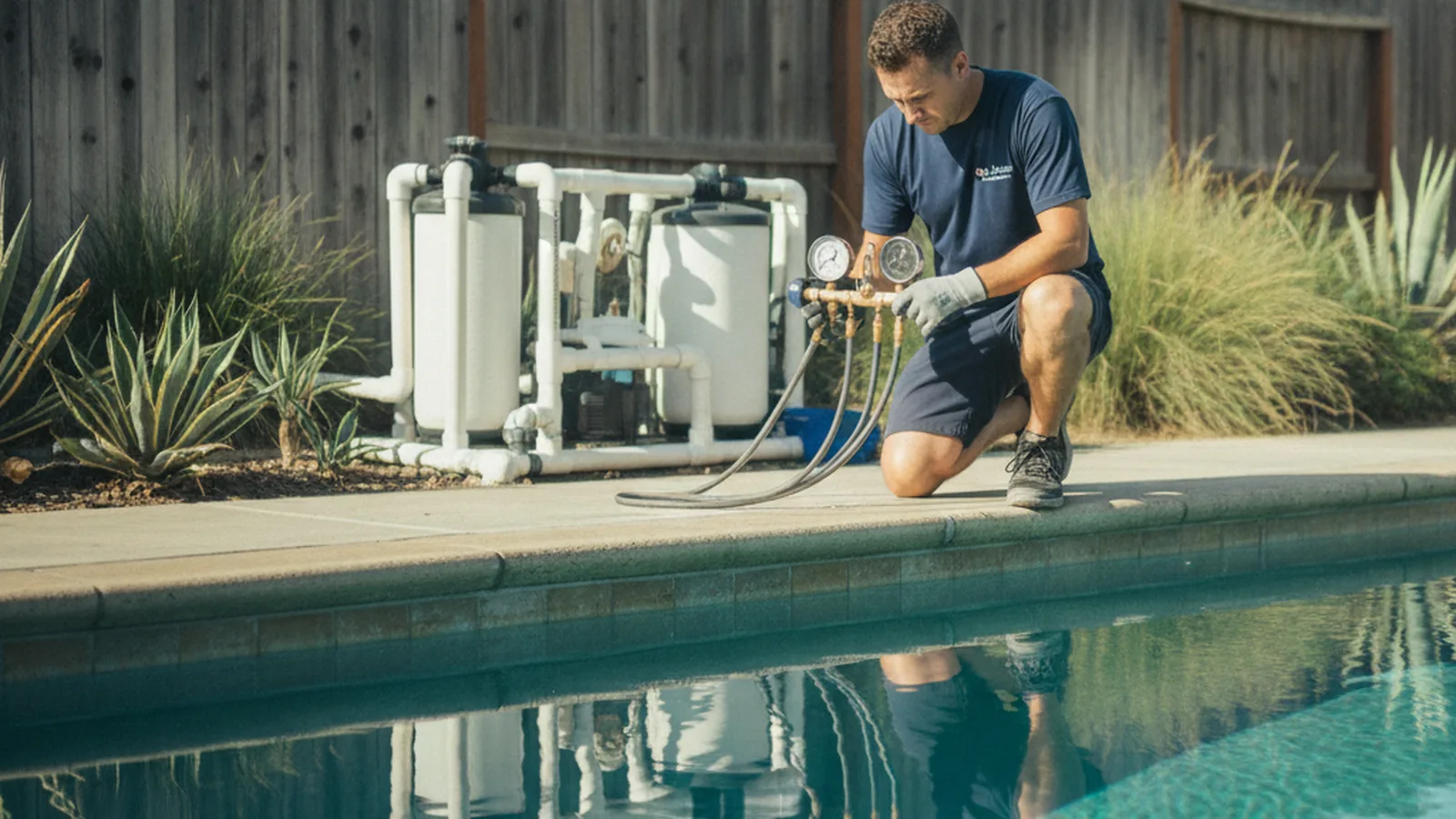
If your pool’s water level keeps dropping, the first question is whether you’re dealing with a real leak or just evaporation from San Diego’s dry air. Here’s the short version: our sun and low humidity alone pull a noticeable amount of water out of an exposed pool, so a lower water line by itself doesn’t prove much. What actually separates ordinary evaporation from a leak or evaporation problem worth worrying about is a simple 24-hour bucket test, and it’s the same first step a pool repair specialist would tell you to run before ever booking a visit.
Pool leak or evaporation: how to tell which one you have
It’s a question pool owners from Chula Vista to Poway ask every summer. San Diego’s sun and low humidity are great for swimming, but that same dry air pulls water off an exposed pool surface faster than most homeowners expect. A hot, breezy afternoon evaporates more than a still, overcast one, and a pool with a raised spa spillover or a rock waterfall loses even more, since moving water evaporates faster than still water.
Weather swings that number around a lot. During a Santa Ana wind event, when the air turns hot, dry, and fast-moving, a pool can lose noticeably more water than it does on a calm day. An unheated pool also keeps losing water overnight once the air cools and dries out, even with the pump off. None of that means something’s wrong. It means the pool is doing exactly what water does in a low-humidity climate.
The bucket test settles the question because it creates a fair, side-by-side comparison instead of a guess. The water sitting in the bucket experiences the same sun, wind, and air as the water in the pool, so if both drop by the same amount, evaporation explains all of it. If the pool drops noticeably more than the bucket, something besides weather is pulling water out, and that’s a leak or evaporation call that resolves in favor of a leak.
How to run the pool bucket test
This test costs nothing and takes a day. For an accurate read, turn off the auto-fill valve first so the system isn’t quietly topping off the pool behind your back, and skip running the pump if you can.
- Set a standard 5-gallon bucket on the second or third step, positioned so it’s partly submerged but the rim stays above the waterline.
- Fill the bucket with pool water until the level inside matches the pool’s water level outside it.
- Mark both water lines with waterproof tape or a grease pencil, one mark inside the bucket, one on the outside where the pool sits.
- Let it sit undisturbed for a full 24 hours. No swimming, and keep the pump and auto-fill off if possible.
- Check both marks the next day. If the pool and the bucket dropped the same amount, that’s evaporation. If the pool dropped noticeably more, you’re looking at a leak, not just evaporation.
If the pool drops more than the bucket, run the test a second time, once with the pump on and once with it off. Faster loss with the pump running usually points to a leak on the pressure side of the plumbing. Loss that stays the same either way usually means the leak sits on the suction side or somewhere in the shell itself.
Signs you have a leak, not just evaporation
The bucket test is the most reliable proof, but a few other clues are worth watching for around the yard and the equipment pad. An unusually soft or green patch of grass can mean an underground line is leaking, though San Diego’s sandy, fast-draining soil in a lot of neighborhoods means that patch doesn’t always show up the way it would in heavier clay soil elsewhere. Visible cracks in the plaster are sometimes purely cosmetic, but a wider structural crack can lose real volume over time. Deck pavers or concrete that start lifting or settling unevenly can mean water escaping below has washed out the soil that was supporting them. A pool that suddenly needs more chemicals than usual is also a tell, since constantly topping off with fresh water dilutes whatever balance you just dialed in. And if you spot standing water or drips right at the pump, filter, or heater, that’s often the easiest leak of all to find. Our guide on a pool pump leaking water walks through that specific case in more depth.
When to call a pool leak detection specialist
Once the bucket test rules out evaporation, the next move is finding exactly where the leak is instead of guessing and chasing symptoms. Professional pool leak detection uses pressure testing, dye testing, and sometimes electronic listening equipment to isolate the leak to the shell, the plumbing, or the equipment pad, usually without draining the pool. If you want the full walkthrough of how that process actually works, our post on how pool leak detection works covers each step.
Letting a leak run for weeks or months adds up, in wasted water and in some cases real damage to the shell or the soil around the equipment pad. The pool repair specialists in our network serve homeowners across San Diego and nearby communities like El Cajon and Rancho Santa Fe, and they can tell you within a visit or two whether you’re dealing with a stubborn evaporation stretch or an actual leak or evaporation call that needs a repair plan.
Frequently asked questions
How do I know if my pool water loss is normal?
The only reliable way to know is a side-by-side comparison, not a gut feeling about the water line. Run the 24-hour bucket test described above. If the pool and the bucket drop the same amount, you’re looking at ordinary evaporation. If the pool drops noticeably more, something besides the weather is pulling water out.
Can Santa Ana winds make my pool lose more water?
Yes. Hot, dry, fast-moving Santa Ana air pulls water off the surface faster than a calm day does, so it’s normal to see a bigger drop in the water line during one of those wind events. That’s exactly the kind of swing that can look like a leak or evaporation problem when it’s really just the weather, which is why the bucket test matters more during windy stretches, not less.
Does a pool cover reduce evaporation?
Yes, a cover reduces the amount of pool surface exposed to sun and moving air, which is the driver behind most evaporation. Solar covers and vinyl safety covers both work this way. A cover left off for weeks at a time, especially during a windy or hot stretch, is one of the more common reasons a pool owner sees a bigger-than-usual drop and starts wondering if it’s a leak or evaporation.
What should I check first if I suspect a leak?
Start at the equipment pad. Look at the pump, filter, heater, and every visible valve and union for drips, spray, or a damp base. Pad leaks tend to be the easiest to spot on your own, so ruling that out first narrows things down before you assume the leak is in the shell or the underground plumbing.
Can pool leak detection find a leak without draining the pool?
Yes, in most cases. Pressure testing, dye testing, and electronic listening equipment all work with the pool full, since the goal is finding where water escapes under normal conditions. Draining is sometimes needed for the repair itself afterward, particularly on a structural crack below the waterline, but not for locating the leak.
Need professional help in San Diego County?
Refresh Pool Pros connects you with a licensed specialist for any service in this post.