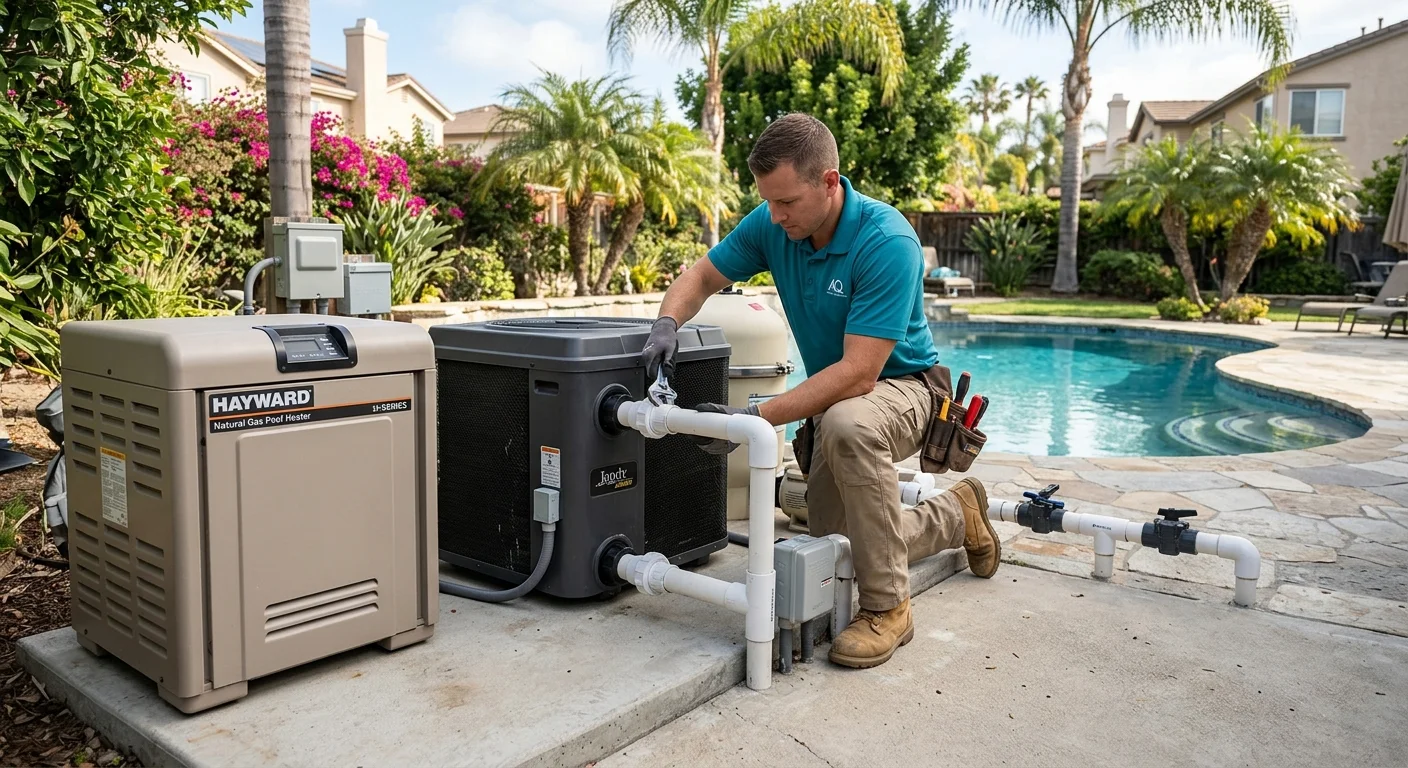
Fall is when San Diego pool water starts holding overnight chill. A gas heater and a heat pump both belong on local pads, but they win for different yards and different weeks of swimming. The right call follows your climate band, your pad, and whether you heat in short bursts or hold a set temperature.
What each system is actually good at here
A gas pool heater burns natural gas or propane. Pool water moves through a heat exchanger and picks up that heat on the way back to the basin. Outdoor air does not have to cooperate. On a cool Encinitas night it still fires. Same in Alpine wind, if gas, flow, and ignition are healthy.
Speed is the reason people keep gas. You can leave the water cool Monday through Thursday, then bring it up for a Friday swim. Families who use the pool in bursts tend to stay on gas. So do spa-side setups that need a fast jump before anyone sits down. A heat pump is a weak match if you only want heat for a few hours.
A heat pump pulls warmth from the air around the cabinet and moves it into the water. It runs on electricity. It holds a set temperature for days and does not sprint from cold. A Clairemont, Carlsbad, or Chula Vista pool kept in the swim zone most of the season is usually a heat pump job.
Do not mix up a heat pump with an electric resistance heater. Resistance units heat with an element, like a giant toaster in the water path. They draw a lot of power on a full outdoor pool. A heat pump moves heat. If a salesperson says electric heater, ask which of those two they mean.
There is no single best pool heater for San Diego. The county is not one climate. Swim habits, a cover, and what the pad already has matter more than a brand label. For a swap, start with pool equipment installation and upgrades.
Solar can sit beside either choice when roof space and sun line up. It will not give on-demand heat after dark. If that path is on the table, see the pool heater solar guide and treat it as a pointer, not a third comparison here.
Coastal nights versus inland valleys
San Diego County is not one weather station. A heat pump on a Mission Beach pad lives in different air than the same unit in Ramona.
Along the coast, from Imperial Beach through Coronado, Pacific Beach, La Jolla, Encinitas, and Oceanside, nights stay milder. Marine layer keeps the air from crashing as hard after sunset. That air is what a heat pump eats. Coastal yards that hold temperature with a cover often do well on a pump. Salt air is the trade. Coil fins, cabinets, and fasteners take a beating from ocean moisture.
Inland north county and the valleys run hotter by day and colder after dark. Escondido, San Marcos, Poway, Santee, El Cajon, Lakeside, and Alpine see that swing every fall. A heat pump still has air to work with on many afternoons. Overnight, the unit may run longer, or it may fall off if the air around the pad is too cold for that model. Gas does not care. If you want late swims in East County in November, gas, or gas as a backup, is the honest answer.
South Bay yards in Chula Vista, National City, and San Ysidro sit between those two. Walk the pad at dusk in October. If the air already feels sharp, ask how that model behaves in that air, not on a Florida sales page.
A cover changes both stories. Uncovered water dumps heat into a dry inland night faster than it does under a coastal layer. No heater type erases that. Runtime still follows the hole you leave in the surface.
We do not publish degree-day charts or a magic outdoor cutoff. Manufacturers rate each heat pump for a range of air temperatures. The matched licensed pro should read that rating against your pad.
Pad space, gas line, and electrical needs
The equipment pad in a San Diego backyard is often tight. Heat pumps are bulky. They need clear air around the coil and fan. Crowd them against a stucco wall, a fence, or a second unit and they starve. Gas heaters are usually smaller, but they need combustion air and a legal exhaust path. Clearances live in the unit manual and in what your city inspector will accept. Do not guess them from a photo.
Gas wants a properly sized line. An older run that fed a small heater may not feed a larger one. Some pads never had gas at all. Running a new line is plumbing work, and it often needs a permit. We cannot confirm every city’s permit trigger from this page. The licensed pro and the building department for your city set that. Propane is the workaround where natural gas never arrived. You then live with a tank and a refill schedule.
Heat pumps want electricity, usually a dedicated circuit sized to the unit. Panel space in older Clairemont, Allied Gardens, and East County houses is not a given. An electrician working with the pool specialist confirms load, breaker, and wire. A spare 120-volt outlet is not enough.
If you are swapping types, the pad work is the real job. Unions, flow, drains, and a pad that does not sit in water all come with the swap. We match you with a licensed specialist. That specialist does the physical work. Confirm the license on the CSLB license lookup before anyone orders a unit.
Under California contractor law, work is exempt from licensing only when the aggregate contract price for labor, materials, and all other items is under $1,000, the work is casual and minor, and no building permit is required. That $1,000 threshold is in effect January 1, 2026. Heater changeouts usually fail that test. Splitting a job to stay under the number does not create an exemption. Anyone who advertises as a contractor loses the exemption at any price.
Failures a pool pro sees on each type
Gas heaters fail in ways you can smell or hear. No ignition. A weak flame. A unit that tries to fire and then shuts down. Scale and pool chemistry chew the heat exchanger. A blocked vent or a bad pressure switch stops a safe start. If the cabinet is dark and silent, start with our guide to a pool heater that will not turn on. Do not keep resetting it.
Heat pumps fail more like outdoor air conditioners. Fans seize. Coils cake with lint, salt, and mulch. Compressors weaken. Refrigerant leaks. Water-flow switches false-trip when the filter is dirty. Coastal pads see coil corrosion earlier than inland pads. When the fan spins but the water never gains heat, that is a heat pump repair visit, not a chemistry problem.
Both types hate low flow. An undersized pump, a clogged filter, or a valve left half closed will trip safeties on either heater. A dirty filter can look like a dead heater on both types. Fix flow before you condemn the box on the pad.
We do not publish equipment life in years. That number depends on chemistry, rinse habits, salt air, and whether anyone ever serviced the unit. A blog that quotes a guaranteed lifespan is guessing.
Questions to ask before you switch
Write down how many days a week you actually swim in fall and spring. Note whether you heat a spa on short notice. Check whether gas already reaches the pad, and whether anyone has measured that line. Look at the electrical panel for a spare slot. Measure clear air around the current unit. Decide if you will run a cover every night. Say whether you are replacing a dead heater or adding heat for the first time.
Ask the specialist to size to your gallons, surface area, and wind, not a rule of thumb from another state. Ask for the heat pump’s rated air range from the spec sheet, in writing. Ask whether a hybrid setup (pump for hold, gas for sprint) even fits on your pad. Ask who pulls the permit if the city requires one. Ask for the contractor license number and check it yourself.
If the current heater still runs, a repair may beat a swap. If it is down, get a diagnosis before you buy a different fuel. Quotes should separate the unit from pad, gas, and electrical work. We do not publish a price list. The matched pro quotes after seeing the site. Your utility sets the therm and kilowatt-hour rates that drive the bill. We do not publish a cost to keep a given gallon count warm, because that figure is not a single number.
When to call us
Call when you are choosing a heat pump or gas heater for a pool, when a unit will not fire, or when the pad cannot take the next size up. A licensed pool specialist should see the site before anyone orders equipment. Call us at (858) 400-4598 and we’ll connect you with a licensed local pool specialist.
Frequently asked questions
What are the downsides of a heat pump pool heater in San Diego?
A heat pump heats slower than gas, needs outdoor air to work, takes more pad space, and usually wants a dedicated electrical circuit. Coastal salt air is hard on the coil. It is a poor fit if you only heat for a few hours on weekends.
Is it cheaper to heat a San Diego pool with gas or a heat pump?
A heat pump usually costs less to run when you hold a set temperature for days. Gas usually costs more per hour of heat, but you run it in shorter bursts. We do not publish a cost for a given gallon count. Your utility rates, cover, set point, and hours of use drive the bill. Ask the matched licensed pro for a runtime picture and check current rates with your utility.
How long does a heat pump take to heat a pool?
There is no single time for a 10,000-gallon pool or any other size. Start temperature, target, air at the pad, wind, a cover, and unit size all change the clock. Gas is typically faster. The specialist sizes the unit to your water and your habits instead of a rule from another state.
Does a heat pump work on cold San Diego nights?
It depends on the model and the air at your pad, not a slogan. Coastal nights stay milder. Inland valleys and East County drop harder in fall. Manufacturers publish a rated air range. Have the matched pro read that sheet against your yard. Gas still fires when the air is cold.
Should I keep gas, switch to a heat pump, or run both?
Hold-temperature swimming most weeks points to a heat pump. Weekend bursts and spa-speed heat point to gas. Some pads can hold both, with the pump for daily hold and gas for a fast jump. That only works if the pad, gas line, and panel can take it. Get the site looked at before you order.
Need professional help in San Diego County?
Refresh Pool Pros connects you with a licensed specialist for any service in this post.