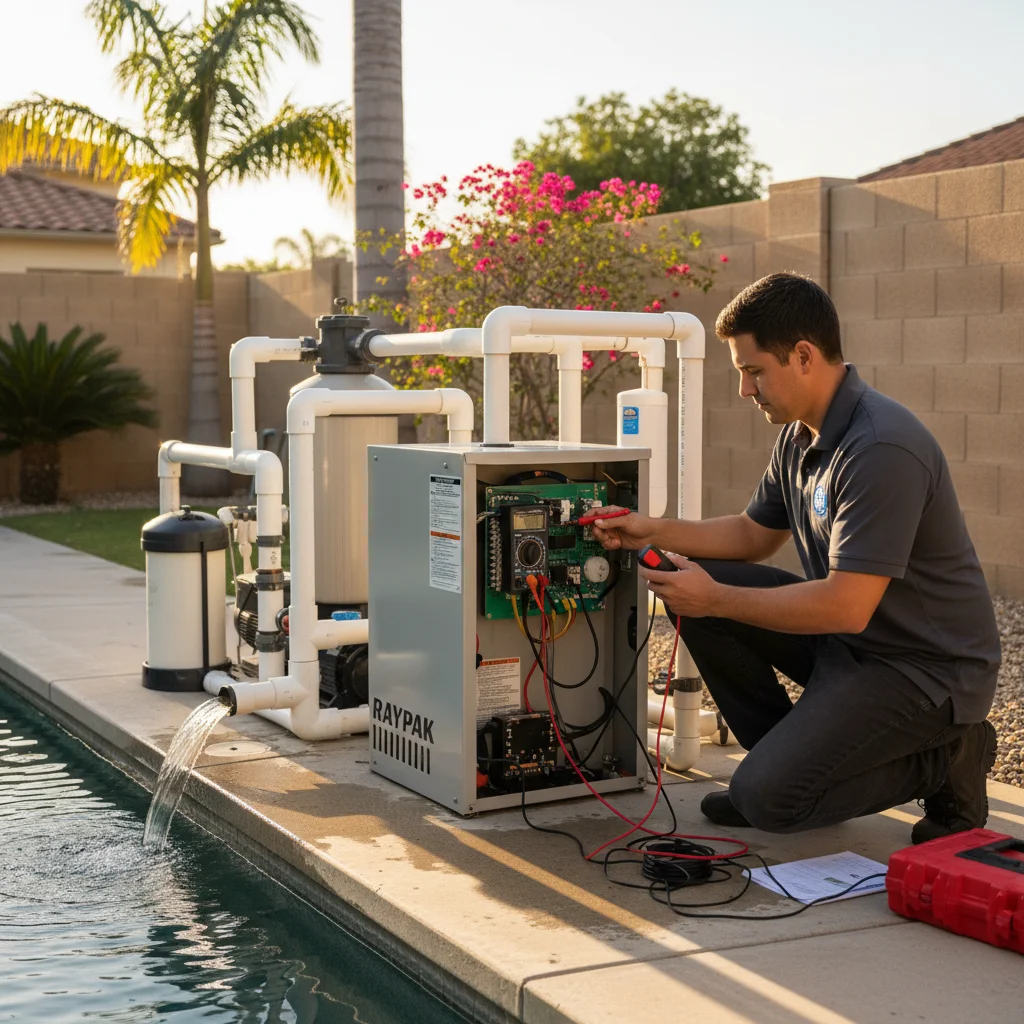
Pool heater repair in San Diego starts with the stage that failed: power, water flow, or ignition. A licensed independent specialist then quotes the part that actually failed, not a guess from the symptom. Inland pads in El Cajon, Santee, and Escondido see mineral scale inside heat exchangers. Coastal pads in La Jolla, Coronado, and Imperial Beach see salt-air corrosion on burners, unions, and boards. Refresh Pool Pros connects homeowners with those specialists. We do not perform the physical work.
Brand-specific faults belong on their own pages. For Raypak Digital LCD messages, see Raypak pool heater repair. For Jandy JXi messages, see Jandy pool heater repair. For Hayward Universal H-Series FD codes, see Hayward pool heater repair. For Pentair MasterTemp LCD codes, see Pentair pool heater repair. For heat pumps, see pool heat pump repair. This page covers the shared diagnostic path that applies before anyone orders a board or an exchanger.
Why is my pool heater not turning on
A pool heater that won’t turn on is failing at one of three stages: it isn’t getting power, it isn’t getting water flow, or it isn’t getting a spark to ignite the gas. Each stage has its own set of usual suspects, and diagnosing which stage is failing narrows the fix down fast. A heater with a completely dark display points to power. A heater that hums or the pump runs but no flame lights points to ignition. A heater that starts, runs briefly, then shuts off points to a safety switch tripping mid-cycle.
Check the power supply first
No power to the heater is the single easiest fix and the one homeowners skip. Start at the dedicated breaker in the electrical panel, since pool heaters typically run on their own circuit separate from the pump. A tripped breaker that won’t reset, or one that trips again within seconds of resetting, usually means a deeper electrical fault and needs a licensed electrician or pool repair pro rather than repeated resets. Check the GFCI outlet near the equipment pad too, if the heater’s control board runs off a standard outlet rather than hardwired power. San Diego’s coastal humidity corrodes outdoor GFCI outlets faster than inland installations, and a corroded outlet trips without warning.
Is the gas valve actually open
Gas heaters need an open shutoff valve at both the meter and the heater itself, and either one closed stops ignition cold. Homeowners sometimes close the heater’s gas valve at the end of summer and forget to reopen it, which looks exactly like a heater failure the following spring. Confirm the valve handle sits parallel to the gas line, not perpendicular, since perpendicular means closed. If the valve is open and gas smell is present anywhere near the unit, stop and call a professional immediately rather than attempting further troubleshooting.
The flow switch is a common ignition stop
A dirty or misaligned flow switch is a frequent reason a San Diego heater never ignites. The flow switch tells the heater’s control board that water is actually moving through the heat exchanger before it allows ignition, and it’s a safety feature that prevents the heater from firing dry and cracking the exchanger. Debris in the filter, a partially closed valve on the equipment pad, or a pump running below the flow rate the heater needs will all trip this switch. Cleaning the pump basket and skimmer baskets, then backwashing or cleaning the filter, often clears a flow-switch trip without a part replacement. If flow reads normal everywhere else, the switch itself may have failed and needs testing with a multimeter, which is a job for a licensed pool repair specialist.
What should you record when a pool heater clicks but will not light?
Record the heater model and describe whether you hear repeated clicking with no flame, or a flame that lights briefly then goes out. Ask the licensed contractor to inspect the heater and compare repairing a failed part with replacing the heater based on written scope, warranty, and parts availability rather than age alone.
Check the thermostat and control board settings
A thermostat set below the current water temperature won’t call for heat at all, which looks identical to a broken heater from the homeowner’s side. Confirm the set temperature is actually above the pool’s current reading, and check that the heater is switched to heat mode rather than off or a filter-only setting on combined systems. Digital control boards on newer heaters sometimes display an error code even when the screen looks blank at first glance, so checking for a faint or flashing code before assuming total failure saves a wasted service call.
What a pressure switch failure looks like
Some heater models use a water pressure switch instead of, or in addition to, a flow switch, and a stuck or miscalibrated pressure switch behaves the same way: the heater won’t fire even with strong water flow present. This failure is harder to diagnose without pressure-testing equipment, since the symptom looks identical to a clogged filter or closed valve from the outside. If flow and filtration all check out clean and the heater still won’t ignite, a pressure switch fault is the next thing a technician checks.
When the heat exchanger has failed
A cracked or corroded heat exchanger sometimes prevents ignition entirely as a safety response, rather than just reducing heating output. If you can see damage on the exchanger, record the heater model and describe it, then ask the licensed contractor to assess repair versus replacement and to explain written warranty and care instructions before you decide.
What to compare in repair and replacement quotes
Record the heater model and describe whether the issue looks like a single part such as an ignitor, flow switch, or control board, a cracked heat exchanger, or more than one failure at once. Ask the licensed contractor to compare the repair quote and the replacement quote on written scope, warranty terms, parts availability, and a condition assessment, not an age cutoff.
Refresh Pool Pros connects San Diego homeowners with licensed independent pool heater repair specialists. Compare repair-versus-replacement pricing, exclusions, parts, and warranty terms in the written quotes. HomeGuide publishes general U.S. installed planning estimates of $1,500 to $4,500 for natural gas or propane, $2,000 to $6,000 for a heat pump, and $2,500 to $6,500 for solar. HomeGuide’s heater repair planning estimate is $150 to $750. Those figures are for planning, and the actual quote from the company you are matched with may fall outside them. If the heater is part of a larger pool equipment issue, or the pad also needs a pump, filter, or salt system looked at, ask whether those items belong in the same written scope. Homeowners converting to a salt water system can have the heater discussed at the same time, since salt systems generate chlorine for sanitation. If the pool is already salt, see salt pool zinc anodes for the sacrificial protection on heaters and niches. If the heater keeps tripping on flow issues, ask whether leak detection should be part of the assessment before you replace parts. For a spa or hot tub heater showing the same symptoms, request a condition assessment and written care instructions for spa and hot tub equipment. Homeowners in Carlsbad and nearby coastal cities can find local details on our Carlsbad pool service page.
Frequently asked questions
Why is my pool heater not turning on at all?
The most common cause is a safety switch that’s stopped the heater before it can ignite, usually the flow switch, high-limit switch, or pressure switch. A blank or unlit display, no error code, and a heater that never attempts ignition usually point to a power or thermostat issue rather than the gas or ignition system. A pool repair specialist reads the control display, tests the named safety circuit, and quotes the failed part after that check.
How much does it cost to fix a pool heater that won’t turn on?
Ask what failed on the heater. Ask whether parts are still in production. HomeGuide publishes a general heater repair planning estimate of $150 to $750. For a typical residential gas heater, HomeGuide lists about $1,500 to $4,500 installed. These are general planning estimates. Refresh Pool Pros connects homeowners with licensed independent pros, and the matched independent pro gives the actual quote after assessing the heater.
Can I fix a pool heater ignition problem myself?
Checking the gas shutoff valve, breaker, and thermostat settings is safe for most homeowners to do first. Anything involving the gas line, ignitor assembly, or heat exchanger should go to a licensed pool repair specialist, since gas heaters carry real fire and carbon monoxide risk if a repair is done wrong.
What should I compare in repair and replacement quotes for a pool heater?
Record the heater model and describe what failed, such as an ignitor, flow switch, or heat exchanger damage. Ask the licensed contractor to compare the repair quote and the replacement quote on written scope, warranty terms, parts availability, and a condition assessment, not an age cutoff.
Does cold weather cause pool heaters to stop working in San Diego?
San Diego rarely sees hard freezes, but coastal marine layer mornings and inland winter nights can drop water temperature enough that an undersized or aging heater struggles to keep up, which sometimes looks like a heater that won’t turn on when it’s actually cycling on low output. A pro can check whether the heater is undersized for the pool’s volume.
A pool heater that will not turn on rarely means the whole unit is dead. Call Refresh Pool Pros at (858) 400-4598 and we will connect you with a licensed independent specialist who can diagnose the unit and quote repair versus replacement in writing.
Need professional help in San Diego County?
Refresh Pool Pros connects you with a licensed specialist for any service in this post.