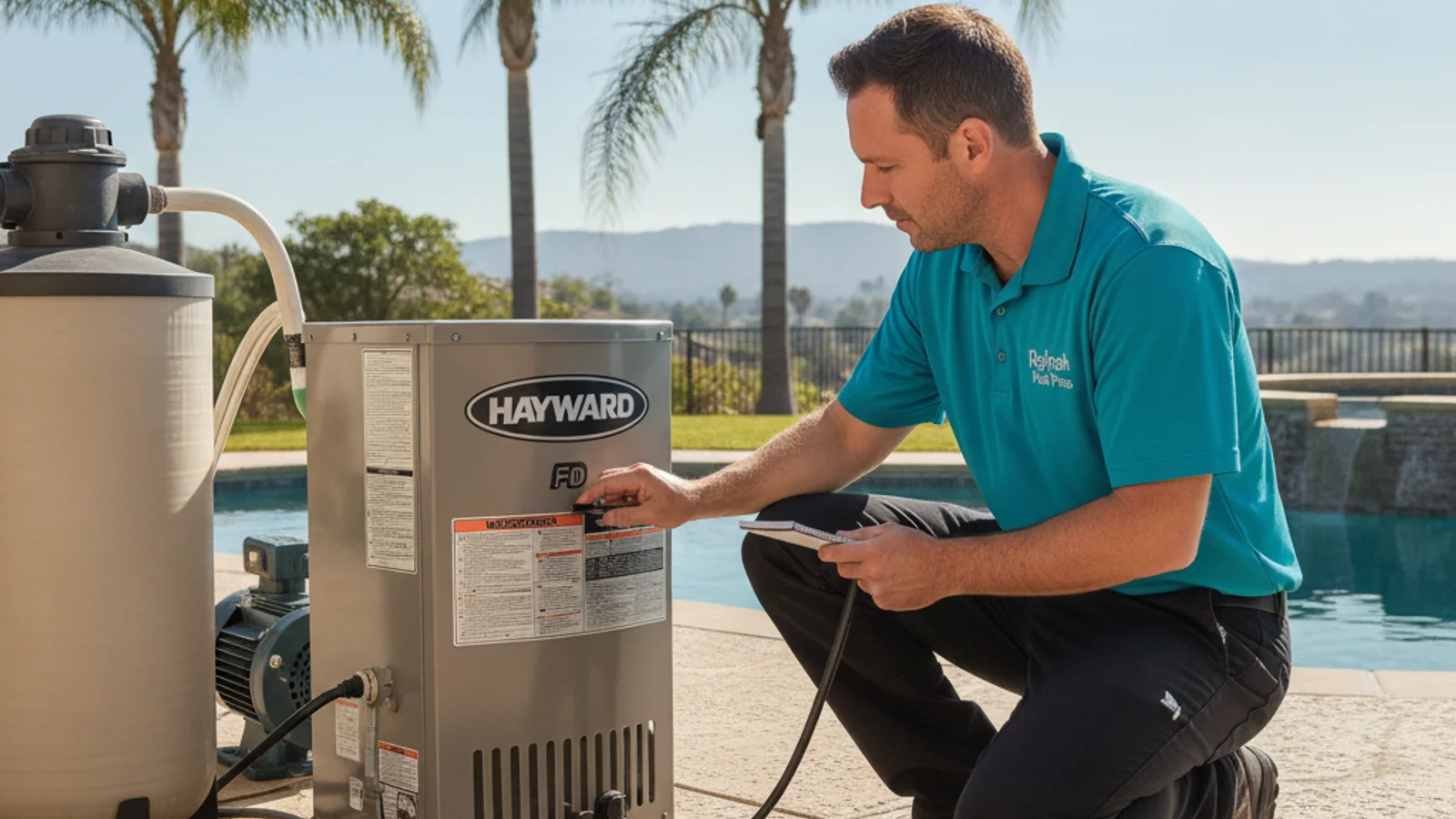
Hayward pool heater repair in San Diego starts with the two-letter code on the display, not a generic dead-heater guess. Universal H-Series FD units, models H150FD through H500FD, report codes such as IF, LO, HS, and PF. Those meanings come from Hayward’s service and installation manual for that family. Match the rating plate to the current Hayward manual for your exact model. Don’t treat this table as the last word on later HFN units. Refresh Pool Pros connects you with a licensed independent specialist. We do not do the physical work.
Hayward also sells heat pumps; this page is the gas H-Series family. Heat pump faults belong on the pool heat pump repair page. Named Raypak LCD messages live on Raypak pool heater repair. Shared power, flow, and ignition checks live on pool heater not turning on.
What makes Hayward different from Raypak and Pentair
Hayward’s FD design choices set it apart from the other two major heater brands, and those choices drive the repair. Universal H-Series FD units use a digital display that reports two-letter codes. They also use an ignition control board, a separate display board, and a blower that has to prove airflow before ignition. That is not Raypak’s named LCD sentences, and it is not a Pentair MasterTemp fault string.
The heat exchanger is the second distinction. Hayward’s FD manual describes the exchanger as copper and nickel, sold as cupronickel. Scale still forms in that metal when inland water is mineral-heavy. A repair pro confirms the rating-plate model before quoting.
The third is the limit string. Water pressure, high limits, and related safeties sit on one open-or-closed string. When that string opens, the display shows LO. A tech who tests flow first usually finds the real fault.
Universal H-Series FD two-letter codes
If your Hayward FD heater shows a two-letter code, write it down before calling, including any second code that follows. The codes below are labeled from the Universal H-Series FD manual for H150FD through H500FD. Confirm each one against the current Hayward manual for the model on your rating plate. Don’t assume they apply to every later HFN unit.
- IF means ignition failure. The control exceeded the maximum ignition retries or recycles and locked out. Automatic reset is 60 minutes.
- LO means the limit string is open. The heater locks out, then auto-restarts two minutes after the string closes. That string includes the water pressure switch. If the heater still has power and the pump is off, LO can be a normal display.
- HS means water-temperature sensing. Inlet water reports over 104°F, or the inlet temperature changes faster than 6°F in 60 seconds, which Hayward flags as possible low flow. After a third detection in one hour, the heater locks out until power is cycled.
- CE means a communication error between the ignition board and the display board. The boards failed to talk at power-up, or lost that link for 30 seconds.
- HF means flame is present with the gas valve off. The blower keeps running until the condition clears. That is a combustion safety trip, not a DIY reset job.
- PF means an electrical supply wiring error: reversed 120V polarity, low voltage, or insufficient ground. Reset is immediate after the wiring fault is corrected.
- AO means the blower vacuum switch is open when the control expects it closed.
- AC means the blower vacuum switch is closed when the control expects it open. The control will not start the blower until that switch opens.
- IO means the igniter circuit is open. If the blower is running and the igniter path is open, the control shuts the blower down and locks out. Automatic restart is two minutes after the fault clears.
- SF means a thermistor error. Hayward trips this when the two thermistors differ by 5°F or more, or when both sit outside 10°F to 180°F. Automatic restart is two minutes after the reading is valid.
- EE means an EEPROM error on the ignition control board.
- Sb means a keypad button has been stuck closed for more than 30 seconds. The code shows, but the control keeps running until the button releases.
A displayed code is a starting point, not a complete diagnosis. The specialist tests the named subsystem before ordering parts. You can cycle MODE through STANDBY and back to POOL or SPA after the pump is running. That clears some lockouts. It doesn’t fix a scaled exchanger or a failed igniter.
Common Hayward gas-heater failures
Beyond the letters on the display, FD electronic-ignition units fail at the igniter, the gas valve circuit, or the ignition board, and they report IF or IO rather than a named sentence. Thermistors drift and throw SF or feed a noisy HS. CE and EE point at the board pair, not at the gas meter.
The water pressure switch is a frequent culprit, because it sits on the limit string and responds to flow. A dirty filter, a closed valve, or a pump that has not primed yet produces LO even when the switch itself is fine. Hayward also notes that a heater wired to constant power will show LO when the pump shuts down. A specialist tests the switch against actual pump output before replacing it.
Erratic high-limit behavior on this family often traces to flow. Hayward’s technician section lists a clogged filter or strainer, too much flow through an external bypass, and lime scale in the exchanger. Inland pads see that last one more than coastal pads.
The blower vacuum switch is the other Hayward-specific trip. The control will not keep lighting if the blower cannot prove airflow. A cracked silicone tube, a stuck switch, or a failing blower shows up as AO or AC.
Hayward’s FD manual also warns against putting chlorine or bromine tablets in the skimmer. High chemical concentrations can flow through the heater and attack the exchanger. A chlorinator belongs downstream of the heater, with a check valve so product cannot backflow into the cabinet.
San Diego-specific factors
San Diego’s geography shapes how Hayward FD heaters fail here, and a local specialist accounts for it. Inland communities like El Cajon, Santee, and Escondido run mineral-heavy water that scales inside heat exchangers, restricting flow and trapping heat. A heater throwing repeated HS or LO messages inland often has a scaled exchanger or a dirty filter rather than a bad board.
Coastal properties in La Jolla, Coronado, Imperial Beach, and Carlsbad face salt air instead. Burner trays, gas unions, and electrical connections corrode faster. The blower vacuum tube and cabinet fasteners take the same air. PF can be a real supply or ground problem on a pad that has sat in marine layer for years. A repair pro checks both scale and corrosion during the diagnostic, because the fix differs. Descaling an exchanger is a different job from replacing corroded burner components.
A North Park pad can see some of both. A Ramona or Alpine pad sits closer to the inland pattern even when the listing looks coastal. Tell the specialist the ZIP. The diagnostic starts in different places.
What to record before calling
A few details help the specialist arrive prepared. Note the model and serial from the rating plate. Write down the exact two-letter code, and whether the pump was running when it appeared. Note whether the pool is salt-chlorinated. Photograph the display and the pad, including valve handles. Note the ZIP, since inland scaling and coastal corrosion point the diagnostic in different directions.
If you already have a name, confirm the license on the CSLB license check before anyone opens the cabinet.
When repair versus replacement makes sense
Repair is the better call when the fault is a single component on an otherwise sound unit: the igniter, thermistor, pressure switch, blower vacuum switch, or control board. Replacement is the stronger option when the heat exchanger is scaled through or corroded, or the cabinet is rusted out. Repeated faults across subsystems point the same way. The specialist weighs parts cost, age, and exchanger condition before recommending either path.
HomeGuide publishes a general U.S. heater repair planning estimate of $150 to $750. That is a national planning range, not a San Diego quote and not a price from Refresh Pool Pros. The matched independent pro on a pool equipment visit gives the actual figure after looking at the heater.
California Business and Professions Code section 7048, as amended effective January 1, 2026, exempts only casual minor work under $1,000 that needs no building permit. The exemption does not apply if the person advertises as a contractor or employs someone to do the work. Heater replacement and most advertised pool repairs should go through a licensed pro. On a written home-improvement contract, section 7159.5 caps the down payment at $1,000 or 10 percent of the contract amount, whichever is less.
When to call us
If your Hayward FD heater is showing a two-letter code or not firing, it is time for a licensed pool repair specialist, not another thermostat tweak. Call us at (858) 400-4598 and we’ll connect you with a licensed pool repair specialist in our San Diego network who knows the Universal H-Series FD line.
Frequently asked questions
What does LO mean on a Hayward H-Series heater?
On Universal H-Series FD models H150FD through H500FD, LO means the limit string is open. Hayward's FD manual puts the heater in lockout, then auto-restarts two minutes after the string closes. That string includes the water pressure switch. An LO when the pump is off can be normal if the heater still has power. A pool repair specialist checks flow and the switch before replacing parts.
How much does Hayward pool heater repair cost in San Diego?
There is no fixed repair price without a hands-on diagnosis. HomeGuide publishes a general U.S. heater repair planning estimate of $150 to $750. That is not a Hayward-only figure and not a quote from this brand. A control board or heat exchanger job can run higher than a sensor or igniter swap. The matched independent pro gives the actual quote after assessing the unit. See [HomeGuide's pool heater cost guide](https://homeguide.com/costs/pool-heater-cost).
Do these two-letter codes apply to every Hayward heater?
No. The codes on this page come from Hayward's Universal H-Series FD manual for models H150FD through H500FD. Later HFN units are a different family. Heat pumps are a different machine. Read the rating plate, then match it to the current Hayward manual for that exact model before anyone orders a board or an igniter.
Does San Diego hard water damage Hayward heat exchangers?
Inland San Diego water is mineral-heavy, and scale inside a heat exchanger restricts flow and traps heat. On the FD line that often shows up as HS or LO rather than a named high-limit sentence. Coastal units face a different risk: salt air corrodes burner trays, unions, and electrical connections. A specialist inspects for both scale and corrosion. This page does not publish a hardness number by district.
Should I repair or replace a Hayward pool heater?
Repair makes sense when the fault is a single component like an igniter, thermistor, pressure switch, or control board on an otherwise sound unit. Replacement becomes the better call when the heat exchanger is scaled or corroded through, the cabinet is rusted out, or repeated faults point to multiple failing systems. The specialist assesses the unit, parts availability for your model, and the cost gap before recommending either path.
Need professional help in San Diego County?
Refresh Pool Pros connects you with a licensed specialist for any service in this post.