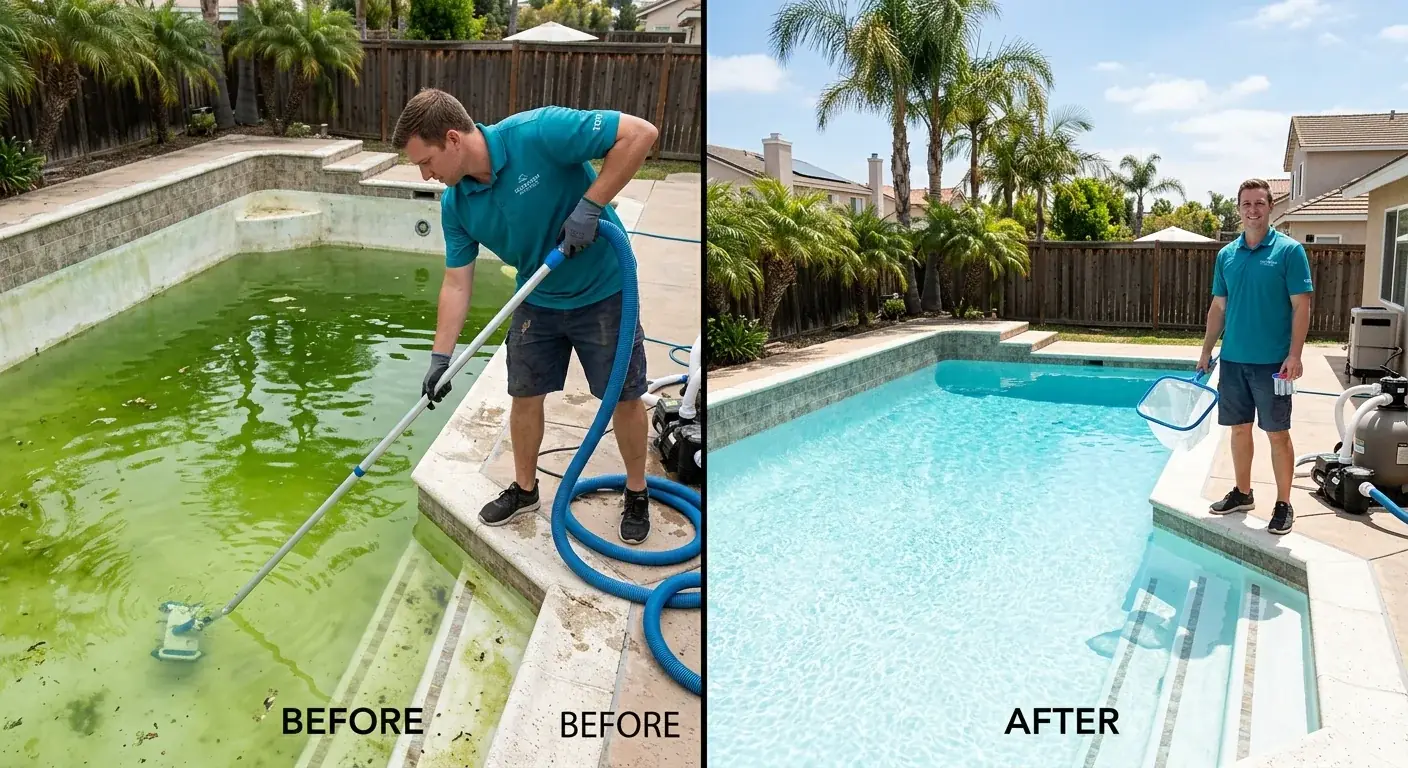
Algae turns a pool green when the chlorine level drops low enough that it can’t keep up, and the fix depends on how far along the bloom already is. A pool with a slight teal tint and a visible bottom step is a different job from a pool that’s gone opaque. Either way, a technician needs to see the water before quoting a flat number, since the volume of the pool, the depth of the bloom, and the condition of the filtration all change what the job actually takes.
Why San Diego pools turn green
San Diego’s pool season runs close to year-round. There’s no hard freeze here to knock algae back the way there is in colder climates, which means a green pool can show up in any month, not just the traditional spring-opening season. Most of the time the trigger is simple: circulation drops off, or the chemical balance slips, and algae that was already present in trace amounts gets the opening it needs.
Where you live in the county changes how fast that happens. The marine layer keeps coastal yards in La Jolla, Pacific Beach, and Coronado shadier and a few degrees cooler, so a lapse in chlorine there tends to show up as cloudy water before it goes fully green. Inland heat pockets work against you faster. In El Cajon, Santee, and Escondido, direct sun burns off available chlorine faster. Once the sanitizer is gone, algae spores that were dormant can take over an inland pool while a coastal pool is still only cloudy.
Local water chemistry adds a second layer to this. San Diego County water districts run moderately hard to hard water, and high calcium hardness makes it harder to hold pH in the range where chlorine actually works. When pH drifts too high, chlorine loses much of its sanitizing punch even at a normal dose. That’s part of why a single shock treatment so often fails to fully clear a San Diego pool: the underlying water chemistry needs correcting first, or the next dose of chlorine underperforms the same way the last one did.
What to describe when a San Diego pool goes opaque
The line between a DIY fix and a professional green-to-clean job comes down to visibility and equipment, not how the water smells or how it started.
If the water carries a slight tint but you can still clearly see the main drain at the bottom of the deep end, write down how far you can see and whether the pump is still circulating. That is a different job from an opaque pool. Don’t treat a retail shock jug as a substitute for seeing the equipment.
Once the water goes opaque, meaning you can’t see the bottom step, write down how far you can see and describe the water before assuming a retail shock treatment will clear it. Dark, swampy water also keeps you from seeing the drain at the bottom of the deep end, and from seeing a swimmer underwater who might need help. If you wake up to a pool that turned overnight, describe what you see and ask a licensed independent pro whether professional recovery or an equipment check fits. Refresh Pool Pros routes calls like that to our emergency pool service, which matches homeowners with licensed independent specialists.
What a professional cleanup actually involves
Clearing a severe bloom isn’t just pouring in chlorine and walking away. A technician works through a specific sequence to break the algae and get the dead matter out of the water for good.
It starts with testing and balancing. Chlorine loses most of its sanitizing power when pH runs high, so the first step is usually muriatic acid to bring pH into a range where the coming shock treatment can actually work. A technician also checks cyanuric acid, since a level that’s too high effectively locks up chlorine and keeps it from touching the algae at all.
Next comes brushing. Algae protects itself with a slime layer on the surface it’s rooted to, and chemicals alone struggle to get through it. A technician brushes the walls, steps, and floor, plaster pools with a stiff wire brush, vinyl or fiberglass with a nylon one, to break that layer apart and suspend the algae in the water where chlorine can reach it.
Then the heavy shock. Once pH is corrected and the surfaces are brushed, the pool gets a large dose of chlorine, often liquid sodium hypochlorite rather than granular shock. Granular shock carries calcium, and adding more calcium to already-hard San Diego water risks scaling the walls, so liquid chlorine is the more common choice here.
Filtration and removal close it out. Killing the algae turns the water a cloudy gray-white as the dead cells suspend in it, and the filter has to keep running to pull that out. It clogs fast doing that work, so a technician typically returns to clean cartridges or backwash sand and DE filters more than once. Anything that settles to the floor gets vacuumed straight to waste so it never has to pass through the filter at all.
What drives the quote
There’s no flat rate for a green pool recovery, because two pools with the same square footage can need completely different amounts of work. A few things move the price: total gallon capacity, since a large deep pool needs more chemical volume than a small plunge pool; the severity of the bloom; and the condition of your existing equipment, since an undersized or aging pump moves water more slowly. Always confirm the actual rate with the technician once they’ve seen the pool, not before.
When it’s really an equipment problem
A green pool isn’t always a chemistry lapse. Sometimes the chemistry is fine on paper and the water still turns green because the equipment can’t circulate it properly. A pump that hums but won’t prime leaves water sitting still, and algae takes advantage of stagnant water regardless of how much chlorine you’ve added. If your pump has failed or the impeller’s clogged, the fix is on the hardware side, not the chemical side. Our pool equipment connections cover diagnosing and replacing failing pumps, filters, and heaters.
Saltwater systems fail differently. A salt cell that’s scaled over or has worn-out internal plates stops generating chlorine, and the water can go green soon after that even if nothing else about the pool changed. If cell failures keep recurring, it’s worth having a salt water conversion specialist check whether the cell actually matches your pool’s volume.
Filter failures are the third path. Torn cartridge pleats, a cracked filter manifold, or a channeled sand bed all let dirty water bypass the filter media and return straight to the pool, feeding the next algae bloom before the last one’s fully gone. That’s a pool filter repair job, rebuilding or replacing the filter, not another round of shock. A dead pump is a pool pump repair job.
If you’re inland, in El Cajon or a nearby heat pocket, equipment failures compound faster because the same heat that burns off chlorine also pushes a struggling pump toward overheating. Catching a small pump problem early is a lot cheaper than the green pool cleanup that follows it.
Call (858) 400-4598 and describe what the water looks like. Refresh Pool Pros routes the call to a specialist who handles the chemical recovery, the equipment repair, or both, depending on what’s actually behind it.
Frequently asked questions
How long does it take to clear a green pool?
Ask the specialist after they see how far you can see into the water and whether the pump and filter are still moving it. A tinted pool with a visible bottom is a different job from an opaque pool. This page does not publish a standard recovery length.
Can I swim in a green pool?
No. Algae itself isn't especially toxic, but a green pool has effectively zero active sanitizer left, which means it can't kill the bacteria that grow alongside it. Cloudy or opaque water also hides debris, drop-offs, and drains, which is a separate safety problem on top of the water quality.
Why did my pool turn green overnight?
Chlorine dropped to near zero during a stretch of warm weather, and dormant algae spores multiplied while nothing was left to stop them. Inland San Diego heat pockets can burn off chlorine faster than a coastal marine-layer yard, which is why an inland pool can go from clear to green faster than a coastal one.
Does a green pool need to be drained?
Usually not. A technician can chemically treat, brush, and filter out most algae blooms without emptying the pool. Draining is typically reserved for water with cyanuric acid or calcium hardness so far out of range that no amount of chemical adjustment will bring it back.
Will running the pool filter clear green water on its own?
No. A filter only captures dead organic matter and debris, it doesn't kill living algae. The water needs a heavy chlorine shock first to kill the algae, and only then does the filter earn its keep pulling the dead matter back out. Ask how long they want the system running and how often the media needs cleaning during recovery.
Is a green pool always a chemistry problem?
No. A chemistry lapse is the most common trigger, but stagnant water from a failed pump, a dead salt cell, or a clogged filter can turn a pool green even when someone is adding chlorine on schedule. If a pool keeps going green despite consistent maintenance, the equipment is worth checking before buying more chemicals.
Need professional help in San Diego County?
Refresh Pool Pros connects you with a licensed specialist for any service in this post.