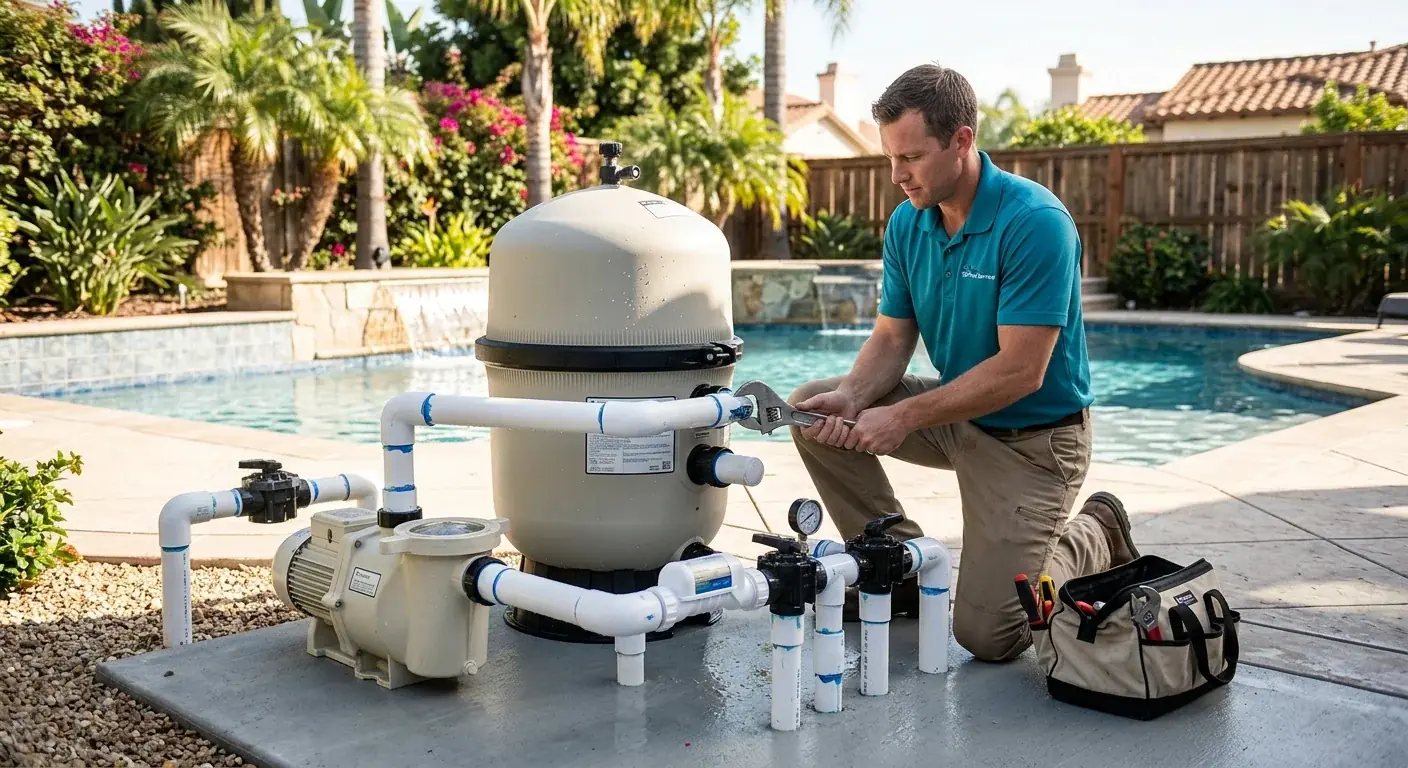
Repair the filter when the failure is limited to a replaceable internal part, gauge, valve, clamp, or seal and the tank remains sound. Replace it when the housing is cracked, badly corroded, repeatedly leaking, or failing in several places. Pool filter repair in San Diego is that diagnosis, not a default new tank. A specialist should also test pressure and circulation before condemning the filter. See pool pump repair if the pump is also struggling. If the tank is still sound and the question is which type you have, see sand vs cartridge vs DE.
Pool filter repair in San Diego: cartridge, DE, and sand
Cloudy water doesn’t automatically mean the entire filter has failed. The problem may be dirty media, a damaged internal part, a faulty gauge, or restricted circulation elsewhere on the equipment pad.
Start with the failure pattern. Debris returning through the pool jets suggests that filter media or an internal component isn’t containing material. Water around the tank suggests a seal, valve, clamp, drain, or housing problem. Weak return flow requires a broader circulation check before anyone recommends replacement.
The tank’s condition matters most. A sound tank with one serviceable failure often supports repair. Structural damage changes that calculation because replacing an internal part won’t correct a compromised housing.
A specialist should identify the filter type, inspect the tank and valve, and compare the pressure reading with the system’s normal clean pressure. That sequence prevents a pump or plumbing problem from being mistaken for filter failure.
Read the pressure before blaming the filter
The pressure gauge is one of the most useful diagnostic tools on the pad. It needs context, though. A generic pressure number can’t describe every pool because plumbing layout, filter size, elevation, and equipment differ.
High pressure commonly means the filter media is loaded with trapped material. Cleaning the cartridge, DE grids, or sand-filter flow path may restore normal circulation. If pressure rises again soon after cleaning, the specialist should inspect the media, internal plumbing, and return side for restrictions.
Persistently low pressure with poor circulation points in another direction. A suction-side air leak, blocked skimmer line, closed valve, clogged pump basket, or clogged impeller may be starving the system before water reaches the filter. Replacing the filter won’t solve an upstream flow problem.
The gauge can also fail. If its needle stays fixed when the pump stops, moves erratically, or doesn’t react after cleaning, the gauge itself deserves inspection. Refresh Pool Pros’ pool repair service covers filter and circulation problems that need an on-site diagnosis.
How cartridge, DE, and sand filters fail
Filter design changes what failure looks like. San Diego pools commonly use cartridge, DE, or sand filtration, and each type has different internal parts.
A cartridge filter traps material within pleated elements. A cracked end cap, split seam, damaged band, or torn pleat can let debris bypass the cartridge. If the tank and manifold remain sound, replacing the damaged element may be enough. Repeated element damage can point to incorrect fit, excessive pressure, or another system problem that needs diagnosis.
A DE filter uses grids coated with diatomaceous earth. A torn grid or damaged manifold can return DE powder to the pool through the jets. That pale material may collect near returns or settle on the floor. Replacing the affected grid or manifold can preserve a sound tank, but widespread internal deterioration may favor replacement.
A sand filter moves water through filter media and internal laterals. Sand appearing in the pool often points to a cracked lateral or another damaged internal component. It doesn’t automatically mean the tank has failed. A specialist must open the filter and inspect the assembly before choosing the repair.
If several components have deteriorated together, compare that repair with a correctly sized replacement. The pool equipment service explains the replacement side of that decision.
San Diego location changes the failure pattern
The equipment pad’s location within San Diego County can influence which parts deteriorate first.
Inland areas of East County and North County Inland can receive harder or more variable water. Mineral scale can build on cartridge and DE media, restrict flow, and make cleaning less effective over time. An El Cajon pool equipment inspection should therefore include a close look at scaled media, manifolds, valves, and the pressure trend.
Coastal conditions create a different pattern. Salt air around La Jolla, Carlsbad, Encinitas, and Coronado can corrode tank clamps, valve hardware, and exposed metal fittings while the filter media remains usable. That means the correct repair may involve the housing hardware rather than the filtration element.
A Carlsbad pool service visit should examine corrosion around clamps and connections, not just water clarity. Surface rust and structural corrosion aren’t the same condition, so the assembly needs an in-person inspection.
These regional differences matter. A generic replacement checklist can miss the part most affected by the property’s water and air exposure.
Signs that favor repair or replacement
One symptom rarely settles the decision. Look at the tank, internal parts, pressure behavior, leak history, and the condition of nearby equipment together.
- Repair: Pressure returns to normal after cleaning or replacing damaged media.
- Repair: One cartridge, DE grid, lateral, gauge, valve, seal, or clamp has failed while the remaining assembly stays sound.
- Repair: The apparent filter problem traces to a clogged impeller, suction leak, or another upstream restriction.
- Replacement: The tank or housing has a structural crack rather than a serviceable seal leak.
- Replacement: Corrosion affects the clamp, valve, fittings, and other major components at the same time.
- Replacement: Leaks or internal failures keep returning after earlier repairs.
- Replacement: The filter no longer fits the circulation needs of an equipment pad changed piece by piece.
A repair is the clear first move when it restores a sound, compatible assembly without leaving another major defect behind. Replacement is clearer when a repair would preserve one component inside a failing or mismatched system.
Never open a pressurized filter tank. Shut the pump down and have the system depressurized before a qualified specialist removes a clamp, lid, valve, or internal assembly.
How filter age affects the decision
Age matters, but a calendar alone can’t make the call. Two filters installed during the same period may age differently because of water chemistry, maintenance, sun exposure, corrosion, and operating pressure.
Look for an equipment label, installation record, or earlier service invoice. Then compare the filter with the rest of the pad. If the pump, heater, controls, and plumbing have already been replaced piecemeal, an older filter may be the remaining weak link.
Compatibility also matters. A filter that worked with the original pump may not suit later equipment changes. The specialist should assess flow, plumbing, available pad space, and the condition of the electrical and hydraulic setup before recommending another isolated repair.
The Pentair and Hayward equipment comparison can help owners understand brand and system considerations. Brand alone shouldn’t decide the outcome. Condition and compatibility carry more weight.
Check the whole equipment pad
Water near the filter doesn’t always come from the filter. Pump seals, unions, valves, heater connections, and nearby plumbing can send water across the same slab. Trace the source before ordering parts.
The guide to standing water around a San Diego pool equipment pad explains how nearby leaks can confuse the diagnosis. Wet equipment also deserves prompt attention when electrical components are nearby.
Pump performance belongs in the same inspection. Weak circulation can make a sound filter look ineffective, while a restricted filter can make a working pump struggle. If the pump is also showing signs of failure, review the San Diego pool pump replacement guide before changing either component.
A good diagnosis separates the symptoms from the source. That protects homeowners from replacing a filter when the real fault sits elsewhere on the pad.
Frequently asked questions
How do I know if my pool filter is bad?
Check water clarity, return flow, pressure, and whether debris reappears after filtration. A damaged cartridge, torn DE grid, or cracked sand-filter lateral can let material pass through. A specialist can separate those failures from pump and plumbing problems.
Can a pool filter be repaired, or does it need replacement?
Many filters can be repaired when the tank remains sound and the problem is a replaceable internal part, gauge, valve, clamp, or seal. Replacement makes more sense when the housing has structural damage, extensive corrosion, repeated leaks, or several failing components.
How long should a pool filter last in San Diego?
There isn’t one useful lifespan for every San Diego filter. Water chemistry, filter type, sun exposure, coastal corrosion, pressure history, and earlier repairs all affect the decision. Check the equipment label, service records, and physical condition instead of relying on one age estimate.
What does a bad pressure gauge reading mean?
High pressure usually points to loaded or dirty filter media. Persistently low pressure with weak circulation often points upstream, such as a suction-side air leak or clogged pump impeller. A gauge that doesn’t move may itself need replacement.
Is it worth repairing an old pool filter?
It can be, if the tank and valve remain sound and one replaceable component caused the failure. Replacement becomes the stronger choice when corrosion, recurring leaks, obsolete parts, and piecemeal equipment changes make another isolated repair a temporary answer.
Refresh Pool Pros connects San Diego County homeowners with a local specialist who can inspect the system and make the repair-or-replace call in person. Call (858) 400-4598 to request help.
Need professional help in San Diego County?
Refresh Pool Pros connects you with a licensed specialist for any service in this post.