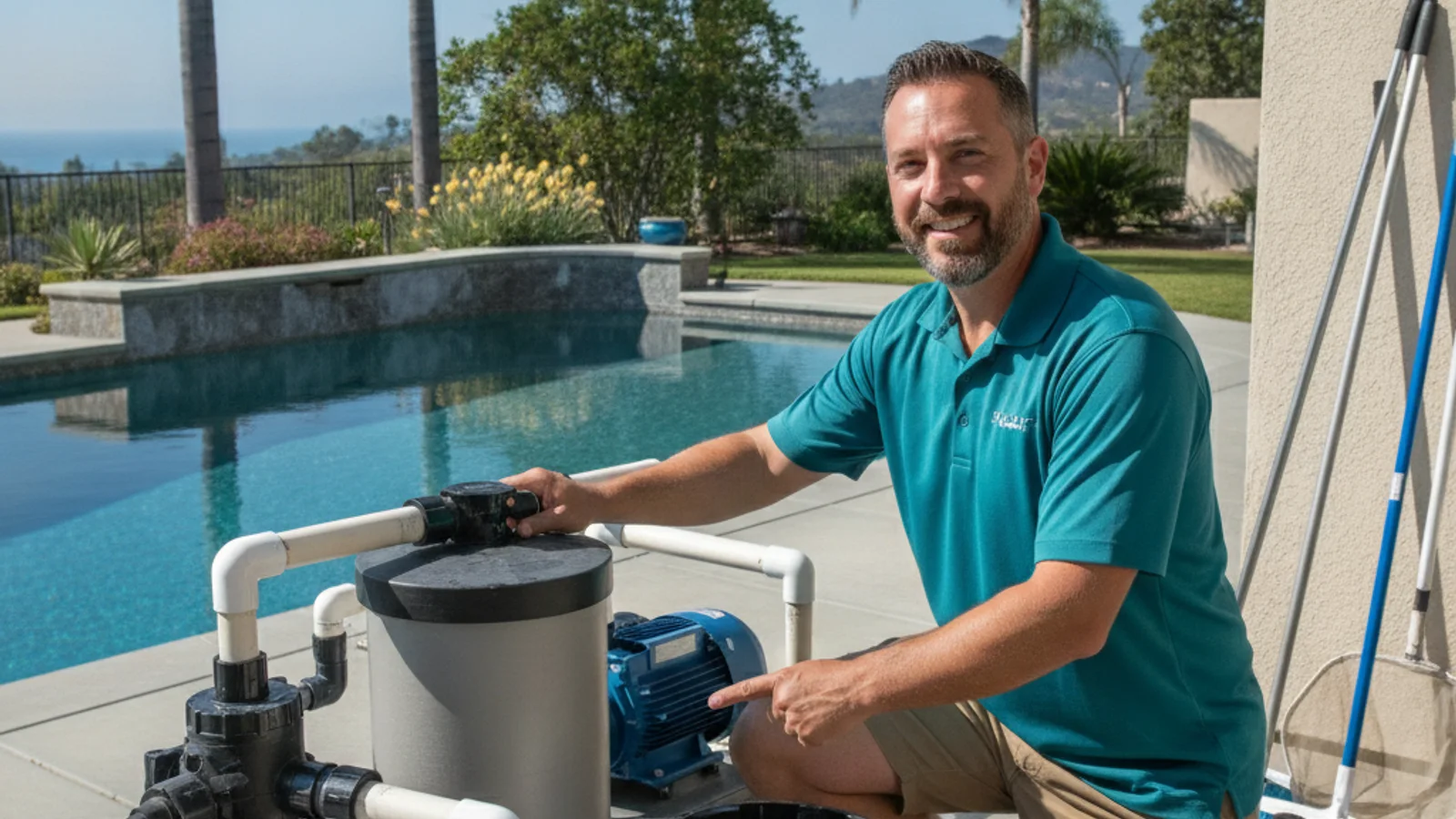
San Diego pool pads run one of three filter types: sand, cartridge, or DE. That choice decides whether you backwash water to waste, rinse pleated elements, or recast grids with powder. If the tank is leaking or the pressure gauge is stuck, stop here and use pool filter repair or replacement. That page is the failed-tank diagnosis. This one is how to identify the tank you already have.
Refresh Pool Pros connects homeowners with licensed independent specialists. We do not perform the physical work.
How to tell which filter is on the pad
The outside of the tank usually gives the type away. Start with the printed label. Brand, model, and media are often on a plate or sticker. Photograph it before anyone guesses.
A clamp band around the lid is the usual cartridge tell. You will not see a multiport backwash valve on that tank. Sand and DE tanks often share the same silhouette: a round vessel with a multiport or push-pull valve on top. Those two can look identical from the walkway. DE powder bags, a slurry pot, or the word “diatomaceous” on the label settle it. If none of that is obvious, do not open the tank to find out.
Do not open a pressurized filter. Shut the pump off at the timer or breaker and let a qualified specialist relieve pressure before anyone removes a clamp, lid, or valve. Identification is a photo job. Leave the clamp and lid alone until the tank is depressurized.
Manufacturers publish micron ratings on the product sheet. The matched pro reads the label on the tank. This page does not reprint those numbers.
What each type does with water
Backwash is not a free rinse. It sends pool water out a waste line, drops the water level, and has to go somewhere legal.
Sand filters
A sand filter pushes water down through a sand bed and back to the pool. When the bed loads, the usual next step is backwash: reverse flow that flushes dirty water to waste. That is why a sand tank has a waste port. After backwash, you refill what you dumped.
Ask the water district that serves this address where backwash water may go. A specific drought ordinance number was not confirmed for this page. Instructions for Carlsbad should not be assumed to cover El Cajon. The San Diego County Water Authority is a regional starting point. Your bill names the actual provider.
Sand in the pool is not a type question. It is a laterals or internal-failure question, and it belongs on the repair page.
Cartridge filters
Cartridge filters have no backwash cycle. There is no waste setting to dump a tank of water down a line. The specialist shuts the pump off, depressurizes the tank, and pulls one or more pleated elements to rinse or replace.
That saves a backwash dump. It does not make the filter maintenance-free. Inland mineral film cakes pleats so a hose rinse does less. Coastal salt air attacks the clamp band and lid hardware while the elements may still be usable. Either way, the job is elements and hardware, not a multiport.
Debris returning through the jets after a fresh rinse points to a torn pleat or a bypass. That is the repair page, not a different filter type.
DE filters
A DE filter coats internal grids with diatomaceous earth powder. After a backwash, those grids have to be recast. The powder is a handling product, not pool dust. Follow the manufacturer’s PPE directions on the bag or sheet. This page does not invent a mask type.
DE backwash still sends water to waste, and the discharge can carry spent powder. That is a second reason to ask the district before anyone opens a valve. Do not dump it to a driveway, a gutter, or a canyon.
Pale powder returning through the returns means a torn grid or a damaged manifold. Photograph the cloud, then use the repair page. Recasting a failed grid will not hold.
East County minerals vs coastal salt air
San Diego County is not one water and not one climate. The same filter type fails for different reasons in El Cajon and in Imperial Beach.
Inland East County and inland North County, including El Cajon, Santee, and Escondido, run mineral-heavy fill water. Scale builds on sand, on cartridge pleats, and on DE grids. It can also seize multiport internals. A sand filter that will not come back down after backwash may have a scaled or channeled bed, not a “wrong” type. A cartridge that loads a day after rinsing may be caked with minerals. For the water chemistry side of that, see hard water in San Diego pools. A full drain is a different decision from a backwash. Confirm discharge for either one at this address.
Coastal pads in La Jolla, Coronado, Imperial Beach, and Carlsbad take salt air instead. Clamp bands, valve handles, pressure-gauge fittings, and exposed screws corrode while the media inside may still be doing its job. A cartridge tank with a rusted band is a hardware problem. A sand or DE multiport that will not turn can be seized from salt, not from dirty media.
There is no one best filter for every San Diego backyard. An inland plaster pool with heavy mineral load and a coastal salt-air pad are different equipment environments. The specialist matches the tank you have, the water you fill with, and the air around the pad. We do not publish per-city grains per gallon.
Weak returns with low pressure can also be the pump. See pool pump repair in San Diego before anyone condemns the filter.
Filter replacement cost and licensed work
There is no Refresh Pool Pros price list for a filter swap. HomeGuide’s pool repair cost guide publishes a general U.S. planning estimate of $250 to $1,700 for filter replacement. That band is planning context, not a San Diego average and not a brand quote. Tank size, valve, plumbing, and whether the type is sand, cartridge, or DE all move the number. The matched independent pro quotes after seeing the pad.
A full tank swap is pool equipment work. This page does not tell you to keep or scrap a cracked housing. That call lives on the repair page.
California Business and Professions Code section 7048, as amended effective January 1, 2026, exempts only casual minor work under $1,000 that needs no building permit. Advertising as a contractor or employing someone to do the work voids the exemption. Filter replacement and most advertised pool equipment work should go through a licensed pro. Check the person or company on the CSLB license lookup.
For a covered home improvement contract, the downpayment cannot exceed $1,000 or 10 percent of the contract amount, whichever is less. Confirm the contract type before you pay a deposit.
What to record before you call
A photo of the tank label is more useful than a guess on the phone. Shoot the whole pad as well, including the pump and any waste line.
Write down whether you see a clamp lid or a multiport valve. Note the number on the pressure gauge, and whether that needle moves when the pump shuts off. Note cloudy water versus water on the slab. Note the neighborhood, because inland scale and coastal corrosion point the visit in different directions. Note whether DE powder is stored on site.
Do not keep running a pump against a packed filter while you wait. If the pump is humming, leaking, or losing prime, record that too. The specialist uses those notes to bring the right tank knowledge on the first visit.
When to call us
Call when you need a licensed specialist to identify the tank, plan a type-matched swap, or handle backwash discharge and DE powder. Call us at (858) 400-4598 and we’ll connect you with a licensed local pool specialist.
Frequently asked questions
How do I know if I have a sand, cartridge, or DE pool filter?
Read the label on the tank. A clamp-lid tank is usually a cartridge filter. A tank with a multiport or push-pull backwash valve is usually sand or DE. DE systems also tend to have powder bags or a slurry pot on the pad. Photograph the tank if the type is not printed, and let the matched pro confirm it.
Do cartridge pool filters need to be backwashed?
No. Cartridge filters have no backwash cycle. The elements come out and get rinsed or replaced after the pump is off and the tank is depressurized. Sand and DE filters do backwash, and that water leaves through a waste line.
Where does pool filter backwash water go in San Diego?
Backwash sends pool water out a waste line. This page could not confirm one countywide discharge rule. Ask the water district that serves this address where that water may go. Do not dump it to a driveway, a gutter, or a canyon.
How much does pool filter replacement cost?
HomeGuide publishes a general U.S. planning estimate of $250 to $1,700 for filter replacement. That is not a Refresh Pool Pros price and not a measured San Diego average. The matched independent pro quotes after seeing the tank, valve, and plumbing. See [HomeGuide's pool repair cost guide](https://homeguide.com/costs/pool-repair-cost).
Which pool filter is best for San Diego hard water?
There is no one best type for every San Diego pool. Inland East County water is mineral-heavy and scales media. Coastal pads face salt air on clamps and valves. Manufacturers publish micron ratings on the product sheet. The matched pro reads the label on your tank.
Need professional help in San Diego County?
Refresh Pool Pros connects you with a licensed specialist for any service in this post.