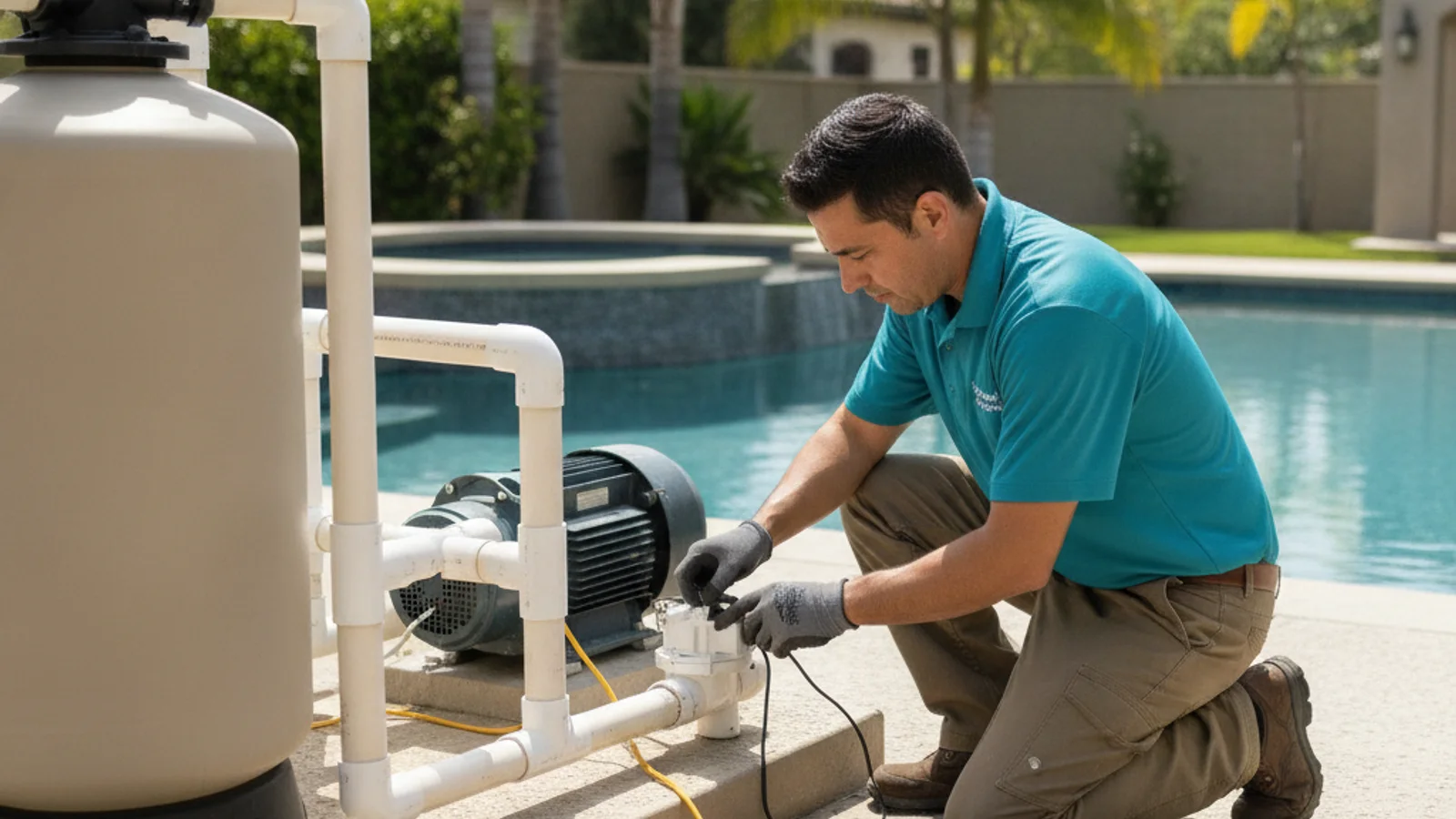
Pool actuator repair in San Diego is a valve-motor job, not a new control panel. The actuator is the 24-volt motor that turns a 3-way or 2-way diverter valve, often a Jandy-style or similar body on a pool and spa combo. When it clicks, sits still, or the spa will not switch over, the fault is usually that motor, the valve under it, or the wire from the panel.
Refresh Pool Pros connects San Diego County homeowners with licensed independent pool equipment specialists. We do not perform the physical work. This page is the motor on the valve. For the wall panel and the app, use the pool automation systems guide.
What a pool actuator is, and what it is not
A pool actuator is a small 24-volt motor bolted on top of a diverter valve. On a command from the automation system, it rotates the diverter so water goes to the pool, the spa, a water feature, or a heater bypass. It is not the control panel. It is not the pump. It is the motor that turns the valve.
Pentair, Jandy, and Hayward all sell valve actuators that mount on standard valve bodies. One published example is Pentair’s IntelliValve actuator, P/N 521485, used with a 2-inch 3-way valve, P/N 263026, in the MasterTemp automatic bypass kit. That kit is a heater-bypass use, not the only job an actuator does. Pool and spa combos and water features commonly use actuators to switch those valves. Do not treat every motor as interchangeable. The specialist matches the existing valve, voltage, and control system. This page does not publish a compatibility matrix.
If a handle used to turn that valve by hand, and an actuator now sits on the same body, you are looking at the right part. The panel still matters as the source of the 24-volt command. A dead panel is a different repair, and that diagnosis belongs on the automation guide linked above.
Clicking, mixed spa water, and a spa that will not switch
Clicking with no rotation often means the motor is trying against a stuck valve. The gears may still be intact. The diverter inside the valve is the thing that will not move. Keep hitting spa mode from the phone and you can strip those gears on the next try. Write down the sound, then stop commanding it.
Spa water mixing into the pool is a travel problem. The valve did not finish rotating, so both ports stay partly open. A spa that will not heat can be the same fault. Heaters need flow. If the diverter never arrives at spa, the spa heater never sees the water it needs. Do not start at a new heater when spa mode never completed.
A waterfall or deck jet that will not shut off is the feature-valve version of the same story. The motor clicked, the cams did not land, or the diverter froze mid-port.
Silence is a different clue. No click and no motion can be a dead motor, an open wire from the panel, or a command the panel never sent. If the pump, lights, and heater still obey the app, the panel is probably alive and this valve circuit is the one to test. If nothing on the pad responds, stop and use the automation guide.
Broken receiver or cams can also look like a valve that never lands. The motor turns, then never stops at the right port. The specialist checks those end-of-travel parts before ordering a second motor.
Gears, seized valves, and the wire from the panel
These are the failures that show up on San Diego pads:
- Stripped gears. The housing hums or clicks. The output shaft does not drive the diverter. That often follows a seized valve the motor kept fighting.
- Seized valve under the motor. Scale or debris locks the diverter. Replacing only the actuator leaves the next motor to die the same way.
- Broken receiver or cams. End-of-travel is wrong. The valve overshoots or never arrives.
- Wiring from the automation panel. A cut, corroded, or loose 24-volt pair leaves a good motor sitting still.
- A calcified valve body. Inland mineral load coats the diverter until it will not rotate even with a new motor on top.
Cutting power at the breaker before anyone removes an actuator is licensed work. Do not pull the motor off a live circuit to see if it spins. Confirm the specialist’s license on the CSLB license check before the cover comes off.
California Business and Professions Code section 7048, as amended effective January 1, 2026, exempts only casual minor work under $1,000 that needs no building permit. The exemption does not apply if the person advertises as a contractor or employs someone to do the work. Advertised actuator replacement belongs with a licensed pro.
Why inland scale and coastal salt air stall different parts
San Diego is not one equipment pad. Inland East County water in El Cajon, Santee, and Escondido is mineral-heavy. Scale builds inside the valve body and freezes the diverter. The actuator then clicks against a valve that will not turn. The repair may be the valve, not only the motor.
Coastal pads in La Jolla, Coronado, Imperial Beach, and Carlsbad take salt air. Corrosion hits the motor housing, the mounting screws, and the connector. Screws can seize so the actuator will not lift off the valve. Ask the specialist to treat seized screws as likely, instead of snapping a fastener and leaving a worse leak.
Pool and spa combos here run that switchover in every season. A stuck actuator shows up as a spa that will not open on a weeknight, not only in summer. A water feature on a timer does the same work on a different valve. That is a use pattern, not a published lifespan. A half-open valve still mixes spa water into the pool until the diverter finishes traveling.
What to record before calling
A short note beats a guess on the phone. Write down:
- Whether the actuator clicks, hums, or stays silent
- Whether the valve moved at all
- Whether spa water is mixing into the pool
- Whether the spa will not heat, or a feature will not shut off
- The brand and any model marks on the actuator and the valve body
- The automation brand on the panel, if you can read it
- Any message the panel showed about a valve
- Your city, because inland scale and coastal corrosion change the first inspection
Photograph the motor on the valve, the wiring as it sits, and the panel display. Do not disconnect wires to make the photo tidier. Do not force the handle with a wrench on a pressurized line. A snapped diverter is a bigger job than a motor swap.
Bring that list to the pool equipment specialist we match you with. The person who does the work quotes after seeing the pad. We do not.
What the quote should separate
There is no HomeGuide line for pool actuators, and this page does not invent a part price. The quote depends on whether the motor, the valve, or the control wire failed.
Ask for those as separate findings. A new actuator on a calcified valve is a repeat call. A new actuator on an open wire never moves. A valve-only repair on stripped gears leaves a motor that cannot drive the new diverter. The written scope should say which of the three was tested, and which one is being replaced.
If the proposal jumps to a full automation panel, ask what test ruled out the actuator, the valve, and the wire. Panel work is real, and it is a different page. Keep this job on the valve motor unless the specialist shows you a panel fault.
For a covered home improvement contract, California Business and Professions Code section 7159.5 says the downpayment shall not exceed $1,000 or 10 percent of the contract amount, whichever is less. On a larger job the cap is $1,000, not 10 percent of a big number.
If your actuator is clicking or the spa will not switch over, call Refresh Pool Pros at (858) 400-4598 and we’ll connect you with a licensed pool equipment specialist in our San Diego network.
Frequently asked questions
What is a pool actuator?
A pool actuator is a 24-volt motor that turns a 3-way or 2-way diverter valve, usually a Jandy-style or similar valve body. It is not the automation panel. Pentair, Jandy, and Hayward all sell actuators that mount on standard valve bodies, and the specialist matches the existing valve, voltage, and control system.
Why does my pool actuator click but not turn?
Clicking with no rotation often means the motor is trying against a stuck valve. Inland scale can freeze the diverter inside the valve body. Stop commanding spa mode from the app and have a licensed specialist check the valve under the motor before anyone swaps the actuator.
Why will my spa not switch over from the pool?
Spa water mixing into the pool, or a spa that will not heat, can be a valve that did not finish traveling. The actuator, the cams, or the wire from the panel can leave the diverter half open. That is a valve-motor diagnosis first, not an automatic new heater.
How much does pool actuator repair cost in San Diego?
There is no published HomeGuide line for actuators, and this page does not invent a part price. The quote depends on whether the motor, the valve, or the control wire failed. The matched independent pro prices the job after seeing the pad.
Should the automation panel be replaced when an actuator fails?
Usually no. A stuck or clicking actuator is the valve motor, a seized valve, or a control wire. Replace the panel only if a specialist shows a panel fault. Whole-system questions belong on the pool automation systems guide, not on this valve-motor page.
Need professional help in San Diego County?
Refresh Pool Pros connects you with a licensed specialist for any service in this post.