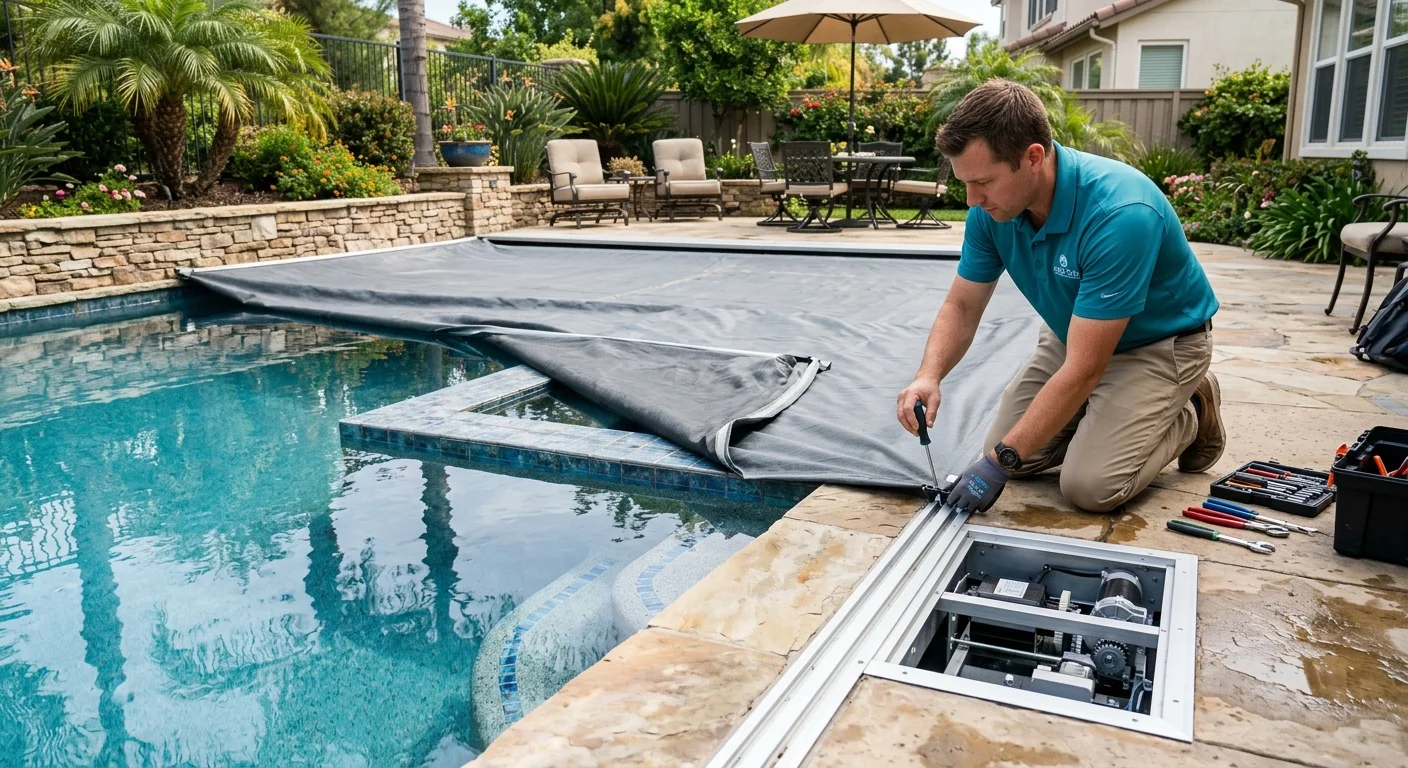
A stuck, torn, or uneven cover needs the right diagnosis before parts get ordered. Pool cover repair in San Diego is that diagnosis on an existing automatic, safety, or solar cover. It is not a new-cover installation quote. First identify the cover type and stop forcing any mechanism that’s binding.
Automatic covers, anchored safety covers, and solar covers fail differently. A local specialist can inspect the fabric, hardware, controls, and surrounding deck before recommending repair or replacement.
The three cover types and what fails on each
An automatic cover moves through tracks using a powered drive mechanism. Its trouble may appear as uneven movement, loose fabric, a stalled edge, unusual noise, or controls that don’t produce movement. Those symptoms can come from several connected parts, so replacing the first suspicious component may not solve the problem.
An anchored safety cover stretches across the pool and connects to deck anchors with straps and hardware. Look for torn panels, loose stitching, damaged straps, missing hardware, or anchors that no longer sit correctly. Fit matters too. A panel that has shifted or lost its intended shape needs more than a cosmetic patch.
Solar covers are lighter and usually move by hand or with a reel. Common concerns include torn material, a cover pulling away from its reel attachments, bent reel parts, and hardware that won’t turn smoothly. The repair decision often centers on whether the damage is confined to the reel or spread throughout the cover.
San Diego’s varied pool settings can change what an inspection finds. A coastal yard in Encinitas or Point Loma may expose hardware to salt film and grit. An inland yard around Poway or El Cajon may collect dry dust around tracks and housings. Photos of the cover, equipment label, deck edge, and failed area help the specialist see the actual setup.
These categories aren’t interchangeable. Confirm the cover’s intended use, model, and manufacturer instructions before approving a repair.
Automatic cover tracks, ropes, and the motor
Automatic cover problems often involve more than the visible fabric. The specialist should inspect both tracks, the cover’s alignment, the leading edge, ropes or cables, pulleys, drive components, controls, and housing. Terminology differs by manufacturer, so the model label matters.
A cover that moves farther on one side may have uneven resistance or a problem within the pulling system. A cover that starts and stops can also have several possible causes. Debris in a track, a displaced component, tangled material, or a control fault may produce overlapping symptoms.
Don’t keep cycling a binding cover to see whether it clears itself. Record what happened before it stopped. Note whether the problem began while opening or closing, whether one side moved first, and whether the motor or mechanism made a sound. Those details can shorten the diagnostic process without guessing at the failed part.
The specialist should also inspect the housing and nearby deck. A damaged lid, loose mounting point, or altered deck edge can affect how the system sits. Broader deck or pool concerns may call for pool repair support beyond the cover mechanism.
Motor and control work may overlap with pool equipment installation and upgrades. If the cover controls sit near a larger control panel, our San Diego pool automation guide can help you separate cover controls from other pool functions.
Before signing a contract, check the contractor through the official CSLB license lookup. Confirm that the name and license details match the written proposal.
Safety cover straps, anchors, and torn panels
A safety cover is meant to function as a drowning-prevention feature. Treat torn fabric, failed straps, damaged stitching, missing anchors, or a poor fit as more than an appearance issue. Keep access controlled while its condition is being evaluated.
Start by checking the entire perimeter. One visible tear may not be the only concern. Compare the tension at each strap, look for stretched attachment points, and note anchors that are loose, tilted, stuck, or missing. Don’t assume a generic fabric patch restores the cover’s intended performance.
Ask the specialist to identify the manufacturer and model when possible. The maker’s instructions may specify approved panels, patches, straps, springs, or other hardware. If identification is missing, request a written explanation of the proposed repair and how its compatibility was determined.
California law requires at least two of seven drowning-prevention safety features when a permit is issued for pool construction or remodeling at a private single-family home. That isn’t a blanket retrofit rule for every existing pool. The complete list and project applicability should be checked in the current California statute and with the building department serving the property.
Don’t assume one cover repair resolves every permit or safety question. For a permitted remodel in San Diego, Chula Vista, Oceanside, or another county city, ask the local building department which documents and inspections apply to that address.
Solar covers and reels
Solar-cover repairs usually center on the material, reel, attachment points, or supporting hardware. Begin by separating a cover problem from a reel problem. Material that has torn away from sound reel hardware presents a different decision than a bent tube or a stand that shifts during use.
Inspect the full cover while it’s spread flat. Look for splits, thinning areas, damaged edges, and attachment points pulling through the material. A small isolated opening may have a manufacturer-approved repair method. Damage across several areas can signal that patching one spot won’t address the cover’s overall condition.
Next, inspect the reel without forcing it. Note whether the tube turns evenly, the stands remain stable, and the straps wind without crossing or bunching. Confirm that fasteners are present and that the reel hasn’t shifted relative to the pool. Take clear photos before moving loose components.
The pool’s shape and deck layout matter. A rectangular pool with open deck access creates a different setup from a freeform pool, raised spa, narrow side yard, or deck interrupted by steps. San Diego County has all of these configurations, from compact central-city yards to larger inland properties.
Treat a solar cover according to its manufacturer-stated purpose and ratings. Don’t assume it provides the same function as an anchored safety cover. If the label is unreadable, ask the manufacturer or a cover specialist to identify the product before relying on it for anything beyond its documented use.
When a repair is not worth it
A repair makes the strongest case when damage is isolated, compatible parts remain available, and the rest of the system is in sound condition. Replacement deserves consideration when several parts are failing or the repair would leave another obvious weak point untouched.
For an automatic cover, that may mean fabric damage combined with track trouble, worn pulling components, and a damaged housing. It can also mean the original system can’t be identified or supported with matching parts. Ask for separate written options when both repair and replacement remain possible.
For an anchored safety cover, look beyond the largest tear. Widespread stitching trouble, several damaged straps, failing attachment areas, or a cover that no longer fits correctly can change the decision. If coping, decking, steps, or the pool shape changed during a remodel, the old cover may no longer match the current opening.
Solar covers call for the same whole-system view. Replacing reel straps won’t resolve material that’s failing across the panel. Replacing the cover alone may not help if the reel is bent, unstable, or poorly positioned for the pool.
No verified standard price applies to every San Diego cover repair. Cover type, manufacturer, dimensions, access, failed components, and material condition all shape the quote. Ask the specialist to identify the cause, list proposed parts, separate repair from replacement, and explain what remains unchanged.
Also request the matched pro’s warranty terms in writing. Refresh Pool Pros doesn’t perform or warranty the physical work. Warranty coverage comes from the independent specialist and should appear in that specialist’s proposal.
When to call us
Call when an automatic cover binds, a safety cover loses its fit, or damaged hardware makes the next step unclear. A licensed local pool specialist can inspect the complete system and explain the available options.
Call us at (858) 400-4598 and we’ll connect you with a licensed local pool specialist.
Frequently asked questions
What usually breaks on an automatic pool cover?
Common problem areas include the track, ropes or cables, pulleys, drive mechanism, controls, and cover fabric. A specialist should inspect the full system before recommending a repair.
Can a torn safety cover be repaired?
Some localized damage may have a manufacturer-approved repair. Widespread tears, damaged stitching, poor fit, or failing hardware can make replacement the better option.
Does a stuck automatic cover always need a new motor?
No. Track resistance, tangled ropes, pulley trouble, control faults, or drive mechanism problems can produce similar symptoms. The cause should be diagnosed before parts are ordered.
How much does pool cover repair cost in San Diego?
No verified standard rate applies to every cover. The type, manufacturer, dimensions, access, failed parts, and fabric condition all affect the quote.
Need professional help in San Diego County?
Refresh Pool Pros connects you with a licensed specialist for any service in this post.