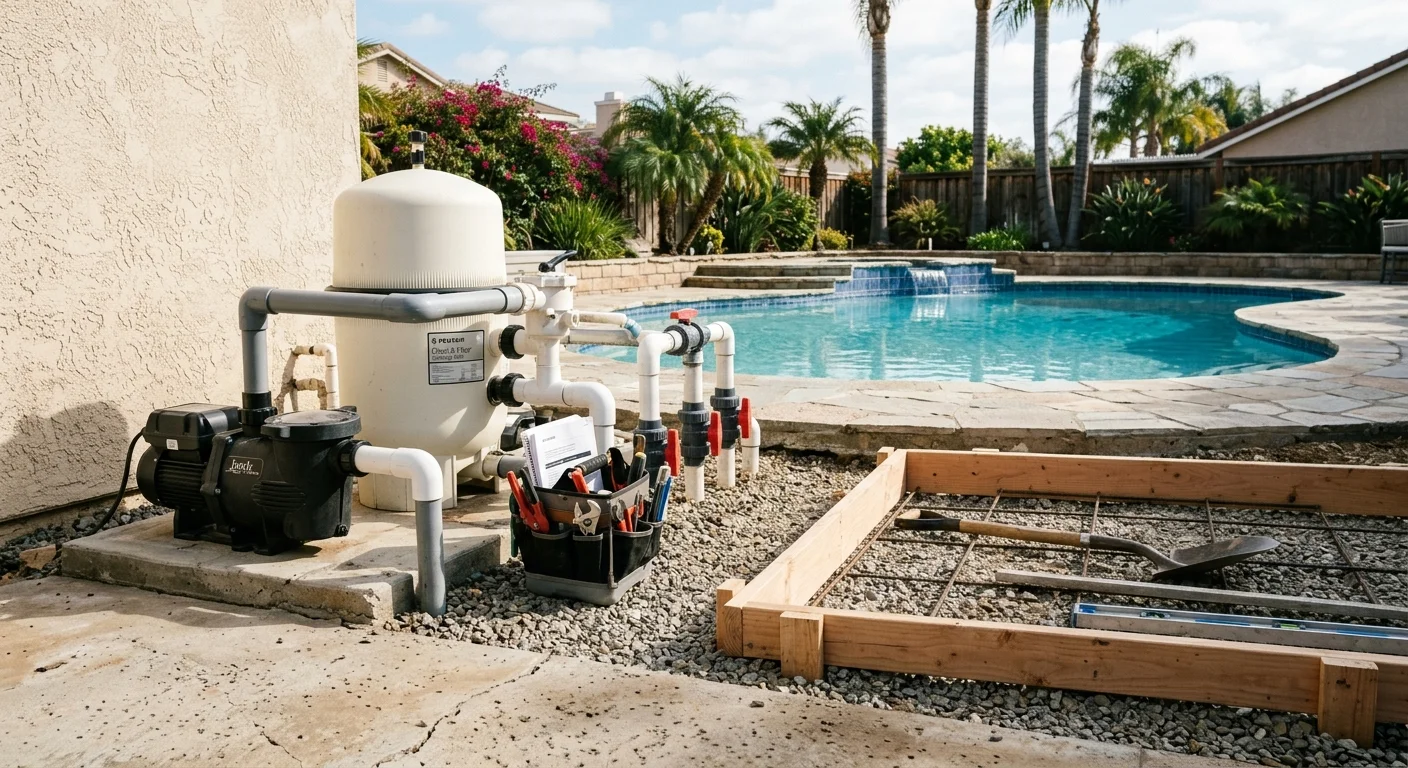
A noisy pump under a bedroom window, a new ADU eating the side yard, or standing water around a heater can make the original slab unusable. Relocating the pad is the real job. The licensed specialist you get matched with has to move the slab, the pipe, and often the gas and electric, then prove the pool still circulates. That’s moving pool equipment in San Diego, and it isn’t a same-spot swap.
Why a pad gets moved, not just re-plumbed
Plenty of San Diego pads sit where the original builder left them: against a fence in Clairemont, in a Chula Vista side yard, or down a canyon stair in La Jolla or Spring Valley. That spot worked in 1985. It fails when you add a kitchen, a casita, or a bedroom on that wall.
Re-plumbing in place only helps if the pad is still the right place. If the heater is boxed in, the filter lid hits a new wall, or irrigation ponds on the slab, sliding unions a few feet won’t fix it. The gear has to sit where it can drain, vent, and get serviced.
Coastal lots in Encinitas and Carlsbad often tuck equipment next to the house for wind. Inland pads in El Cajon and Lakeside sit in full sun, with more heat, more dust, and longer pump runs. South Bay yards in National City and San Ysidro share the pad with a gate and a water heater. East County heat and a tight coastal side yard don’t take the same layout.
Homeowners relocate a pool equipment pad when the yard is changing, when the pump hums through a bedroom wall, or when the slab holds water. If a specialist can’t pull a motor or open a filter without climbing a fence, the pad is wrong. Heater and electrical clearances can also kill a location that still runs. Our pool equipment pad layout guide is the place to read drainage and space before anyone pours a new slab.
A re-pipe that leaves the gear in a bad spot just moves the failure. The pad move starts with a location that works. The plumbing follows.
Gas, electric, and setbacks a pro has to check
A pad move is rarely pool pipe only. Most San Diego systems have a gas heater, a dedicated circuit, bonding, and a control box. Those trades are licensed. The pool specialist you get matched with coordinates them and doesn’t guess at distances.
The heater’s gas line, shutoff, and venting have to work at the new spot. Extending or relocating gas is licensed gas work. If you smell gas during planning or demo, leave the area and call SDG&E. A capped stub isn’t finished until a licensed gas fitter says it is.
Pumps, heaters, salt systems, and timers need a legal disconnect, bonding, and fittings rated for a wet pad. Relocating a circuit is licensed electrical work. A junction box that came with the house still has to be legal at the new pad.
Heater makers publish clearance to walls, windows, and combustibles. Cities and the county add rules for equipment near property lines and bedrooms. A specific setback distance for every San Diego lot couldn’t be confirmed from the sources this site uses. The licensed pro checks the manufacturer’s instructions and the building department for your address. Inside the city that’s Development Services. Unincorporated areas such as Lakeside, Alpine, Ramona, and Spring Valley go through County Planning & Development Services. Chula Vista, Oceanside, El Cajon, and other cities run their own counters.
HOAs in Carmel Valley, 4S Ranch, and coastal condos can add screening and noise rules. Those are private. They still change where a pad can sit.
That’s why this job isn’t a clean equipment install on a ready pad. Install assumes the location is already legal. Relocation has to prove the new location first.
What happens to existing plumbing during a move
The old suction and return lines were sized for the old pad. Move the pad and those runs change length, depth, and sometimes height.
The system is shut down and isolated. Unions come apart. Lines are cut, capped, or abandoned in place so they can’t siphon or leak under the yard. New pipe is run to the new slab with unions, valves, and a place to prime. The filter drain or backwash line has to land somewhere legal, not in a neighbor’s yard and not in a dish on the new pad.
Suction lift matters. If the new pad sits higher than the old one, or farther from the skimmer and main drain, the pump may not prime. That’s a layout issue. A licensed specialist measures the new run and the elevation before anyone orders pipe.
Longer pipe adds friction. A pad that moves from a Clairemont side yard to the back corner of a deep lot can add fittings the original pump was never sized for. The pro should say whether the existing pump and filter can still move the water, or whether the move is the moment to change equipment. Keep that conversation inside pool equipment installation and upgrades, not as a surprise at the end.
Ask for a sketch of abandoned lines. Future leak work is ugly when a dead pipe is still wet under a Point Loma deck or a Mission Hills slope. Don’t cut a live suction line yourself. A bad joint can empty the pool into the hillside.
Permits when the equipment changes location
Whether a given pad move needs a building, electrical, or plumbing permit in San Diego County couldn’t be confirmed as one countywide rule. The city or county that covers your address is the authority. Ask that building department before work starts.
City of San Diego Development Services covers most of the city proper, including Pacific Beach, North Park, Clairemont, and Otay Mesa. Unincorporated communities go through the County of San Diego. Chula Vista, El Cajon, Oceanside, Escondido, and Carlsbad each have their own permit desk. A rule you heard for Encinitas may not be the rule in El Cajon.
Gas and electrical relocations are the items departments most often want to see. A new slab can trigger inspection too. Have the licensed pro name who is pulling what, and keep a copy of anything the city or county issues.
California contractor law still applies. Work is exempt from a contractor license only when the total for labor, materials, and everything else is under $1,000, the work is casual and minor, and no building permit is required. Both the dollar cap and the no-permit condition have to be true. The cap is $1,000 as of January 1, 2026. Splitting a pad move into smaller invoices to dodge licensing isn’t allowed. Acting as a contractor without a license is a misdemeanor unless an exemption applies. Confirm a license on the CSLB license lookup before anyone breaks a union.
If the job is a home improvement contract, the down payment can’t exceed $1,000 or 10 percent of the contract, whichever is less. On a large relocation, that cap is $1,000.
We match you with a licensed local specialist. We don’t pull the permit, and we don’t do the physical work.
Questions to ask before a pro relocates the pad
Bring these to the site visit. Write the answers down.
Where will the new pad sit, and how does it drain. Short, hard San Diego rains still flood a dished slab. Inland heat in El Cajon and Santee will cook a pad with no airflow. Coastal salt air in Point Loma and Imperial Beach is harder on cabinets and heaters.
Who handles gas and electric, by license name. Who pulls the permit if the building department requires one, and whose name is on it. What happens to the old slab and the old pipe.
Will the existing equipment move as-is, or is this the week you also replace a pump, filter, or heater. Relocating the pad is a different job from a replacement. Keep the scopes separate on the bid.
How long the work takes once a pro is on site, and how the pool sits while the lines are open. How the new run changes prime and flow, in plain feet of pipe and elevation.
Ask for a simple layout: room to open the filter, room to service the pump, and a path that doesn’t block the only gate. Then check the license yourself on the CSLB site.
When to call us
Call when the pad has to move, not when you only need a union tightened. A remodel, a wet slab, a heater that no longer has clearance, or a pump you can hear from the bedroom are the usual triggers. Call us at (858) 400-4598 and we’ll connect you with a licensed local pool specialist.
Frequently asked questions
Can the same pump and filter move with the pad?
Often yes, if the new pipe run and elevation still suit them. A licensed specialist should measure both before anyone assumes a reuse. If the pad move adds a long run or a big lift, the existing pump may not prime or may not move enough water.
Does moving pool equipment in San Diego always need a permit?
A single countywide rule could not be confirmed. Ask the building department for your address: City of San Diego Development Services inside the city, County Planning and Development Services in unincorporated areas, or your city counter in places such as Chula Vista, Oceanside, or El Cajon. Gas and electrical relocations are the items departments most often review.
Who handles the gas and electrical work on a pad move?
Licensed gas and electrical trades. Pool equipment relocation often includes a heater line, a circuit, bonding, and a disconnect. Ask the pool specialist you get matched with which licensed trades will be on the job, and confirm licenses on the CSLB site.
Is relocating a pad the same as installing new equipment?
No. Relocation is moving the slab and the utilities to a new legal location. Installation is setting equipment on a pad that is already the right place. They can happen in the same project, but they are different scopes and should be written that way on the bid.
Can I relocate a pool equipment pad myself?
Treat this as licensed construction. Work is exempt from a contractor license only when the total is under $1,000, the work is casual and minor, and no building permit is required. Both conditions have to be true. Cutting live pool lines, extending gas, or moving electrical isn't weekend work. Confirm a license on the CSLB lookup before anyone starts.
Need professional help in San Diego County?
Refresh Pool Pros connects you with a licensed specialist for any service in this post.