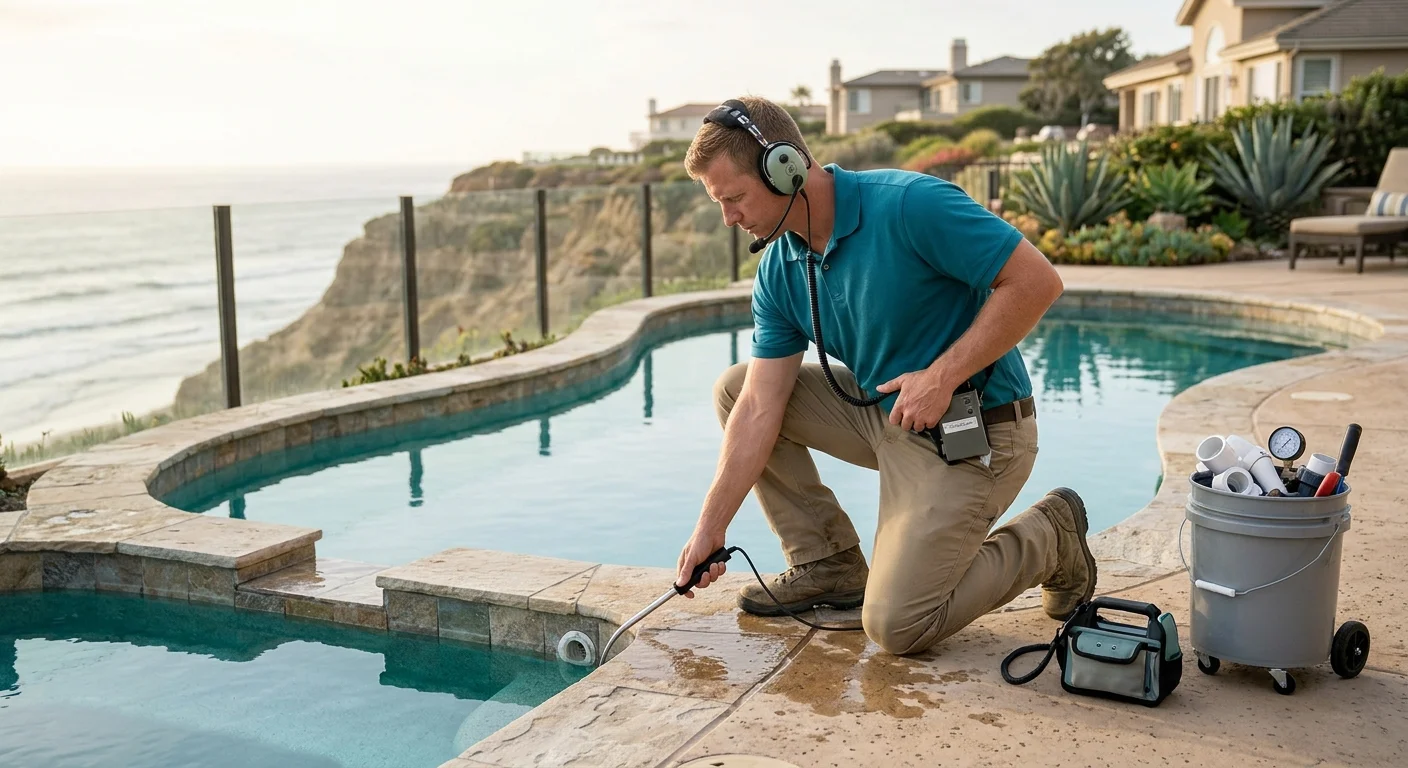
A waterline that drops on a Tamarack or Terramar pool during May gray still points to a real leak. The marine layer sits over Agua Hedionda and Batiquitos. Mornings stay cool and wet. The shell still loses water. Pool leak detection in Carlsbad is how a licensed specialist separates that loss from weather, then marks the fitting, line, or crack that is actually open.
Salt air, marine layer, and a real leak
Coastal north county weather fools a lot of homeowners. East County heat bakes water off a pool in a hurry. Carlsbad works differently. From the Village west of I-5 through Aviara and La Costa, the Pacific marine layer can sit for days in late spring. Skies stay gray. The deck stays cool. Evaporation still happens. It happens slower than it does in El Cajon.
When the auto-fill keeps running, or you add water by hose every few days, treat that as a leak signal. A bucket test gives you a baseline before you book pool leak testing in Carlsbad. Fill a bucket with pool water. Set it on a step. Mark the level inside the bucket and on the tile. Check both marks the next day with the pump on. Check again with the pump off if you can leave it down that long. If the pool drops more than the bucket, the loss is leaving the system. That is the moment to match with a licensed specialist.
Salt air is the other local load. Pads in Terramar, Carlsbad Village, and along Carlsbad Boulevard take more salt than pads in Bressi Ranch or Rancho Carrillo. Unions weep. Heater cabinets rust. Pump lids warp. A wet pad can be a fitting leak, a cracked filter tank, or spray from a tired lid o-ring. Those are still leaks. They waste water the San Diego County Water Authority asks the region to protect. They also pull air into a suction line and chew up a pump.
A licensed pro reads that climate with the equipment. They treat a Carlsbad pool as a coastal north county pool. Cool nights, salt on metal, and a marine layer that hides evaporation are the starting facts for swimming pool leak detection in north county. The full method behind those tests is the same toolkit. The weather that sends you looking is local.
Watch the waterline against a tile grout line you can photograph. Watch whether the drop stops at the skimmer mouth or the light. Watch the yard after a dry week for a sour strip of grass beside the bond beam or the pad. Those notes save the specialist time on site. They do not replace the visit.
Where north county coastal pools usually lose water
Most Carlsbad pool leak calls start at a penetration, not a dramatic crack down the floor. Skimmer throats open where the throat meets the shell. Return fittings weep behind the escutcheon. Light niches fail at the cord gland or the niche rim. Water falls to that height and then seems to stabilize, because the hole is now above the waterline.
The equipment pad is the next place. Stand at the pad after the pump has been running. Look for drip at the pump lid, the unions, the filter tank clamp, the heater headers, and the salt cell if you have one. Coastal pads west of I-5 show that wear earlier. Inland pads in Calavera Hills and La Costa still get it. They just get more of it from heat and age than from salt spray.
Underground PVC is the find people fear, and it is real. Lines run from the skimmer and main drain to the pad, then back to the returns. A break near a 90-degree elbow, under a control joint, or beside the pad will wet the soil and never show a puddle on the deck. Listening gear and pressure tests are how a specialist marks that run before anyone talks about cutting concrete.
Spas tied to the pool add another circuit. A shared spa on an Aviara or La Costa lot can lose water through the spa jet bodies, the spillway, or the valves that isolate the spa. A Carlsbad Village pool with a later spa add-on often leaks at the tie-in. Tell the specialist if the spa and pool share a wall. That changes the order of the tests.
Negative edges, sheer descents, and boulder waterfalls show up on some lagoon-view lots and on HOA amenity pools. Those features have their own troughs and catch basins. A leak there can look like a shell leak from the main pool. The specialist treats the feature as its own system.
None of this is a diagnosis from a photo. It is the map a north county pro walks so they do not skip a cheap fitting leak and go straight to the deck saw.
What a leak detection visit actually includes
A detection visit is a sequence. It is not a glance over the fence. The specialist you get matched with should be able to tell you, before they arrive, which tests they bring.
They start with your notes and a look at the waterline, the tile, the coping, and the deck. They look at the pad with the pump on. They look at it with the pump off. Air in the returns, a pump that loses prime, or a wet ring at a union already points to a suction or pressure-side plumbing leak.
Then they isolate lines and pressure-test them. Suction and return runs get tested one at a time so a failing skimmer line does not get blamed on a return. A gauge that will not hold is a plumbing leak on that run. A gauge that holds sends the search back to the shell and the fittings.
Dye testing is the in-water pass. Food-grade or commercial leak dye at a skimmer throat, a return, a light, a step seam, or a hairline in the plaster shows whether water is leaving at that spot. It is slow, close work. It is how a specialist confirms a fitting leak without opening the deck.
If the lines fail a pressure test and the leak is under hardscape, they use listening gear: a hydrophone in the water or a ground microphone on the deck. The point is to mark a small area before anyone cuts. Ask how they pinpoint an underground break. Ask whether they will write down the location, the test that found it, and what happens if a second leak shows up after the first repair.
A diver is sometimes part of the visit on a deep or dark plaster pool. It is not always required. Pressure tests and dye still do most of the locating.
Bring a clear photo of the auto-fill, the recent water bills if they jumped, and any wet spots in the yard. Confirm the specialist’s license on the CSLB license lookup before the visit. Refresh Pool Pros matches you with a licensed local pro. We do not send a truck of our own, and we do not perform the tests.
If anyone talks about draining the pool so they can “see the crack better,” pause. Most pool leak testing in Carlsbad is done with water in the shell. A City of Carlsbad rule that tells a homeowner exactly how to drain a residential pool into the sewer or the storm system could not be confirmed for this page. Call the City of Carlsbad and the water district named on your bill before anyone opens a drain valve.
Older Carlsbad shells versus newer HOA pads
Olde Carlsbad, the Barrio, and the older Village lots carry gunite shells from an earlier building wave. Original skimmers, original light niches, and original returns have had decades of movement, tile work, and acid washing. Hairlines at the steps and in the corners show up here. So do skimmer throats that were never rebuilt when the plaster was done last. The specialist spends more time in the water on these pools, dye bottle in hand.
La Costa, Aviara, Bressi Ranch, and Rancho Carrillo read as a different stock. Many private yards there have newer plaster, tighter equipment pads, and automation. HOA amenity pools in those neighborhoods add shared spas, more valves, and equipment packed into a side-yard closet. A leak on an HOA pad can be a union you can see. It can also be a buried line under a stamped deck the association will want a plan for before anyone cuts.
West of I-5, salt and damp are the aging agents. East of El Camino Real, you still have marine layer, plus more heat on the plaster in the afternoon. That split matters for how fast a small fitting leak becomes a wet yard. It does not change the tests. It changes what the specialist expects to find first.
If the pool sits on a slope toward a lagoon or a canyon, say so when you book. Hillside lots in Carlsbad can show deck movement and soil that stays wet below the bond beam. The specialist still has to prove the leak. They should not skip the pressure tests because the lot looks dramatic.
Housing era is a clue, not a diagnosis. An older Village gunite pool and a 1990s Aviara pool can share a failed return fitting. The older shell is simply more likely to add a second problem at the skimmer or the light. That is why a full pass beats a single dye squirt at the crack you can see from the patio.
For work after the find, the repair path on these two stocks often diverges. That is covered in our Carlsbad pool repair guide. Detection comes first. Repair quotes come after the mark is on the deck.
Repair after the leak is found, without a price
Finding the leak is one job. Closing it is another. A fitting, a lid o-ring, or a union may be a short repair once it is marked. A buried PVC break, a skimmer rebuild, or a structural crack in the shell is a longer one. The specialist prices the repair after they know which of those they are looking at. This page publishes no price list, and Refresh Pool Pros does not quote the work.
Ask what the repair actually is. A cut in the deck, a reroute of a line, a skimmer throat rebuild, and a plaster patch are different jobs. Ask whether the City of Carlsbad will want a permit for the repair they recommend. That permit trigger was not confirmed here as a single published number, so the licensed contractor on the job is the person who checks with the city.
If the contract is a home improvement contract, California caps the downpayment at $1,000 or 10 percent of the contract amount, whichever is less. On a larger repair that cap is $1,000. Confirm the contractor on the CSLB lookup. Work at or above $1,000, or work that needs a permit, is not casual handywork. Unlicensed contracting is a misdemeanor under California law.
Do not replaster over an active leak. Do not ignore a suction leak because the waterline “only drops when the pump runs.” A suction leak that pulls air will take out a pump. A shell leak that wets the soil can lift or settle a deck. The detection visit is how you stop guessing which of those you have.
Once the repair is done, the same specialist should verify the waterline. A second leak can sit behind the first. That is a fair question to ask before anyone leaves: what happens if the pool is still losing water after this fix.
When to call us
Call when a Carlsbad pool loses water through the marine layer, when the bucket test shows the pool dropping faster than the bucket, or when the yard or pad stays wet. That is licensed detection and repair work, and it belongs with a local pool specialist. Call us at (858) 400-4598 and we’ll connect you with a licensed local pool specialist.
Frequently asked questions
How do I tell evaporation from a Carlsbad pool leak?
Run a bucket test for a day with pool water in the bucket, marks on the bucket and the tile, and a note of whether the pump was on or off. If the pool drops more than the bucket, treat it as a leak and match with a licensed specialist for pool leak testing in Carlsbad. Marine-layer days still lose some water to air, so the comparison is the useful part.
What does swimming pool leak detection in north county include?
A typical visit covers a visual pass of the shell, skimmers, lights, returns, and equipment pad, then pressure testing of isolated lines, dye at fittings and cracks, and listening gear if a line may be under the deck. Ask the specialist which of those tests are in the visit and whether they put the finding in writing before anyone cuts concrete.
Do I have to drain a Carlsbad pool before leak testing?
Most detection work happens with water in the pool. Dye, pressure tests, and listening gear all need a working waterline. A full drain is a separate decision. A City of Carlsbad rule for draining a residential pool into the sewer or storm system could not be confirmed for this page, so call the city and the water district printed on your bill before anyone opens a drain.
Who repairs the leak after it is found?
The licensed pool specialist who locates it, or another licensed contractor they recommend for that repair. Refresh Pool Pros matches you with that pro and does not perform the work. Confirm the license on the CSLB lookup before you sign, and ask for a quote on the actual repair after the leak is marked.
Where do Carlsbad pools usually leak?
On coastal north county pads the usual finds are skimmer throats, return fittings, light niches, pump lids and unions, and PVC under the deck near the equipment. Older Olde Carlsbad gunite and newer Aviara or La Costa HOA pools fail in different spots, which is why the specialist tests the whole system instead of chasing one wet patch.
Need professional help in San Diego County?
Refresh Pool Pros connects you with a licensed specialist for any service in this post.