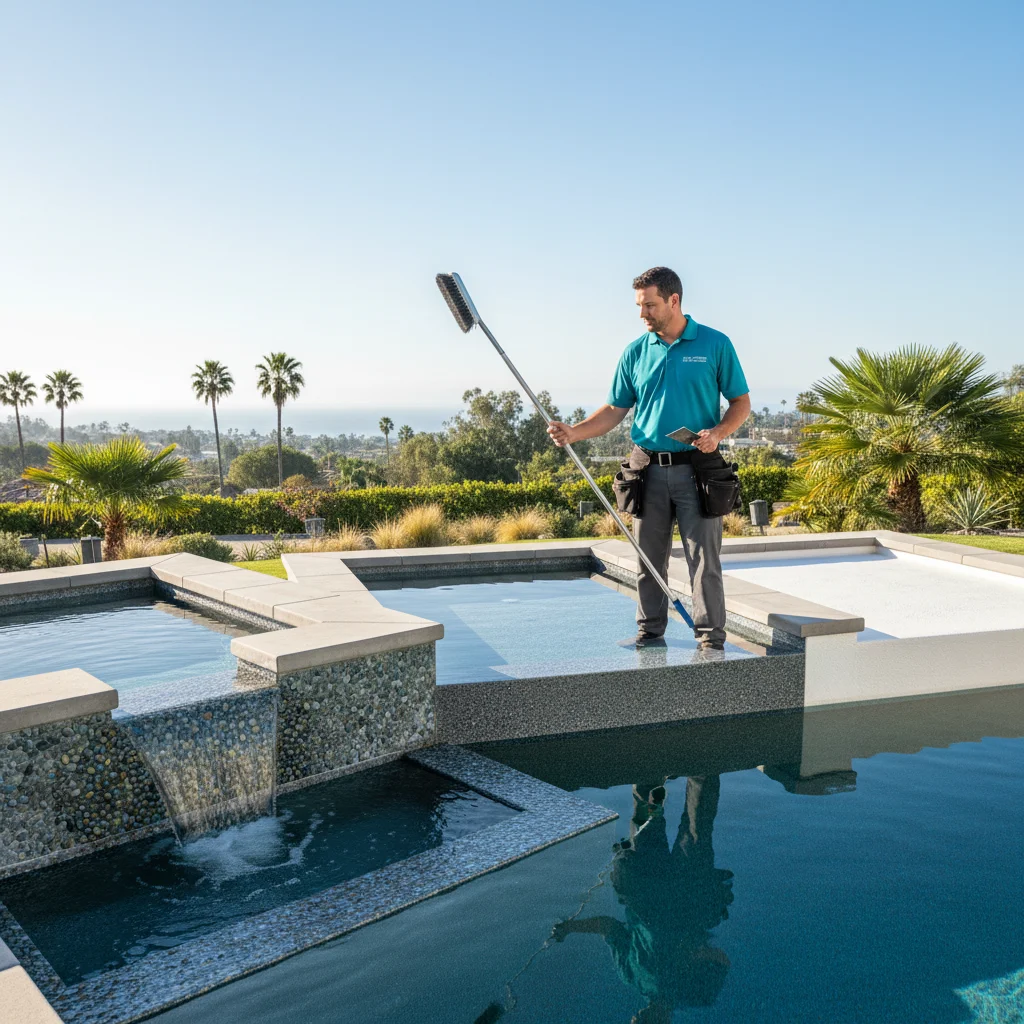
Plaster costs less to install than pebble, and that’s the number most homeowners compare first. But priced over a single install, plaster and pebble aren’t actually being compared on equal terms, because plaster in San Diego’s hard water usually needs resurfacing again within 7 to 12 years, while pebble commonly runs 15 to 25 years on the same pool. Run the math across a full 20-year ownership window instead of one project, and the finish that looked cheaper upfront can end up costing more.
Refresh Pool Pros connects San Diego homeowners with vetted resurfacing specialists who quote plaster, quartz, and pebble side by side. This guide runs the real 20-year numbers so the decision isn’t just about which quote looks smaller today.
How long each finish actually lasts in San Diego’s water
Standard plaster typically lasts 7 to 12 years before it needs to be redone, and San Diego’s hard water tends to push that toward the lower end. Much of the county runs on moderate to hard water, and the calcium in it etches and stains plaster faster than it would in a softer-water region, which is why plaster pools in harder-water zones around East County and parts of North County Inland often need attention closer to year 7 or 8 than year 12.
Quartz, which blends ground quartz aggregate into the plaster mix, holds up better against that same hard water and typically lasts 10 to 15 years. Pebble finishes go furthest, commonly running 15 to 25 years, since the aggregate surface resists the etching and staining that wears down a smooth plaster or quartz finish over time. Actual lifespan for any of the three still depends on water balance and how consistently the pool gets serviced, but the order holds across San Diego pools: plaster shortest, quartz in the middle, pebble longest.
What each finish costs to install
For a standard San Diego pool, plaster resurfacing runs $6,500 to $9,500 per job. Quartz runs $8,500 to $12,500. Pebble runs $10,500 to $16,000. Larger pools, pools with more steps and benches, or pools with a spa attached land toward the top of each range, since more surface area means more material and more labor regardless of which finish you pick.
Looked at as a single transaction, plaster is clearly the cheapest way to get a pool resurfaced. The real comparison, though, isn’t one job against one job. It’s how many times you’re likely to pay that price over the years you actually own the pool.
Running the 20-year math
A plaster pool in San Diego’s hard water realistically gets resurfaced twice in 20 years, once around year 8 to 10 and again around year 16 to 18. At $6,500 to $9,500 per job, that’s a total of roughly $13,000 to $19,000 across the two cycles.
A pebble pool installed once at $10,500 to $16,000 typically makes it the full 20 years without needing a second resurface, since its 15 to 25 year lifespan covers or nearly covers the whole window. Even at pebble’s highest price point, a single $16,000 install can come in under plaster’s two-cycle total, and at the lower end of each range, pebble’s $10,500 one-time cost beats plaster’s $13,000 two-cycle total outright.
Quartz falls into an odd spot in this math. At a 10 to 15 year lifespan, most quartz pools still need a second resurface within 20 years, just later than plaster would. Two quartz cycles at $8,500 to $12,500 each land around $17,000 to $25,000 total, which can end up costing more than either plaster’s two cycles or pebble’s one, despite quartz sitting in the middle on upfront price.
Why plaster’s total cost sneaks up on you
The install price is only part of what repeats. Every resurfacing job, regardless of finish, starts with draining the pool and acid-washing the old shell to prep it for bonding. That’s real labor and downtime that gets billed again each time the pool gets redone, on top of the finish material itself. A homeowner comparing a single plaster quote against a single pebble quote sees a clear price gap in plaster’s favor, but that comparison quietly leaves out the second drain-and-prep cycle that plaster’s shorter lifespan makes likely.
Quartz: worth it, or a detour?
Quartz is a genuine upgrade over plaster in texture, color depth, and resistance to the etching that hard water causes, and for homeowners who want something better than plain white plaster without going all the way to pebble, it’s a reasonable middle choice. Where it doesn’t clearly win is the cost math. Because quartz still often needs a second resurfacing within a 20-year window, its total cost of ownership can land close to or above pebble’s one-time price, without matching pebble’s longer runway. Quartz is best chosen for how it looks and feels, not as a way to save money over the long run.
Which finish wins over 20 years (and the catch)
For anyone planning to own the home 15 years or longer, pebble comes out ahead on total cost despite having the highest install price, because it’s the finish most likely to make it through the full window on a single job. Plaster wins on a different measure: the smallest check written today. If you’re planning to sell within 5 to 8 years, or the upfront number matters more right now than what happens a decade out, plaster still makes sense, since you likely won’t be the one paying for the second cycle. The math favors pebble. The cash-flow reality of a specific household sometimes favors plaster anyway, and that’s a legitimate call to make with eyes open.
Refresh Pool Pros connects San Diego homeowners with vetted pool resurfacing specialists who quote plaster, quartz, and pebble against your actual pool rather than a generic price sheet. If you’re still weighing the finishes beyond cost alone, our fiberglass vs. plaster vs. pebble guide covers the full tradeoffs, and how long does pool resurfacing last breaks down lifespan expectations in more detail. For the base numbers on a single resurfacing job before running your own 20-year math, see our pool resurfacing cost guide.
Frequently asked questions
Which pool finish is cheapest over 20 years?
Pebble usually wins on total cost even though it has the highest sticker price. Standard plaster in San Diego’s hard water often needs resurfacing twice within 20 years, landing around $13,000 to $19,000 total, while pebble typically needs only one install at $10,500 to $16,000 across the same window. The upfront gap narrows fast once a second plaster job enters the math.
How much does plaster resurfacing cost compared to pebble?
A single plaster resurfacing job runs $6,500 to $9,500 for a standard San Diego pool, compared to $10,500 to $16,000 for pebble. Quartz sits in between at $8,500 to $12,500. Plaster’s lower price per job is real, but it’s a price you’re likely paying more than once over 20 years of ownership.
Does San Diego’s hard water shorten plaster life?
Yes. Much of San Diego County runs on moderate to hard water, and the calcium in it etches and stains plaster faster than it does quartz or pebble. Standard plaster generally lasts 7 to 12 years, but pools in harder-water zones like East County or parts of North County Inland often land toward the lower end of that range rather than the higher one.
Is quartz a good middle option between plaster and pebble?
Quartz sits between plaster and pebble on price, texture, and lifespan, typically lasting 10 to 15 years. It’s a real upgrade over plaster in durability, but the 20-year cost math doesn’t clearly beat pebble, since quartz still often needs a second install within that window. Quartz is more of an aesthetic and feel choice than a cost-saving one.
Do I need to drain and acid-wash the pool every time I resurface?
Yes. Every resurfacing job, regardless of finish, starts with draining the pool and acid-washing the old shell so the new material bonds properly. That’s a real cost and downtime hit that repeats each time a pool gets resurfaced, which is part of why a finish that only needs one cycle in 20 years saves more than just the material cost.
Should I choose based on 20-year cost or upfront budget?
It depends on how long you plan to own the home. If you’re staying 15 years or more, pebble’s total cost of ownership usually comes out ahead despite the higher install price. If you plan to sell within 5 to 8 years, plaster’s lower upfront cost may make more sense, since you likely won’t be the one paying for the second resurfacing cycle.
Not sure which finish makes sense for your pool and your timeline? Call Refresh Pool Pros at (858) 400-4598 and we’ll connect you with a vetted San Diego resurfacing specialist who runs the numbers with you.
Frequently asked questions
Which pool finish is cheapest over 20 years?
Pebble usually wins on total cost even though it has the highest sticker price. Standard plaster in San Diego's hard water often needs resurfacing twice within 20 years, landing around $13,000 to $19,000 total, while pebble typically needs only one install at $10,500 to $16,000 across the same window. The upfront gap narrows fast once a second plaster job enters the math.
How much does plaster resurfacing cost compared to pebble?
A single plaster resurfacing job runs $6,500 to $9,500 for a standard San Diego pool, compared to $10,500 to $16,000 for pebble. Quartz sits in between at $8,500 to $12,500. Plaster's lower price per job is real, but it's a price you're likely paying more than once over 20 years of ownership.
Does San Diego's hard water shorten plaster life?
Yes. Much of San Diego County runs on moderate to hard water, and the calcium in it etches and stains plaster faster than it does quartz or pebble. Standard plaster generally lasts 7 to 12 years, but pools in harder-water zones like East County or parts of North County Inland often land toward the lower end of that range rather than the higher one.
Is quartz a good middle option between plaster and pebble?
Quartz sits between plaster and pebble on price, texture, and lifespan, typically lasting 10 to 15 years. It's a real upgrade over plaster in durability, but the 20-year cost math doesn't clearly beat pebble, since quartz still often needs a second install within that window. Quartz is more of an aesthetic and feel choice than a cost-saving one.
Do I need to drain and acid-wash the pool every time I resurface?
Yes. Every resurfacing job, regardless of finish, starts with draining the pool and acid-washing the old shell so the new material bonds properly. That's a real cost and downtime hit that repeats each time a pool gets resurfaced, which is part of why a finish that only needs one cycle in 20 years saves more than just the material cost.
Should I choose based on 20-year cost or upfront budget?
It depends on how long you plan to own the home. If you're staying 15 years or more, pebble's total cost of ownership usually comes out ahead despite the higher install price. If you plan to sell within 5 to 8 years, plaster's lower upfront cost may make more sense, since you likely won't be the one paying for the second resurfacing cycle.
Need professional help in San Diego County?
Refresh Pool Pros provides every service in this post. Call for a free quote.