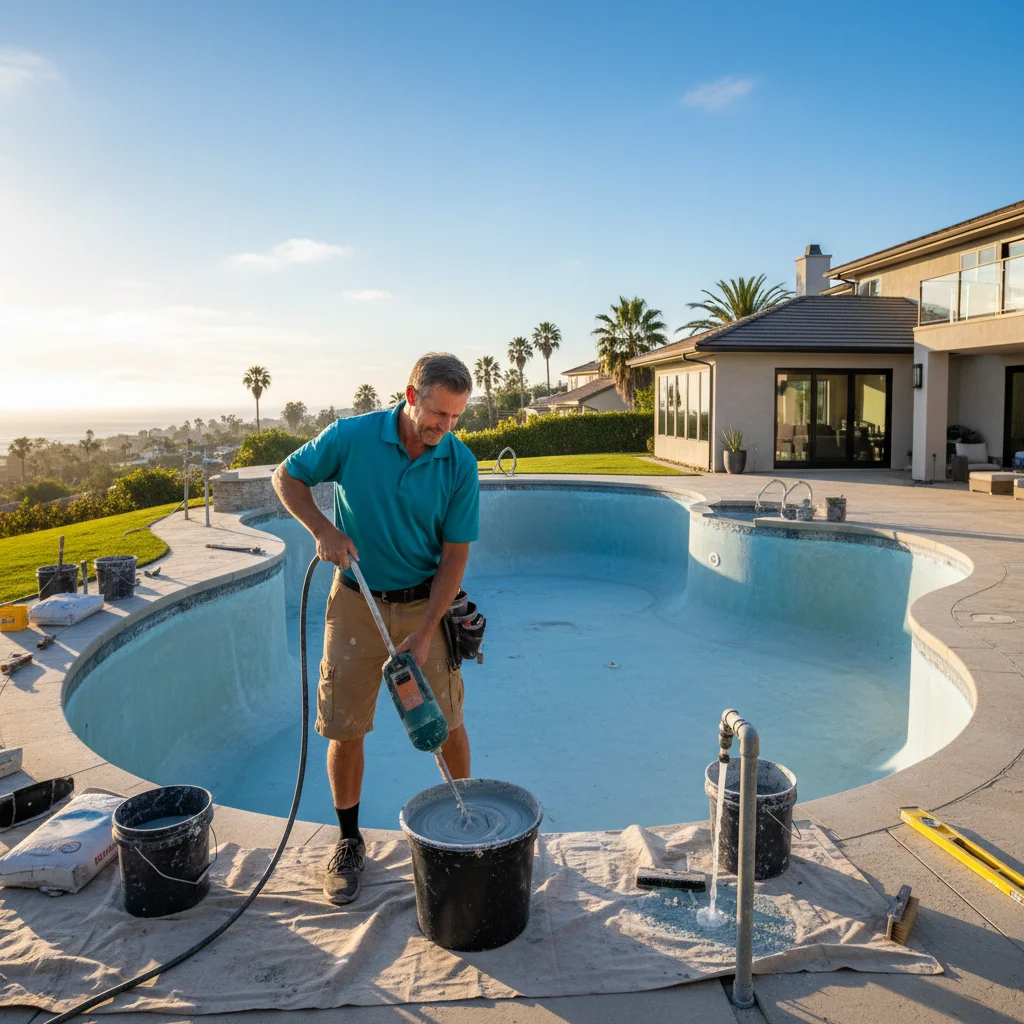
Pool resurfacing in San Diego costs $6,500 to $16,000 for a standard backyard pool, depending on whether you choose plaster, quartz, or pebble. But before that number means anything, there’s a question worth answering first: does your pool actually need a full resurface, or would a spot repair fix the problem for a fraction of the price?
Refresh Pool Pros connects San Diego homeowners with vetted pool repair and resurfacing specialists who answer that question honestly before quoting a job. This guide walks through how to tell the difference, what each finish costs, and what drives the price up or down across the county.
Do you need a spot repair or a full resurface?
Start here, because it changes everything downstream. A single crack, a small area of rough or hollow-sounding plaster, or a discolored patch near a return jet is usually a localized problem. A specialist can chip out the damaged section, patch it with matching plaster, and blend the edge for $300 to $800. The rest of the shell keeps doing its job.
Full resurfacing is the right call when the damage isn’t isolated. That means plaster that’s thinning across the whole floor and walls, widespread rough or pitted texture you can feel underfoot, staining or etching that shows up in more than one spot, or a pool that’s losing water through several hairline cracks instead of one clean break. If you’re only seeing one bad patch, ask your pool repair specialist for a repair quote before you agree to drain the whole pool. Our guide on signs your pool needs resurfacing goes deeper on what separates a patch job from a shell that’s actually done.
How much does pool resurfacing cost in San Diego?
For a standard 600 square foot San Diego pool, plaster runs $6,500 to $9,500, quartz runs $8,500 to $12,500, and pebble runs $10,500 to $16,000. Broken down per square foot, that’s roughly $6 to $11 for plaster, $9 to $14 for quartz, and $12 to $20 for pebble. Larger or oddly shaped pools with more steps, benches, or a spa attached push toward the top of each range, since more surface area and more corners mean more labor.
These figures are for the finish and standard prep work. Tile replacement, coping repair, and equipment upgrades are priced separately, which is why two quotes for the “same” resurfacing job can look very different once you compare line items.
Plaster, quartz, or pebble: what’s actually the right call?
Plaster is the traditional option and the cheapest to install, but it’s also the least durable, typically lasting 7 to 12 years before it needs to be redone. It’s a reasonable choice if you’re planning to sell the home soon or you want the lowest upfront cost and don’t mind resurfacing again sooner.
Quartz blends ground quartz aggregate into the plaster mix, which adds resistance to staining and etching and stretches the lifespan to 12 to 15 years. It costs more than plaster but less than pebble, and it’s a common middle-ground pick for homeowners staying put for a while.
Pebble finishes, the PebbleTec-style aggregate surfaces, cost the most upfront but last 15 to 20 years or longer and hold up best against San Diego’s hard water and sun exposure. Once you count how many resurfacing cycles a plaster pool goes through over 20 years compared to one pebble job, the total cost of ownership often favors pebble even though the sticker price is higher. Our full comparison in plaster vs. quartz vs. pebble: the 20 year cost runs the numbers side by side.
What else gets added to the resurfacing bill?
Waterline tile is the most common add-on. If the existing tile is cracked, missing pieces, or just dated, replacing it during the resurface runs $1,500 to $4,000 depending on the tile style and how much linear footage needs to be redone. Since the pool is already drained, this is the cheapest time to handle it. Our pool tile repair cost guide covers what the same work runs as a standalone project.
Draining and an acid wash to prep the old surface for bonding are usually included in the base resurfacing quote, but confirm that before signing. Some specialists also use the drained window to fix coping, replace pool lights, or upgrade skimmer fittings, since accessing those areas later means draining the pool again. The same logic applies to a cracked or dated pool deck: it’s cheaper to redo while the crew and equipment are already on site. If your equipment is also aging, it can make sense to handle pool equipment upgrades in the same project window rather than scheduling a second shutdown later.
Why do resurfacing costs vary across San Diego?
Access and pool age matter as much as square footage. A pool tucked behind a narrow side yard in older La Jolla or Point Loma neighborhoods costs more to resurface because crews have to hand-carry materials and equipment instead of driving a mixer truck to the edge. Pools built before the 1980s in areas like El Cajon or Chula Vista sometimes have old rebar or structural issues that only show up once the old plaster is chipped away, which can add unplanned cost mid-project.
Clay soil movement across inland North County, including parts of Carlsbad, San Marcos, and Escondido, can also stress the shell over time and show up as cracking that needs structural attention beyond a standard resurface. A specialist who knows the local soil and plumbing eras will flag this during the estimate instead of finding it as a surprise once the pool is drained.
How long does the job take, and when should you book it?
Most resurfacing jobs take 5 to 10 days from draining to refill, with pebble finishes on the longer end since the aggregate needs more careful curing. Spring booking backs up 4 to 8 weeks across San Diego County as everyone tries to get their pool ready before summer, so a resurface scheduled in March often doesn’t start until May.
Booking in fall or winter, when demand drops, usually gets you a faster start date and sometimes a better price, since crews aren’t stretched across a full calendar. The finish also cures the same either way, so there’s no seasonal downside to timing it off-peak.
Refresh Pool Pros connects San Diego homeowners with vetted pool resurfacing specialists who diagnose whether you need a patch or a full redo before quoting anything. If your resurfacing need started with a crack, our guide on cracked pool plaster repair covers what a repair-first approach looks like. And if you’re still deciding between finish types beyond cost alone, fiberglass vs. plaster vs. pebble breaks down the full tradeoffs. Homeowners in San Diego, Carlsbad, El Cajon, and Chula Vista can get matched with a local pro who already knows the soil and plumbing quirks in their neighborhood.
Call Refresh Pool Pros at (858) 400-4598 to get matched with a vetted San Diego resurfacing specialist who tells you honestly whether you need a patch or a full redo.
Frequently asked questions
How much does pool resurfacing cost in San Diego?
A standard 600 square foot San Diego pool runs $6,500 to $9,500 for plaster, $8,500 to $12,500 for quartz, and $10,500 to $16,000 for a pebble finish. Per square foot that’s roughly $6 to $11 for plaster, $9 to $14 for quartz, and $12 to $20 for pebble. Tile line replacement, draining, and an acid wash often add to the base price.
How do I know if I need a full resurface or just a repair?
If the damage is a single crack, a few rough or hollow-sounding spots, or discoloration confined to one area, a spot repair at $300 to $800 usually solves it. Full resurfacing makes sense once the plaster is thinning across the whole shell, you’re seeing widespread etching or staining, or the pool is losing water through hairline cracks in multiple places.
What’s the difference in cost between plaster, quartz, and pebble finishes?
Plaster is the cheapest option and the least durable, typically lasting 7 to 12 years. Quartz costs more upfront but resists staining and etching better, lasting 12 to 15 years. Pebble finishes cost the most, often 15 to 20 years or longer, and hold up best against San Diego’s hard water and sun exposure. The upfront gap narrows once you count how many resurfacing cycles each finish avoids.
What other costs come with a pool resurfacing job?
Beyond the finish itself, most jobs add $1,500 to $4,000 for new waterline tile if the old tile is cracked or dated, plus draining and an acid wash to prep the shell. Coping repair, new pool lights, or updated skimmer fittings sometimes get bundled in since the pool is already drained. Ask for an itemized quote so you know what’s base price versus add-on.
How long does pool resurfacing take in San Diego?
A typical resurfacing job takes 5 to 10 days from draining to refill, depending on the finish and whether tile or coping work is included. Spring and early summer booking backs up 4 to 8 weeks across the county as homeowners rush to get pools ready before peak season, so scheduling in fall or winter usually gets you a faster start date.
Does San Diego’s water and climate affect how long a pool finish lasts?
Yes. San Diego’s hard water leaves calcium deposits that etch plaster and quartz finishes faster than soft water would, and intense UV exposure inland in areas like El Cajon and Santee fades color finishes over time. Pebble surfaces tolerate both better, which is part of why they’ve become the default choice for pools getting resurfaced today.
Frequently asked questions
How much does pool resurfacing cost in San Diego?
A standard 600 square foot San Diego pool runs $6,500 to $9,500 for plaster, $8,500 to $12,500 for quartz, and $10,500 to $16,000 for a pebble finish. Per square foot that's roughly $6 to $11 for plaster, $9 to $14 for quartz, and $12 to $20 for pebble. Tile line replacement, draining, and an acid wash often add to the base price.
How do I know if I need a full resurface or just a repair?
If the damage is a single crack, a few rough or hollow-sounding spots, or discoloration confined to one area, a spot repair at $300 to $800 usually solves it. Full resurfacing makes sense once the plaster is thinning across the whole shell, you're seeing widespread etching or staining, or the pool is losing water through hairline cracks in multiple places.
What's the difference in cost between plaster, quartz, and pebble finishes?
Plaster is the cheapest option and the least durable, typically lasting 7 to 12 years. Quartz costs more upfront but resists staining and etching better, lasting 12 to 15 years. Pebble finishes cost the most, often 15 to 20 years or longer, and hold up best against San Diego's hard water and sun exposure. The upfront gap narrows once you count how many resurfacing cycles each finish avoids.
What other costs come with a pool resurfacing job?
Beyond the finish itself, most jobs add $1,500 to $4,000 for new waterline tile if the old tile is cracked or dated, plus draining and an acid wash to prep the shell. Coping repair, new pool lights, or updated skimmer fittings sometimes get bundled in since the pool is already drained. Ask for an itemized quote so you know what's base price versus add-on.
How long does pool resurfacing take in San Diego?
A typical resurfacing job takes 5 to 10 days from draining to refill, depending on the finish and whether tile or coping work is included. Spring and early summer booking backs up 4 to 8 weeks across the county as homeowners rush to get pools ready before peak season, so scheduling in fall or winter usually gets you a faster start date.
Does San Diego's water and climate affect how long a pool finish lasts?
Yes. San Diego's hard water leaves calcium deposits that etch plaster and quartz finishes faster than soft water would, and intense UV exposure inland in areas like El Cajon and Santee fades color finishes over time. Pebble surfaces tolerate both better, which is part of why they've become the default choice for pools getting resurfaced today.
Need professional help in San Diego County?
Refresh Pool Pros provides every service in this post. Call for a free quote.