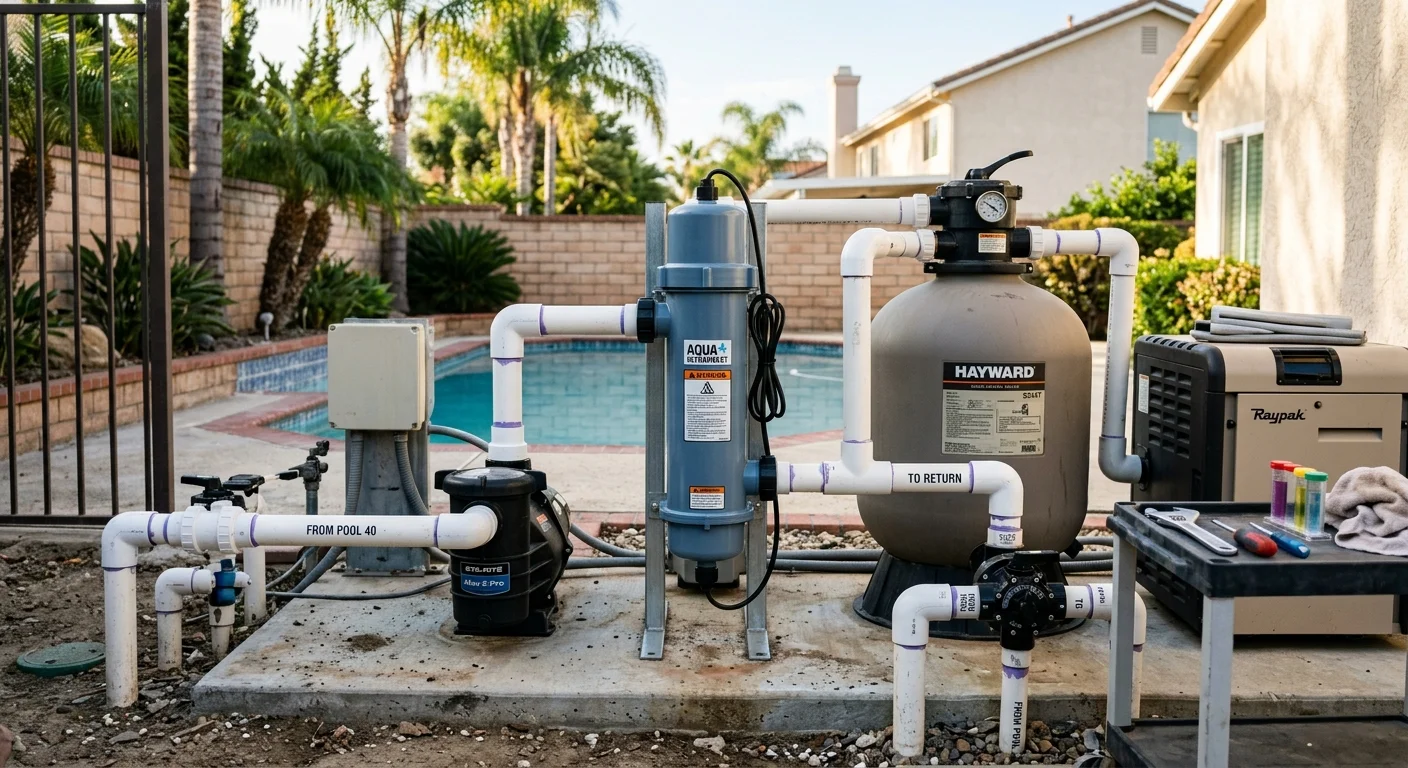
A pool UV system is a chamber on the equipment pad, not a stand-in for chlorine. Water is treated only while it flows through that housing. In San Diego that distinction matters, because sun, bather load, and a salt cell already do a lot of work before anyone adds another box to the pad.
What a UV sanitizer actually does in a pool
A ultraviolet pool sanitizer is an in-line housing with a lamp inside a quartz sleeve. The pump pushes water through the chamber. Light hits that water, then the water returns to the pool. That is the whole event. Nothing is left behind in the deep end once the water leaves the unit.
It does not filter debris. It does not set pH. It does not heat the pool. It does not make chlorine. Those jobs stay with the filter, the chemistry, the heater, and whatever residual sanitizer you already run.
The lamp is a germicidal ultraviolet lamp. Output, rated dose, and flow limits live in that model’s manual. They are not the same from unit to unit, and they are not confirmed in our claims file. Ask the licensed pro to open the spec sheet with you before anyone cuts pipe. If a salesperson quotes a kill rate or a wavelength from memory, stop and read the page in the manual instead.
Most pool UV housings sit somewhere in the return path after the filter. That is a common layout, not a rule you should assume. The licensed pro follows the manufacturer’s plumbing diagram for that exact unit, including any flow switch, union, or bypass the maker requires.
Sunlight on a Mission Beach or La Jolla surface is not the same device. Open-air UV hits the top few inches when the sun is out. A pool UV sanitizer treats a slice of water inside a closed chamber, in shade, at night, and under a cover. Different job, different place in the loop.
CDC guidance on healthy swimming still centers on disinfectant in the water. A lamp in a housing does not change that. If someone tells you a backyard can run with no residual sanitizer because UV is on the pad, treat that as a sales line, not a plan.
How it sits next to chlorine or a salt cell
Think of UV as a helper, not a second pool. Chlorine, whether you add it or a salt cell makes it, stays in the water after the pump shuts off. UV stops the moment flow stops. That is why a combined pad is the usual setup, not a chlorine-free one.
A salt cell is a chlorine maker. It is not a UV system, and UV is not a salt cell. If you are still choosing between those two residuals, read our chlorine vs. salt water pool guide for San Diego first. Add UV later only if the residual plan is already clear.
On a combined pad, water typically leaves the pump, goes through the filter, then through the UV chamber, then back to the pool. The residual sanitizer is still working in the bowl while people swim. UV is working on whatever volume actually passes the lamp during that pump cycle. Short run times mean less of the pool sees the chamber. Long, steady circulation means more of it does.
What UV can take off the residual is organic load and some of the combined chlorine that makes a packed Saturday in Chula Vista or a Mission Valley condo courtyard smell sharp. How much your weekly chlorine use actually drops depends on bather load, sun, phosphates, and whether the filter is clean. We do not publish a reduction percentage. No verified figure for that sits in our claims file. Anyone promising a fixed cut is guessing.
Salt cells still scale. UV sleeves still scale. Inland water from the San Diego County Water Authority system runs hard in qualitative terms, and East County pads in El Cajon, Lakeside, and Alpine show that on glass and metal. Pairing UV with a salt system does not cancel either maintenance job.
Ozone and AOP are different hardware. Ozone is a gas injected into the water. UV is light in a chamber. This page is about the lamp. If a quote mixes the three into one pitch, ask the licensed pro to separate the parts and show which unit is actually on the proposal.
Failures a pool pro sees on UV housings
The quartz sleeve is the weak point most homeowners never look at. Light has to pass through that tube. Scale, film, and fine silt cut the dose even when the lamp still glows. Hard San Diego water, sunscreen, and organics from a heavy weekend all leave a haze on the glass. A glowing sight glass is not proof the water is getting the dose the manual describes.
Lamps age. Hour ratings, replacement intervals, and whether the ballast should be swapped with the lamp are in the unit literature. Confirm those with the licensed pro. Do not run a lamp until it burns out and assume the water was treated the whole time.
O-rings and unions leak. A UV housing sits under pressure on a hot pad. In Clairemont, El Cajon, and Escondido that pad can bake all afternoon. Coastal pads in Imperial Beach, Coronado, and Pacific Beach add salt air to the same heat. Cracked unions, weep at the sleeve nut, and corrosion on fasteners show up on both kinds of yards.
Flow problems look like sanitizer problems. If the pump is starved, the filter is packed, or a valve is half closed, water crawls through the chamber or bypasses it. Some units shut the lamp down on low flow to protect the sleeve. Others keep glowing over a trickle. Either way, the pool is not seeing the treatment you think it is. The licensed pro checks flow against the manual, not against a guess.
Electrical faults are quiet. A tripped GFCI, a sun-cooked cord, or a controller that lost its program can leave the housing dark for weeks. You will not smell that the way you smell a chlorine miss. Pair any UV service visit with a look at the rest of the pool equipment on that pad, because a dark lamp is often a pad problem, not a mystery germ problem.
Cloudy water after a UV install is usually the filter, not the lamp. UV does not remove particles. If anything, it can leave more fine debris for a tired cartridge or sand bed to catch. Clean or service the filter before you blame the sanitizer.
When UV is a fit for a San Diego backyard
UV fits a yard that already runs a residual sanitizer and wants help on heavy swim days. Think after-school loads in Carmel Valley, weekend cousins in Chula Vista, or a small spa that sees four adults every evening. The water volume is modest. The bather load is not. A chamber in the loop can take some of that hit before chlorine has to.
It also fits owners who are tired of the sharp indoor-pool smell on a covered spa, or who get red eyes when combined chlorine climbs after a party. UV is not a medical device and it is not a promise of gentler water. It is one more pass at the organics that drive that smell. Chemistry still has to be in range.
It is a weaker fit when the real problem is a dirty filter, a pump that barely runs, or a salt cell that has not been cleaned. Adding a lamp to a neglected pad in Vista or La Mesa will not clear mustard algae or a green bowl. Those are circulation and residual problems. Fix those first.
Outdoor sun does not make a pool UV sanitizer pointless. The argument you hear on forums is that Southern California already has plenty of UV. Surface sun does burn chlorine, and it does hit the top of an uncovered pool in Alpine or Escondido harder than a foggy Encinitas morning. It does not sterilize the water in the skimmer line, the spa jet, or the shaded deep end at 9 p.m. If you want chamber treatment, you buy a chamber. If you do not, skip the box and spend the visit on filtration and residual control.
New construction is the clean time to plumb a UV housing. A retrofit can still work on an existing San Diego pad if there is space, a legal electrical path, and flow that matches the unit. That is the same judgment call as any other add-on in our pool equipment upgrade guide. The licensed pro looks at the pad, the pump curve, and the manual. A photo of a catalog unit is not a fit check.
Skip UV if the pitch is “chlorine-free.” Skip it if the unit is clearly undersized for the pump. Skip it if nobody has a plan for sleeve cleaning and lamp changes. The hardware only works while water moves and the glass is clear.
Questions to ask before a pro installs one
Ask which residual sanitizer stays in the pool after the lamp is on. If the answer is none, keep looking.
Ask for the model number and the manual pages for flow range, lamp hours, and sleeve service. Sit with those pages. If a spec is not printed there, it is not a spec.
Ask where the housing will plumb, and whether the pump and filter can feed it without starving the returns. Have the licensed pro explain any bypass or flow switch in plain words.
Ask what the pad needs electrically: circuit, GFCI, enclosure, and whether a permit applies on your street. California’s contractor rule is simple on paper. Work is exempt from licensure only when the whole job is under $1,000, it is casual and minor, and no building permit is required, with that $1,000 threshold in effect January 1, 2026. Splitting a job to duck the number does not count. Confirm both the dollar side and the permit side with the pro, then check the license on the CSLB site before anyone starts.
Ask who will clean the sleeve, how often the maker wants it done, and what hard-water film looks like on that quartz. Inland East County and South Bay fills leave more scale than a coastal rinse. Put that on the service calendar, not in a drawer.
Ask for a written quote after the pad visit. Refresh Pool Pros does not sell units and does not publish prices. Catalog numbers from other states are not a San Diego installed cost. The licensed specialist prices the unit, the pipe, the wire, and the labor for your yard.
Ask what happens to warranty if a homeowner opens the housing. Lamp and sleeve work is often owner-accessible in the manual, and sometimes it is not. Follow the paper, not a forum.
When to call us
Call when you want a licensed specialist to size a pool UV sanitizer to your pump, plumb it to the maker’s diagram, and keep chlorine or a salt cell in the plan. Call if an existing housing is leaking, dark, or scaled and you need a pro on the pad, not a catalog page. Call us at (858) 400-4598 and we’ll connect you with a licensed local pool specialist.
Frequently asked questions
Is a pool UV system worth it?
It can be, when you already keep a residual sanitizer and the unit is sized to the pump and pool. UV treats water only as it passes through the chamber. In a San Diego backyard with heavy swim days, that extra pass can take load off chlorine. It is a poor spend if filtration, run time, or basic chemistry are already neglected.
How much does a pool UV system cost?
Refresh Pool Pros does not publish a price list, and no verified San Diego install range is on file for this page. A licensed pro prices the unit, plumbing, electrical, and pad work after seeing your equipment. Ask for that written quote. Do not treat a national catalog number as a local installed price.
What are the disadvantages of UV pool systems?
UV leaves no residual in the pool. Water that is sitting still is not being treated by the lamp. The quartz sleeve scales in hard San Diego water, lamps age, and housings leak at unions. UV also does not clear cloudy water. That job still belongs to the filter and circulation.
Does a UV sanitizer replace chlorine or a salt cell?
No. A pool UV sanitizer is a helper in the equipment loop. You still need a residual sanitizer in the water, from chlorine or from a salt cell. The CDC still frames healthy swimming around disinfectant in the pool, not around a lamp alone.
Will a UV system stop cloudy San Diego pool water?
Usually not by itself. UV does not trap particles. If the filter is dirty, the pump run is short, or pH is off, the water stays hazy even with a working lamp. Fix filtration and chemistry first, then judge the sanitizer.
Need professional help in San Diego County?
Refresh Pool Pros connects you with a licensed specialist for any service in this post.