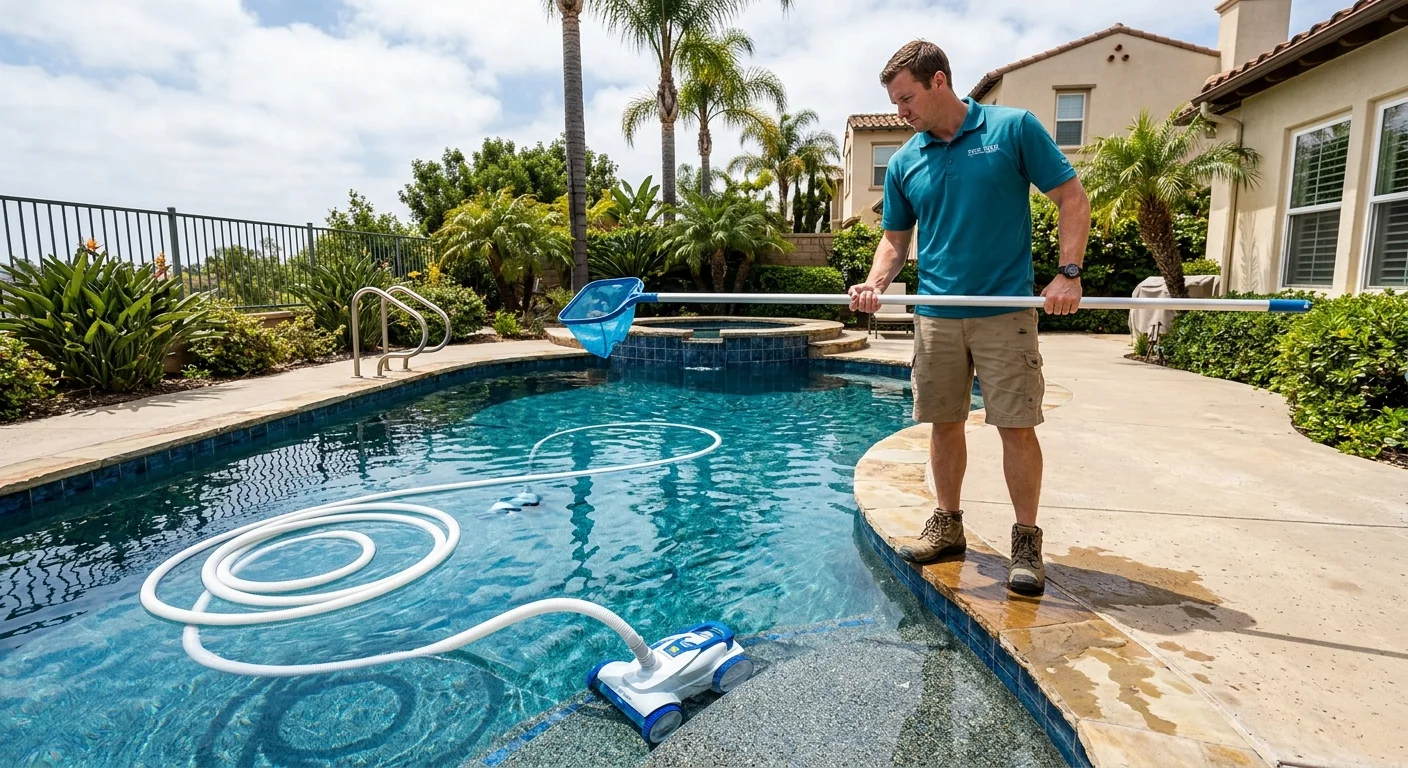
The cleaner is sitting on the plaster like a rock. The pump is running. The hose is still clipped in. Yesterday’s leaves have not moved an inch. A pool vacuum not moving is usually a flow problem, a hose leak, or a seized drive, not a random failure of the whole pool.
San Diego yards make this worse in specific ways. Older gunite pools in Clairemont, Allied Gardens, El Cajon, and inland North County still run suction-side cleaners off the skimmer. Coastal sand, East County eucalyptus, and South Bay palm fronds after a Santa Ana wind each stop a cleaner in a different place.
Suction, pressure, and robotic cleaners fail differently
Three machines get called a pool vacuum. They fail in three different ways.
Suction-side cleaners are still common on older San Diego gunite pools, the kind built before a dedicated cleaner line was standard. They live on pump suction through the skimmer or a wall port. If suction drops, the head parks. If suction is too strong, it glues itself to one spot and the wheels stop walking. A Hayward suction cleaner that will not move is a flow and hose problem until a pro proves otherwise.
Pressure-side cleaners need return pressure, and many also need a booster pump on the pad. A booster that is off, a packed debris bag, a slipped belt, or a clogged wall fitting can leave the unit sitting while the main pump looks fine. The returns can still ripple. The cleaner still will not walk.
Robotic cleaners do not use your filter pump. They have their own motor, cable, tracks, and on-board basket. A dead outlet, a tangled cord, a jammed impeller, or worn tracks will stop a robot even when circulation is strong. Mixing a robot checklist with a suction checklist wastes a Saturday.
Wheels that will not turn have a local flavor. Inland hard water leaves scale on axles and turbines. Coastal yards pack sand in the throat. After Santa Ana winds, South Bay and East County pools load oak leaves and palm fronds into the hose faster than the head can pass them.
If the automatic pool cleaner stopped walking but still sits humming, look at drive parts. If it moves and leaves dirt, the drive may be fine and the intake, bag, or filter is packed. If it will not climb walls, look at worn tracks or brushes on a robot, or low suction on a suction unit. Stuck on steps is often hose length, or a backup valve that no longer reverses.
Hoses, connections, and the skimmer
Most suction pool vacuum not working calls start at the hose, not the head.
Walk the hose in the water. Look for kinks, sun-split sections, and fittings that suck air. A cracked cuff at the skimmer is a classic San Diego failure. UV on a west-facing pad in Mission Valley or Escondido cooks those cuffs. The pump still runs. The cleaner gets foam instead of pull.
Confirm the hose is seated in the skimmer or the dedicated suction port. A loose adapter lets the cleaner starve while the weir still looks busy. If the pool has two skimmers, the second one can steal flow. Closing the idle suction line, or opening it on purpose, changes how the head walks. Do not guess which way the valves were left after the last filter cleaning.
Pull the skimmer basket. Palm fronds, jacaranda blooms, and eucalyptus caps wad into a plug that a homeowner never sees from the deck. A cracked or missing basket lets debris ride into the hose and lock the turbine. If the throat of the vacuum is packed with pebbles or scale flakes, the wheels will not turn even with a perfect hose.
Hose length matters on freeform coastal pools in La Jolla, Encinitas, and Pacific Beach. Too short, and the head never reaches the deep end. Too long, and it knots around the ladder. Neither looks like a broken cleaner. Both look like a pool vacuum staying in one place.
If the skimmer body itself is cracked, the weir is jammed, or the equalizer is pulling air, the cleaner is the symptom. That is a skimmer repair problem, not a new vacuum. Stop forcing hose adapters into a broken throat.
When the pump is the problem, not the vacuum
A cleaner cannot invent flow the pump is not making.
Stand at the equipment pad. Listen. A pump that hums but will not move water, or a lid full of bubbles, will starve a suction cleaner. The head sits still. The floor stays dirty. The mistake is buying a new vacuum while the real fault is on the pad. Start with pool pump repair in San Diego if the lid is sucking air, the basket is packed, or the pump will not hold prime.
Filter condition is next. A dirty cartridge or a sand filter that needs attention cuts flow to every suction and pressure cleaner on the pool. Gauge readings that look high or oddly low after a backwash or a cartridge swap often mean a valve was left partway closed. Homeowners do this after weekend maintenance more than they think. The cleaner line never got reopened.
Water level matters in San Diego heat. If the level drops below the skimmer mouth, a suction cleaner loses its pull in minutes. Inland yards in El Cajon, Santee, and Escondido lose water to sun and wind faster than coastal yards. The pump may still run. The automatic pool cleaner stopped because it is gulping air.
Pressure-side units add the booster. If the booster is not running, the bag is packed, or the wall fitting is clogged with scale, the cleaner sits. Return jets that feel weak are a clue the whole system is restricted, not that the head failed.
Robots are the exception. A dirty pool filter is usually not why a robot sits still. Check the power supply, the cable, and whether the on-board basket or impeller is jammed. If the robot has power and still will not move, stop repeating cycles. Something is jammed or worn inside.
Circulation still matters for the water itself. The CDC’s healthy swimming guidance is a reminder that treatment only works when water actually moves. A dead cleaner plus weak flow is how a backyard goes cloudy after a hot weekend.
What a pool pro checks on a dead cleaner
A licensed local pool specialist does not start by swapping the head. The pro starts by asking which type of cleaner you have, then proving whether the pool can feed it.
On a suction unit, that means baskets, valves, water level, hose integrity, and whether the pump is primed. The pro will look at the skimmer connection, any bypass or regulator in the skimmer, and the cleaner throat. A failed diaphragm or flapper in the head is on that list. So is a turbine packed with grit from plaster dust or decomposed granite that washed in from an East County slope.
On a pressure-side unit, the pro checks booster operation, the wall fitting, the bag, belts, and the backup valve that is supposed to reverse the head. A cleaner that only crawls in a circle often has a worn wheel or a backup valve that is stuck, not a dead pump.
On a robot, the pro checks power at the outlet, the cable for cuts, tracks and brushes, and the impeller housing. Sand from a coastal bottom can load that housing even when the pool looks clear from the deck.
The pro also separates “not moving” from “moving but not cleaning.” Those are different jobs. One is drive and flow. The other is intake, bag, or filter. Mixing them is how a homeowner replaces a vacuum and still has a dirty floor.
If the work is more than a hose or a basket, confirm the specialist’s license on the CSLB license lookup. Refresh Pool Pros matches you with licensed independent pros and does not perform the physical work. For a cleaner that points to a larger equipment fault, pool repair is the right path, not another weekend of guessing.
Repair versus replace, without a price
No typical lifespan for a pool vacuum is verified here. Run hours, debris load, and how hard the pump pulls all change how long a head lasts. Inland scale and coastal sand both chew wheels faster than a shaded, screened yard in North Park.
Repair makes sense when the pool system is healthy and one part failed. A split hose, a worn belt, a packed throat, a failed backup valve, or a skimmer adapter is a contained job. The matched pro can say whether that part is still made for your unit. Do not hunt part numbers from memory. Bring the model tag or a clear photo of the head.
Replacement makes sense when the drive is worn through, the shell is cracked, or the robot’s motor and tracks are both failing. It also makes sense when you have been feeding a suction cleaner with a pump that cannot prime. A new vacuum on a starving system will sit still too.
Skip the guess that a brand-new cleaner will climb walls your old one never could. Wall climbing needs the right type, the right tracks or brushes, and enough flow. A suction cleaner on a low-flow pad will not become a wall climber because the box is new.
What you should not do is keep running a jammed head. Forcing cycles on a robot with a locked impeller, or leaving a suction cleaner glued to a main drain, can chew parts you still needed. Pull it, bag the hose, and have a licensed pro look at both the cleaner and the pad.
When to call us
Call when the pump is running, the hose is attached, and the cleaner still will not walk, or when baskets and valves did not bring it back. A licensed pool specialist can tell whether the fault is the vacuum, the skimmer, or the pump. Call us at (858) 400-4598 and we’ll connect you with a licensed local pool specialist.
Frequently asked questions
Why does my pool vacuum stay in one place?
It is usually starved of flow, glued down by too much suction, or hung up on a hose, step, or drain. On older San Diego gunite pools, a suction-side cleaner often parks because the skimmer basket, pump basket, or filter is packed, a hose is leaking air, or a valve is sending pull to the main drain instead of the cleaner.
Why are the wheels on my pool cleaner not turning?
Debris in the throat, a seized turbine or gear, a slipped belt, or scale on the axles will stop the wheels even when the pump is running. Inland San Diego hard water and East County leaf grit are common reasons a cleaner looks dead while the rest of the pool still circulates.
My Hayward pool cleaner isn't moving. What could be the problem?
Hayward suction cleaners move only when the pump can pull a steady stream through the hose. Check the skimmer connection, hose cracks, packed baskets, filter pressure, and whether another suction line is stealing flow. Do not assume the head is failed until flow is confirmed.
Can a dirty filter stop a pool vacuum?
Yes, on suction-side and many pressure-side units. A dirty filter cuts the water the cleaner needs to walk. Robotic cleaners are different. They have their own motor, so a dirty pool filter usually is not why a robot sits still.
Should I repair or replace a pool cleaner that will not move?
A licensed pool pro can tell you after looking at the hose, drive, and the pump that feeds it. No typical lifespan figure is verified here. If the pool system is healthy and the head, belt, or turbine is worn through, replacement can be the cleaner path. If the pump or skimmer is the real fault, a new vacuum will sit still too.
Need professional help in San Diego County?
Refresh Pool Pros connects you with a licensed specialist for any service in this post.