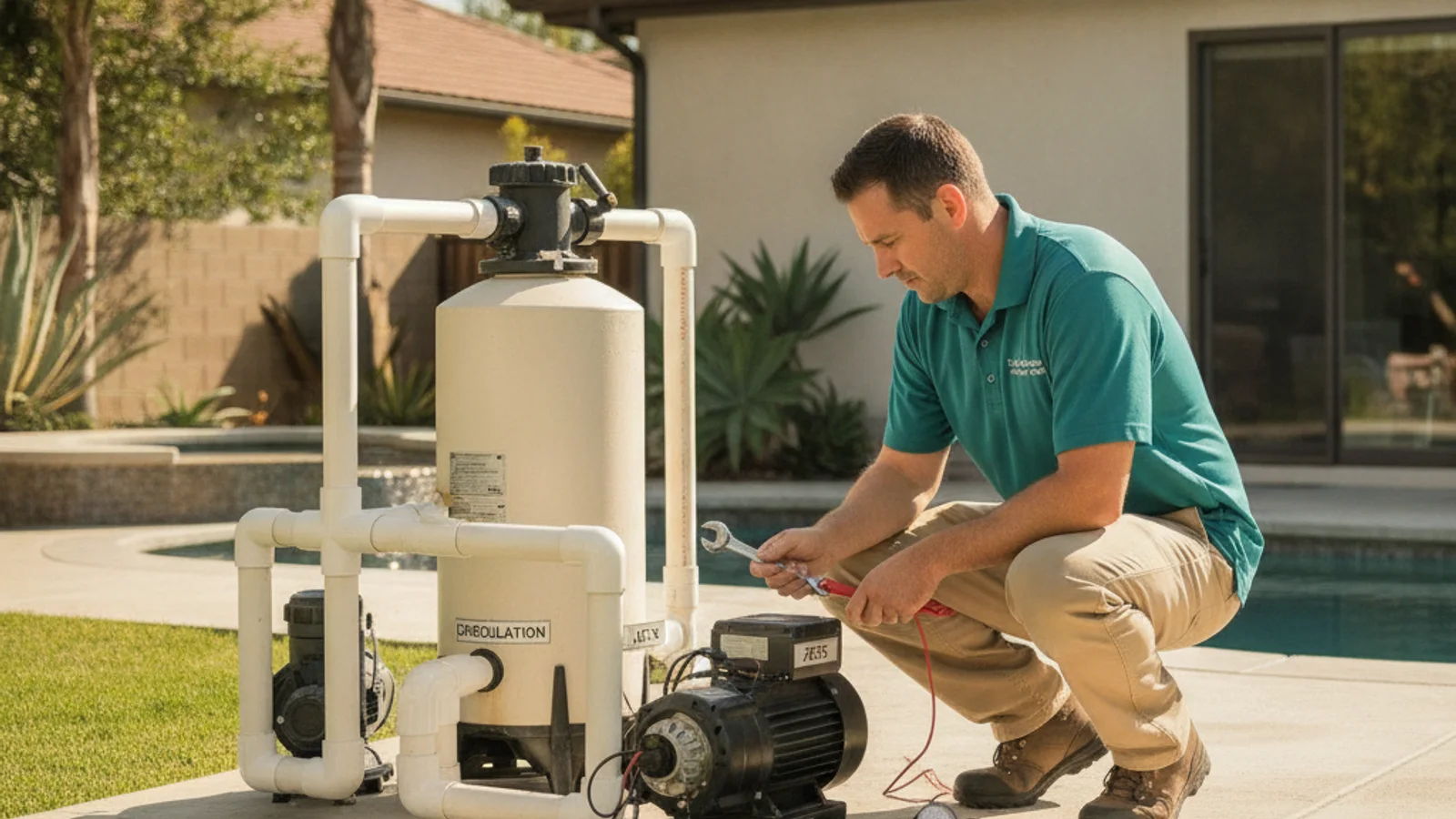
A spa or hot tub pump that hums, leaks, or will not move the jets is a pump diagnosis, not a heater job. Circulation pumps and jet pumps fail in different ways. Weak jets are often a filter, an air lock, or a diverter rather than a dead motor. Refresh Pool Pros connects San Diego homeowners with licensed independent spa specialists. We do not perform the physical work. If the water stays cold while the jets still push, use spa heater repair instead of this page.
Circulation pump versus jet pump
Two pumps are common on portable spas: a circulation pump and a jet pump. The circulation pump is usually the smaller one. It moves water through the filter and the heater. It often runs with a filter cycle, or whenever the spa is set to hold temperature. The jet pump is larger. It only runs when you turn the jets on.
That split is the first diagnostic. If the water still filters, or the heater still has flow, but the seats have no jet pressure, the jet pump, the diverter, or the jets themselves are in play. If nothing moves, the water will not clear, and the heater never gets flow, start with the circulation pump, the cartridge, and air in the lines.
A second jet pump shows up on some larger portable spas. The specialist identifies each pump from the cabinet and which topside button wakes it up. Guessing from the sound of one motor is how the wrong wet end gets ordered.
Don’t treat a spa pump like a pool pump by default. The wet end, unions, and plug on a portable spa sit in a tight cabinet, and parts have to match the spa pack. For a pool pad pump, use pool pump repair.
What humming, leaking, and dead jets actually mean
Write down the symptom before anyone opens a panel. The three complaints look similar from the patio. They are not the same job.
Humming with no water is often a seized wet end or a failed start component. The motor is getting a command. The shaft is not turning. Shut that pump off. A locked motor heats up. The specialist tests whether the impeller is locked with scale or debris, or whether the start circuit failed, before condemning the whole pump.
Water at the shaft, where the wet end meets the motor, is usually a shaft seal. Water at a union is often a gasket or a fitting that backed off. Water that soaks the insulation, runs along a hose, or shows up as a falling waterline with no puddle at the pump is a leak path, not a seal swap. That belongs on spa leak repair.
Weak jets can be a dirty filter, an air lock, a diverter in the wrong position, or the pump. After a filter change or a refill, air sits in the wet end and the pump sounds wet but moves little water. A diverter pointed at one seat starves the other. If every jet is weak, the specialist looks at the filter, the air, and the pump. If one zone is dead and the others are strong, the diverter or that branch comes first.
A topside error can appear beside a pump fault. Record the message. Don’t keep cycling power to clear it.
The spa pack switches each pump. A failed relay can leave one pump silent while the other runs. The specialist tests power at the pump, not only the motor.
Attached spas that share the pool pump
An attached pool and spa often share valves with the pool. The spa sound you hear in spa mode may be the pool pump, with diverter valves sending water to the spa. Weak spa jets on an attached spa can be a valve that did not finish traveling, a dirty pool filter, or the shared pump. They are not automatically a second hidden spa motor.
Look at the equipment pad. If you only see the pool pump, and the spa comes alive when the valves turn, this is a shared system. The specialist checks valve position, automation mode, and the pool pump before ordering a spa-only part. If a second pump runs only in spa mode, treat that as a booster and have it identified from the nameplate.
Don’t spin several valves at once while you wait. Photograph the current handles and the control mode. That record keeps the specialist from diagnosing a system you already moved.
San Diego-specific factors
San Diego County is not one climate for spa pumps. Inland East County water is mineral-heavy. Coastal salt air attacks metal. The same symptom points at different parts once you know which side of the county the spa sits on.
In El Cajon, Santee, and Escondido, scale builds on impeller vanes, seal faces, and the small circulation pump that may run for long stretches. A hum with no flow inland is often a wet end packed with mineral, not a mystery electrical fault. Cartridge filters load faster in that water too, which starves both pumps and looks like a weak motor.
Along the coast in La Jolla, Coronado, Imperial Beach, and Carlsbad, outdoor cabinets take salt air. Union nuts, motor fan covers, screws, and electrical lugs corrode. A leak at a coastal union may be a fitting that will not hold, not only a gasket. The specialist inspects corrosion and scale on the same visit because the fix differs.
A coastal patio with a missing cabinet panel feeds salt straight onto the pumps. An inland spa in a sunny side yard overheats a small motor housing. Those notes belong in the call. They are not a hardness number. We do not publish per-city grains per gallon.
What to record before calling
A few details help the specialist arrive prepared.
- Whether the spa is a portable cabinet unit or attached to a pool
- How many pumps you can see, and which one hums, leaks, or stays silent
- Whether the jets fail on every seat or only one zone
- The exact sound: a hum with no water, a grind, or a pump that spins and still pushes little
- Where water appears: shaft, union, or somewhere else in the cabinet
- When the filter was last cleaned or changed
- Any topside message, photographed before a reset
- The spa or pump model from a readable label
- Your ZIP code, and whether the unit sits in salt air
You can confirm water level, reseat a filter per the manual, and leave the power off on a humming pump. Opening the motor is licensed work. Don’t pry the wet end off to inspect an impeller. Don’t keep resetting a breaker that trips.
HomeGuide publishes a general U.S. planning estimate of $50 to $650 for pool pump repair. That range is national pool-pump planning context, not a spa-specific figure and not a Refresh Pool Pros price. HomeGuide’s pool pump cost page covers pool pump replacement planning. The matched independent pro quotes after assessing this spa pump.
Wet end versus motor versus a full pump
Repair versus replacement on a spa pump is a three-way split: the wet end, the motor, or the whole pump.
The wet end is the water side: impeller, housing, wear surfaces, and the shaft seal. Scale, a locked impeller, or a failed seal can stay on that side if the motor still spins once the load is off. The motor is the electrical side: bearings, windings, and the start component. A hum with a free impeller points at the start circuit or the motor. A full pump replacement enters the quote when both sides are damaged, corrosion has gone through the assembly, or a matching wet end is not available for that spa pack.
Isolated unions, seals, and start components often support repair. A seized wet end that locked the motor, a cabinet full of corroded hardware, or a pump the pack can no longer drive pushes the quote toward a complete unit. Age alone does not decide it. Condition and parts support do.
California Business and Professions Code section 7048, as amended effective January 1, 2026, exempts only casual minor work under $1,000 that needs no building permit. The exemption does not apply if the person advertises as a contractor or employs someone to do the work. Advertised spa pump repair should go through a licensed pro. Opening the motor is licensed work.
If the quote is a replacement, California Business and Professions Code section 7159.5 caps the down payment at $1,000 or 10 percent of the contract amount, whichever is less. On a larger contract the cap is still $1,000, not 10 percent of the whole amount. Before you hire, check the contractor on the official CSLB license lookup. Confirm the name on the license matches the name on the proposal.
When to call us
Call when the spa pump hums and will not move water, leaks at the shaft, or the jets will not push. Refresh Pool Pros matches San Diego County homeowners with licensed independent specialists for spa and hot tub service. We do not do the physical work.
Call us at (858) 400-4598 and we’ll connect you with a licensed local pool specialist.
Frequently asked questions
How much does spa pump repair cost in San Diego?
HomeGuide publishes a general U.S. planning estimate of $50 to $650 for pool pump repair. HomeGuide does not publish a spa-specific pump repair figure. That range is planning context, not a Refresh Pool Pros price. The matched independent pro quotes after assessing this pump. See [HomeGuide's pool repair cost guide](https://homeguide.com/costs/pool-repair-cost).
How do I tell the circulation pump from the jet pump?
On a portable spa, two pumps are common: a smaller circulation pump that moves water through the filter and heater, and a larger jet pump that runs when you turn the jets on. If jets are dead but water still filters or heats, the jet pump, diverter, or that jet bank is the suspect. If nothing circulates, start with the circulation pump, the filter, and air in the lines.
Why does my spa pump hum but the jets do not move water?
Humming with no water is often a seized wet end or a failed start component. The motor is getting a command and the shaft is not turning. Shut that pump off. A licensed specialist tests the wet end and the start circuit before replacing the whole pump. Opening the motor is licensed work.
Water is leaking at the spa pump. Is that the seal?
Water at the shaft, where the wet end meets the motor, is usually a shaft seal. Water at a union is often a gasket or a loose fitting. A soaked cabinet, wet insulation, or a falling waterline with no puddle at the pump is a different leak path. That diagnosis belongs on the spa leak page, not a seal swap by default.
Should I repair the wet end, the motor, or replace the whole pump?
Repair fits an isolated seal, impeller, union, or start component when the rest of the pump is sound. A seized wet end that locked the motor, widespread corrosion, or unavailable parts push the quote toward a full pump. The specialist compares those paths after testing. Opening the motor is licensed work.
Need professional help in San Diego County?
Refresh Pool Pros connects you with a licensed specialist for any service in this post.