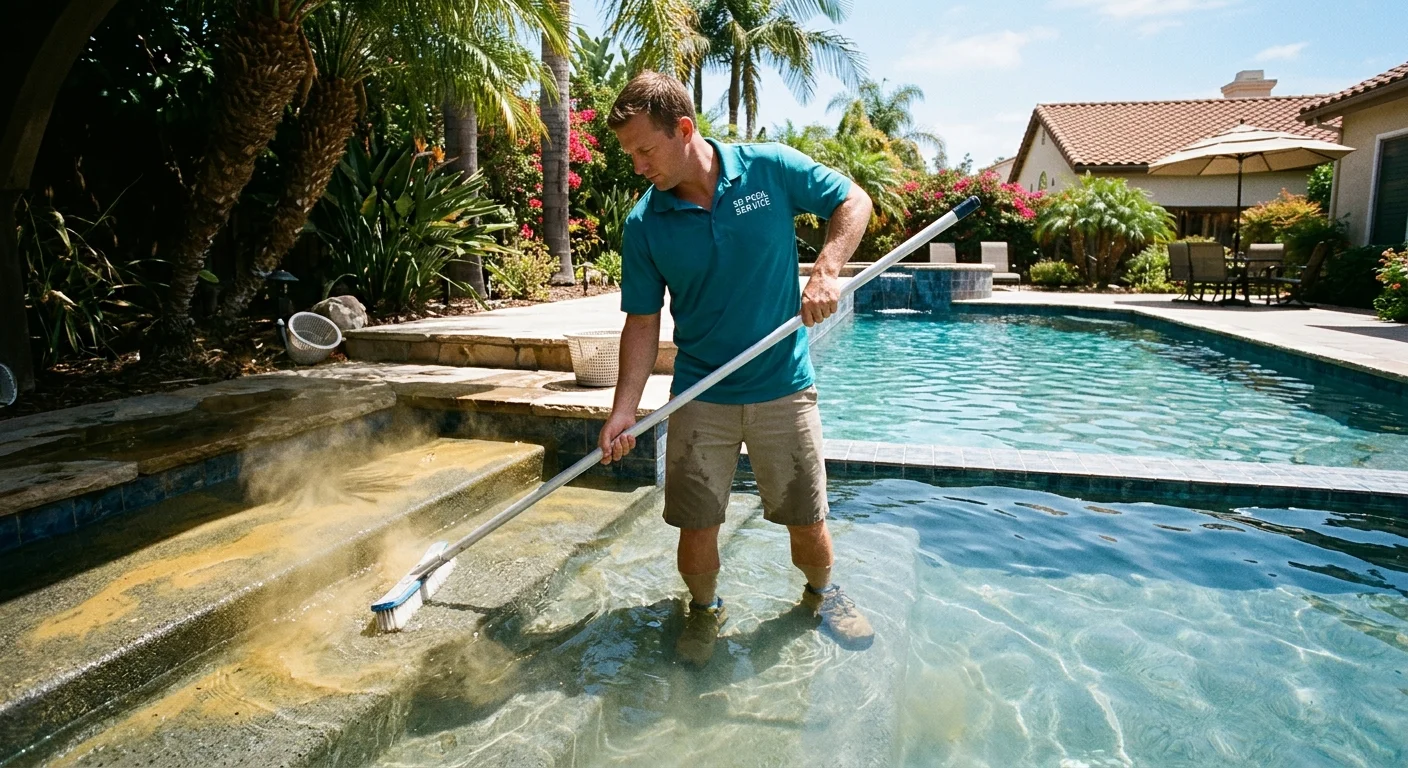
That yellow smear on the shady San Diego step is usually mustard algae, not dirt. It is also not the green soup that turns a whole backyard pool opaque. The film sits on walls, treads, and ladder wells while the water still looks swimmable. You brush it, it lifts in a faint cloud, and it comes back in the same footprint.
How mustard algae looks different from green algae
Green algae wants the whole body of water. It clouds, tints, and can run from a haze to a pea-soup green pool when sanitizer drops and the weather stays warm. You see it in the water column. You often cannot see the floor in the shallow end.
Mustard algae is a surface problem first. It looks like fine yellow-brown dust, pollen, or a mustard smear on plaster, pebble, or vinyl. The water above it can stay fairly clear. That is why a lot of San Diego owners miss it. The pool looks fine from the patio. Then you notice the north wall, the bottom step, or the corner behind the ladder.
A brush test separates it from look-alikes. Dirt and sand brush up and settle somewhere else. They do not rebuild the same patch. Pollen floats, films the surface, and shows up in the skimmer, not as a defined wall stain. A true stain does not move under a brush. Mustard algae usually smears off in a light cloud, then reforms on the same section of wall.
It also hides where you do not look. Deep in the skimmer throat. Under the lip of a step. Behind a light niche. On the house side of a salt pool that still looks almost clear. The yellow film is the only clue.
Green algae is obvious. Mustard algae is easy to argue with. People keep brushing the same tread, adding a little extra chlorine, and watching the yellow return overnight. If the water is cloudy or green, you are in a different job. If the water is clear and the shade line is yellow, treat it as mustard until a licensed specialist says otherwise.
Why it clings to walls, steps, and shady corners
Mustard algae lives on surfaces, not as a free-floating bloom. Shade is the setup. Open water gets sun and moving sanitizer. A dark corner does not. The film collects where the sun never sits for long.
In San Diego that map is local, not generic. A north-facing wall in Kensington or South Park stays dim most of the day. A palapa or patio cover in Chula Vista or Eastlake puts a permanent shadow on the top step. Canyon lots in Tierrasanta, Poway, and La Jolla throw afternoon shade from the slope. Inland yards in El Cajon, Santee, and Escondido run hotter, but the house wall still makes a still, dim pocket.
Steps and benches are common landing spots. Treads sit out of the main return flow. Ladders, rails, and toys park there. The film packs into grout lines, pebble texture, and the underside of coping. You can have a bright deep end and a yellow staircase on the same pool.
Circulation is the other half. If a return jet never stirs the far corner, sanitizer in the open water is not the sanitizer on that plaster. A weak pump, a dirty filter, or a closed valve can leave a dead zone. That is when a pool repair conversation matters more than another pass with the brush. Chemicals do not reach what the water is not moving.
Salt systems do not get a pass. A salt pool can look almost clear and still carry yellow algae on the house-side steps. The generator is making chlorine in the cell. It is not scrubbing the shaded plaster by itself.
What brushing alone usually misses
Brushing is the right first move. It is not the whole job. You are breaking a film so sanitizer can touch what is underneath. If you stop there, the smear comes back.
The debris you just loosened has to leave the pool. Vacuuming after a brush pass matters. If the filter valve has a waste setting, a specialist often vacuums to waste so the yellow dust does not cycle through the media and back into the water. If there is no waste setting, the filter has to catch it, then it has to be cleaned. A cartridge packed with mustard film will keep seeding the pool.
Gear is the leak most owners skip. Mustard algae rides on the brush you used, the vacuum hose that sat damp in the shed, the skimmer basket, floats, goggles, and swimsuits. Wash what can go in a machine. Soak hard goods in a sanitizer mixed to the product label, not to a guess. Let toys dry in the sun before they go back in. If last week’s floats go straight back onto the step, you are reloading the same corner.
The filter is a hiding place. Sand, cartridge, or DE media can hold the same organisms you just brushed off the wall. Clean or backwash per the equipment, then test. If the yellow returns in the same corner after a “clean” pool, look at the filter and the hose before you buy another bottle of shock.
Water testing belongs in this step, not after you have already dumped product. A strip that says chlorine is fine is not a diagnosis. Mustard algae can sit on a wall while the water in the middle of the pool still shows a residual. A licensed specialist tests, then decides what the label and the reading actually call for. This page will not give you a dose chart. Dose belongs on the product and in the test, not in a blog.
A routine weekly shock is not the same as yellow algae treatment. Shock is often part of the work. It is not a one-pour fix when the film is still on the steps, the filter, and last weekend’s floats.
Warm San Diego water and sun as the setup
San Diego does not give algae a real off-season. Coastal yards from Encinitas to Imperial Beach sit under a long swim calendar. Inland North County and East County run hotter through late spring and fall. The marine layer cools mornings near the water. By afternoon the same pool is in full sun.
Warm water plus sun is a growth setup for any algae. Mustard algae uses the parts of that setup you do not see from the patio: the shaded plaster, the still corner, the salt pool that looks clear. Open water can be bright and blue while the north wall is a yellow film.
Pollen season confuses the diagnosis. Eucalyptus, jacaranda, and street trees drop yellow-green dust on decks from spring into early summer. Pollen rinses, floats, and skims out. Mustard algae grips the wall. If the yellow is only on the surface and in the baskets, start with skimming. If it is a wall patch that reforms, treat it as algae until a pro says otherwise.
Hard San Diego tap water and a long outdoor season also mean chemistry drifts. Stabilizer builds when water does not leave the pool. pH climbs. Owners keep adding tabs and wondering why the yellow smear ignores them. None of that is a reason to invent a number on this page. It is a reason to test, not guess, and to have a licensed specialist read the results against the actual pool, not a national chart. For a sense of why maintained water matters before anyone swims, see the CDC’s healthy swimming guidance.
A Mission Beach plunge with afternoon wind is not an El Cajon yard closed in by block walls. The mustard pattern still rhymes: shade, poor flow, a film that brushes off and returns.
When a pool pro has to take over the cleanup
Hand the job off when the same yellow patch comes back after you have brushed, vacuumed, cleaned the filter, and followed a shock product’s label. Hand it off when you cannot tell stain from algae. Hand it off when the filter clogs as fast as you clean it, the pump is not moving water into the corners, or the pool is yellow on the walls and going green in the water.
A licensed local specialist starts with the pool in front of them. They test. They look at circulation, shade, salt versus chlorine, and every piece of gear that has been in the water. They clean or isolate contaminated tools so the pool is not reseeded from the shed. They treat to the product label and the readings, then they confirm the film is gone before they call it done.
How long it takes is not a number this brand can promise, and it is not a number this page will invent. Some pools clear after a thorough surface attack and a filter clean. Others keep seeding from a hose, a suit, or a dead zone behind a bench. The person on site can tell you what they are seeing. A blog cannot.
Confirm the specialist is licensed before work starts. Use the CSLB license lookup, not a random directory.
If the water is cloudy or green, not just yellow on the plaster, start with the green-pool guide, then get a pro on the actual water.
When to call us
Call when the yellow film keeps returning to the same San Diego steps, walls, or ladder well, or when brushing and a routine shock have not held. Refresh Pool Pros matches you with a licensed local pool specialist. We do not send our own crew to scrub or dose the water. Call us at (858) 400-4598 and we’ll connect you with a licensed local pool specialist.
Frequently asked questions
Is it safe to swim in a pool with mustard algae?
Visible algae means the water is not in the well-maintained condition public-health agencies describe. The CDC's healthy swimming guidance is about properly treated water. Skip swimming until a licensed specialist tests the pool and confirms it is back in range. We could not confirm a mustard-algae-specific illness rule, so do not treat a yellow film as a green light to swim.
How can I get rid of mustard algae in my pool?
Brushing the film is only the start. The debris has to leave the pool, the filter and every wet toy or hose have to be cleaned, and the water has to be tested before anyone doses product. Follow the label on shock or algaecide. Do not run a blog dose chart. If the same yellow patch returns, a licensed local specialist should take over yellow algae treatment rather than another round of guessing.
How long does it take for mustard algae to go away?
There is no verified standard timeline we can publish. Some films drop after a thorough brush, vacuum, filter clean, and labeled treatment. Others keep coming back from a damp hose, a swimsuit, or a dead corner the returns never stir. A licensed pro can tell you what they are seeing on your pool. This page will not invent a day count.
Does pool shock get rid of mustard algae?
A routine weekly shock often does not. Mustard algae can sit on shady plaster while the water in the middle of the pool still shows a chlorine residual. Shock is often part of a cleanup, but dose, product, and whether you need a specialist algaecide belong on the label and in a real test, not in a blog chart.
How do I tell mustard algae from pollen or dirt in San Diego?
Dirt and sand brush up and settle somewhere else. Pollen floats, films the surface, and shows up in the skimmer, especially under eucalyptus and jacaranda. A stain does not move. Mustard algae smears off in a light cloud, then reforms on the same shady step, wall, or ladder well.
Need professional help in San Diego County?
Refresh Pool Pros connects you with a licensed specialist for any service in this post.