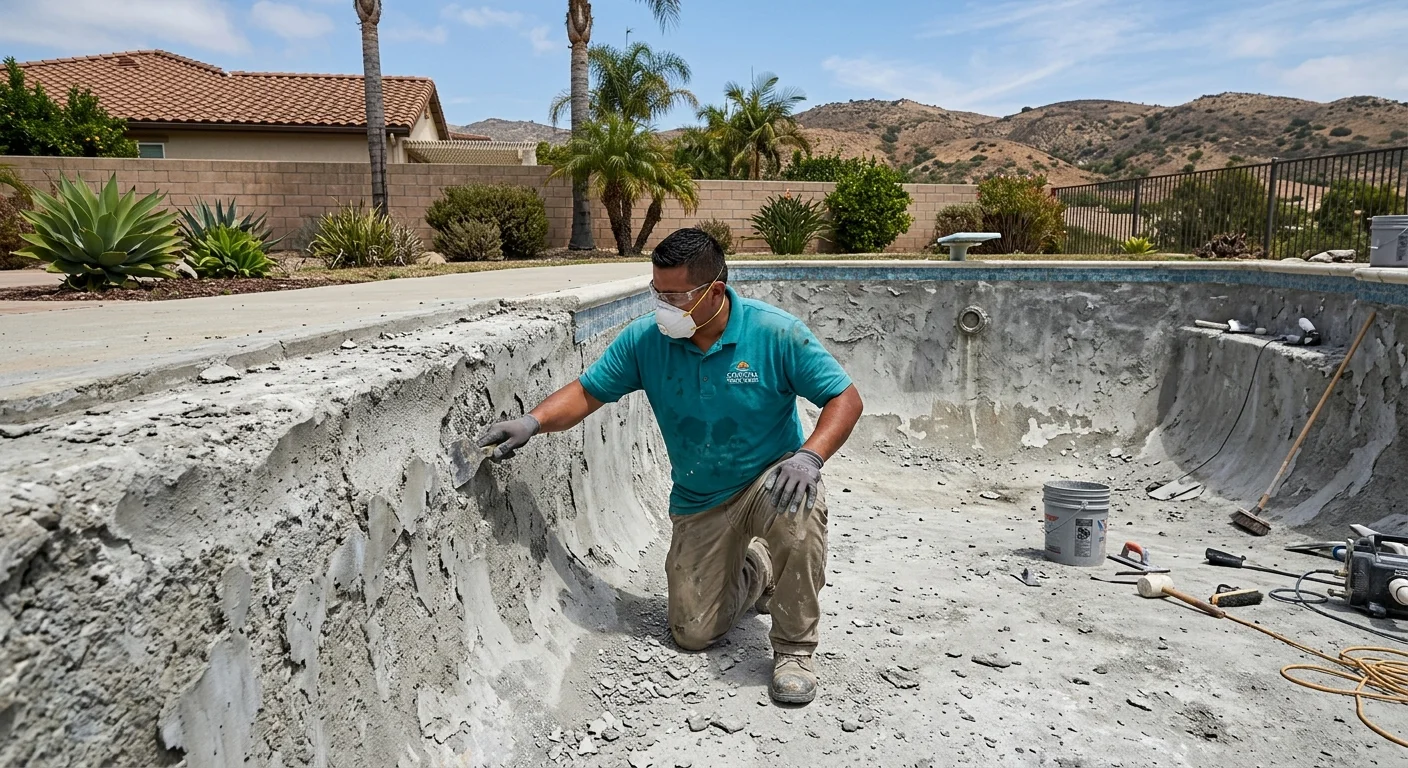
The plaster in a lot of Eastlake and Otay Ranch pools is past the point where brushing brings it back. South Bay sun cooks the water through the afternoon. Then the marine layer sits on the surface overnight. That cycle, plus hard tap water, is what sends a Chula Vista interior to a full pool resurfacing instead of another acid wash.
South Bay sun, marine layer, and older plaster
Chula Vista is not one climate. West of I-805, toward Castle Park, Hilltop, and the older lots around downtown, you still find gunite pools from the mid-century tract years. Those shells have had decades of chemistry, sun, and the odd freeze-free winter that never really rests the finish. East of the freeway, Eastlake, Otay Ranch, Rancho del Rey, Rolling Hills Ranch, and San Miguel Ranch filled in later. Builder-grade white plaster went in with the house. It is now the surface people are staring at when they search pool plastering Chula Vista.
The weather in between those two halves is South Bay weather. Mornings can sit under a marine layer that never quite reaches El Cajon. Afternoons open up, especially inland of the bay along Telegraph Canyon Road, Olympic Parkway, and Eastlake Parkway. Otay Mountain and San Miguel Mountain cut the eastern skyline. San Diego Bay sits to the west. You get more humidity than Santee and less salt fetch than Coronado. Plaster does not fail from one of those things. It fails from all of them stacked on the same interior for years.
That is why a Chula Vista resurface should not read like an inland job with the city name swapped. Pool resurfacing in El Cajon contends with East County heat and dry air. Here the finish also lives through May gray, June gloom, and overnight moisture that keeps the water from behaving like a desert pool. Cool mornings, bright afternoons, and hard fill water are the local pattern. The licensed pro who chips the old coat has to plan the new one for that pattern, not for a generic San Diego County backyard.
HOAs add another local wrinkle on the east side. Many Eastlake and Otay Ranch lots sit in associations with rules about color, tile, and what the backyard is supposed to look like from the slope above. Confirm those rules before anyone orders a dark pebble or a colored plaster. The west-side tracts are often freer on finish choice and tighter on access: side yards, older decks, and equipment pads tucked against a fence.
If the surface is only stained in a few spots, start with the signs your pool needs resurfacing. Rough texture underfoot, a chalky haze, and hollow sounds in the plaster are the cluster that usually means the coat is done. A stain by the waterline alone can be scale. The whole floor feeling like sandpaper is a different conversation.
Scale and staining on Chula Vista finishes
South Bay tap water runs hard. Western Chula Vista often sits on Sweetwater Authority. Eastlake and Otay Ranch sit on Otay Water District. Both are hard. Exact grains per gallon are not published here because those figures have to come from each district’s own current report. What you can see in the bowl is enough: white crust on tile, rough plaster at the waterline, and gray or brown mineral maps that do not brush off.
Scale is calcium sitting on the finish. Staining can be metals, organics, or the plaster itself wearing thin and showing the sand coat underneath. People treat those as cleaning problems for a long time. Weekly service can keep water clear. It cannot put paste back on a wall that has already lost its cream. If you have been acid-washing the same spots, the surface is telling you the coat is tired.
Sun makes the chemistry less forgiving. Stabilizer and sanitizer swing through a bright Chula Vista afternoon, then the marine layer slows evaporation overnight. That is a different rhythm than a hot, dry East County yard. Overcorrect on pH or calcium, and the plaster takes the hit. Undercorrect, and algae finds the rough spots first. Either way, a worn interior holds dirt and scale the way new plaster does not.
Tile tells on the pool before the floor does. A crusty waterline in a Rolling Hills Ranch yard, or a ring that comes back a week after a tile wipe in Sunbow, is often the same mineral load that is etching the plaster below. Resurfacing is the moment a lot of homeowners replace that tile line so the new interior and the new waterline match. It is a choice, not a requirement. It is also the choice that makes the finished pool look like one project instead of a new floor under old grout.
Do not wait on hollow spots. A drummy sound under a knuckle tap means the finish has lost bond. Water can sit behind it. That is a shell inspection issue, not a stain issue. The matched licensed pro should look at those areas once the pool is empty, before any new coat goes on.
The resurfacing sequence from chip-out to startup
Swimming pool resurfacing in Chula Vista is a drain-and-rebuild of the interior, not a paint day. Refresh Pool Pros does not chip, plaster, or fill the pool. The licensed specialist you get matched with runs the sequence. You should hear it in this order so the quote makes sense.
The pool is drained. Decks, coping, and the equipment pad get protected. Then the old finish comes off. On a tired Eastlake plaster job that often means a full chip-out, down to a sound base. On a thinner remaining coat, the pro may grind instead of chipping every inch. The point is a clean, bonded surface, not a shortcut that leaves loose material under the new work.
With the interior open, the shell gets read. Hollow plaster, check cracks at steps, and wet spots in the gunite are the finds that change the job. If the pool was losing water, this is when leak questions get honest. A new finish over an active leak is a redo waiting to happen. Structural cracks are a separate repair. Surface work does not close a moving shell.
A bond or scratch coat goes on so the new finish has something to grab. Then the chosen interior goes up in sections: floor, walls, steps, and any bench or spa. The crew keeps the mix consistent so you do not get a color break at the deep end. After application, the finish has to cure. The pool stays empty during that window. Fill starts when the pro says the coat is ready, not when the weekend looks good.
Startup chemistry is part of the job. Fresh plaster is thirsty. It wants calcium and careful brushing while it hydrates. Skip that and the new interior can spot or scale in the first weeks, especially on hard Otay or Sweetwater fill. The matched pro should hand you a startup plan: brush schedule, what not to add yet, and when swimming is actually allowed. There is no verified day-count that belongs on this page. Weather, finish type, and city inspection timing all move the calendar.
Expect the yard to be a jobsite. Chip-out is loud. Trucks need room on streets that were not built for them in the older west-side tracts, and hillside Eastlake lots can make material staging the slow part. Ask the pro, before the drain, how they will protect the deck and where debris leaves the property.
Finish choices for a south county backyard
Pool refinishing Chula Vista usually comes down to three interiors: plaster, quartz aggregate, and pebble. None of them get a lifespan figure here. Those numbers are marketing, not a verified standard. What you can choose on purpose is color, feel underfoot, and how the surface will show scale in hard South Bay water.
White plaster is still the common builder look. It is smooth when new. It also shows every mineral map. Colored plaster hides some of that, and it can read better against the stucco and tile that already sit on a Rancho del Rey lot. Quartz adds aggregate to the cement so the surface has more texture and a tighter look. Pebble is the roughest underfoot of the three and the one people pick when they want a stone look in a sunny yard.
Light finishes bounce the Chula Vista sun and show less heat in the water. Dark finishes look dramatic from the kitchen window and show scale and dust faster. In a master-planned HOA, the darker pebble that photographs well may be the color the architectural committee rejects. Bring a sample board, not a phone photo, and walk it in the actual backyard. Eastlake light at 4 p.m. is not showroom light.
Feel matters if kids live on the steps. Fresh plaster is the smoothest. Pebble is grippier and can be hard on small feet until you get used to it. Quartz sits in the middle. Have everyone who uses the pool put a hand on a sample. The finish you never touch in a showroom is the one you stand on every June.
Tile, coping, and waterline details are optional add-ons at resurface time. They are also the details that make an older Castle Park pool stop looking like 1985. Keep the scope honest. A new interior with the old cracked coping still in place will look like a half-done yard. A full deck rebuild is a different project. The matched pro can tell you where the interior stops and the deck begins.
Compare more than one written quote, on the same scope. How to compare pool refinishing quotes in San Diego is the checklist for chip-out depth, startup, and what is excluded. Phone numbers on a postcard are not a scope.
Permits and inspections in Chula Vista
A specific City of Chula Vista permit rule for pool resurfacing could not be confirmed for this page. Do not guess a fee, a form number, or whether every chip-out needs a permit. Call the city’s Building Division and ask about your address before the pool is drained. The licensed pro on the job should be willing to pull whatever the city actually requires. If a bid shrugs that off, keep looking.
California contractor law still sits under the city process. Work is exempt from licensing only when the total for labor, materials, and everything else is under $1,000, the work is casual and minor, and no building permit is required. That $1,000 threshold is the figure in effect as of January 1, 2026. Splitting a job into smaller contracts to dodge a license is not allowed. A full interior replacement is not casual yard work. Hire a licensed contractor and check the license on the CSLB site before you sign. Unlicensed contracting is a misdemeanor under California law.
The down payment has a hard cap. Under Business and Professions Code 7159.5, the down payment cannot exceed $1,000 or 10 percent of the contract, whichever is less. On a large resurface, that cap is $1,000, not 10 percent of the whole job. If someone asks for more up front, that is a problem with the contract, not a local custom.
If the city issues a permit for construction or remodel of a pool at a private single-family home, California Health and Safety Code 115922 requires at least two of seven drowning-prevention safety features. An enclosure is the first item on that list. The full list of seven was not fetched for this site, so it is not enumerated here. Whether your resurface counts as that remodel is a question for the city and the licensed pro, not a yes from a blog post.
Keep the paperwork with the house. HOA approval letters, the city permit if one is issued, the contract, and the CSLB license number are what a buyer will ask for later. Eastlake and Otay Ranch turn over often enough that this is not theoretical.
For water quality context while you plan fill-up, the San Diego County Water Authority is the regional starting point. Your actual hardness and metals still come from Sweetwater Authority or Otay Water District, depending on the side of town.
When to call us
When the plaster is rough, stained through, or hollow under a tap, you need a licensed pool specialist on the shell, not another round of stain treatment. Call us at (858) 400-4598 and we’ll connect you with a licensed local pool specialist.
Frequently asked questions
How much does pool resurfacing cost in Chula Vista?
Refresh Pool Pros does not publish a price list, and no verified local average belongs on this page. Cost follows pool size, how far the old finish has to come off, tile and coping work, access on the lot, and the finish you pick. The licensed pro you get matched with quotes after seeing the empty shell.
What time of year is best to resurface a Chula Vista pool?
There is no verified calendar rule. Late spring brings May gray and June gloom, which keep mornings cool. Summer is when most families want the water. Fall and winter are when many South Bay yards can spare the downtime. Confirm inspection timing with the City of Chula Vista and the licensed pro on the job.
How do I know my Chula Vista pool needs a full resurface?
Rough plaster underfoot, mineral stains that brushing will not lift, a chalky haze, and hollow or drummy spots are the usual cluster. A patch can hold a small chip. Once the interior is worn across the walls and floor, a full chip-out is the honest path. A licensed specialist should inspect the shell before anyone starts cutting.
Do I need a permit for swimming pool resurfacing in Chula Vista?
A specific City of Chula Vista permit rule for resurfacing could not be confirmed here. Check with the city's Building Division before the pool is drained. California contractor law still applies: licensed work above the casual-work threshold, a deposit cap of $1,000 or 10 percent of the contract (whichever is less), and a CSLB license check before you sign.
Is pool resurfacing in Chula Vista different from El Cajon?
Yes. Chula Vista sits in the South Bay, with morning marine layer, milder nights, and hard water from local districts. El Cajon is inland East County heat and dry air. The chip-out sequence is similar. The climate that wears the plaster is not.
Need professional help in San Diego County?
Refresh Pool Pros connects you with a licensed specialist for any service in this post.