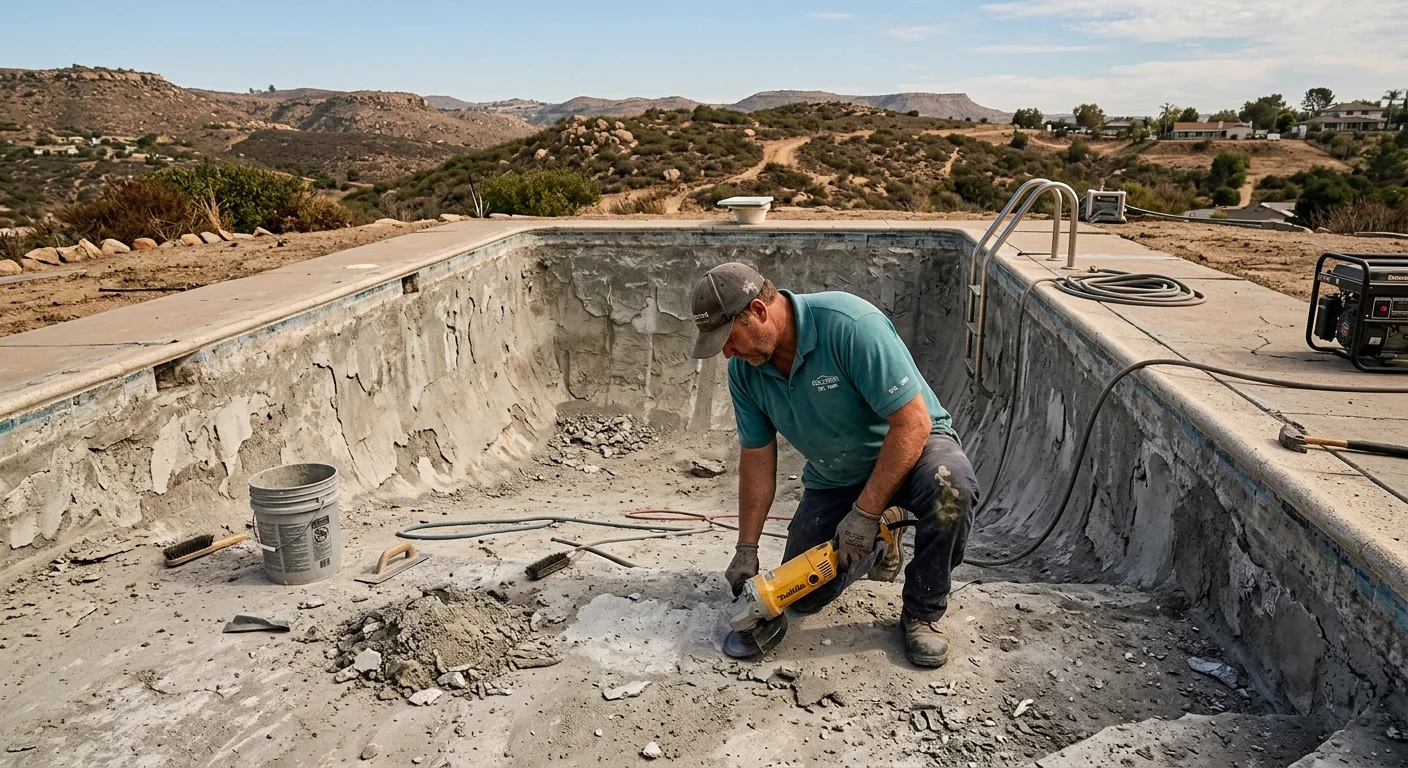
A white plaster pool on a Mount Helix slope usually fails at the waterline first. Scale, a sandy floor, and gray staining show up while the gunite shell is still sound. Pool resurfacing in La Mesa replaces that worn interior. The licensed specialist you get matched with chips the old finish, applies the new one, and runs startup.
Why La Mesa finishes age differently from El Cajon
La Mesa sits on the first East County hills east of San Diego. I-8 cuts through it. La Mesa Boulevard holds the Village. Lake Murray sits on the west edge. Mount Helix and the older streets around Grossmont look out over dry slopes and canyon lots.
Summer here is warm and dry. It’s inland weather. The daily bake is milder than the El Cajon valley floor a few miles east. That’s why we wrote a separate pool resurfacing in El Cajon guide. On a La Mesa mesa lot, plaster still etches. Water still evaporates. Mineral rings still form.
Helix Water District serves much of the city. The supply is hard, which is typical for East County. The San Diego County Water Authority is the regional wholesaler behind that system. As water leaves the pool on a hot week, calcium and other minerals stay on the plaster. Brushing lifts dust. It doesn’t lift a scale band that has bonded to a rough wall.
Canyon lots add their own wear. Afternoon shade on a north-facing pocket can keep a wall damp. A south-facing Mount Helix deck cooks the same pool’s opposite side. That shows up as uneven color and a waterline that stains on the sun side first.
Access shapes the job as much as climate. Many 1950s and 1960s lots step down from the street. Side yards are narrow. Equipment pads sit below the deck. A chip-out crew has to plan haul-out and mix delivery around stairs and retaining walls. That’s a La Mesa condition.
Scale, staining, and older tract gunite
A lot of La Mesa pools went in with the mid-century tracts. Think 1950s through the 1970s gunite, white plaster, and a rectangle or a kidney off the back patio. Some of those interiors are original. Some already had one later coat. Either way, the tells stack up the same way.
The floor goes from smooth to sandpaper. White plaster turns gray or tan in patches. The waterline holds a crust that acid washing only thins. Hollow, drummy spots show where the finish has let go of the shell.
Those are the signs your pool needs resurfacing. Spot-patching a few chips can buy time. When the roughness is underfoot on every step, a full chip-out is the honest reset.
Older gunite in this city often hides a second problem once it’s drained. Hairline shell cracks from hillside movement. Hollow tile at the waterline. Coping that has opened a gap with the deck. It’s a reason for the matched licensed pro to look at the empty bowl before anyone talks finish color.
Scale is the East County constant. Hard water plus sun plus a plaster surface that has opened up is a staining machine. A quartz or pebble interior still sits in hard water. The aggregate just breaks up the white field that shows every ring.
A pool that loses water still needs a leak check before a new finish goes on. Resurfacing a weeping shell wastes the new coat.
The resurfacing sequence from chip-out to startup
Swimming pool resurfacing in La Mesa follows a set order. The matched pro drains the pool, then reads the shell in daylight. Fittings, steps, tile, and any hollow plaster get marked. The old interior is chipped down to a sound base. That debris leaves the yard. The walls get washed so the new coat can bond.
Detail work comes next. Return covers, lights, and the main drain have to sit at the right height for the new thickness. Waterline tile that is failed usually comes off in this window. Coping that has let go of the shell gets reset or replaced so the new interior has a clean edge.
Then the new finish goes on in a continuous coat. Fill and startup follow the finish maker’s process. Fresh plaster is sensitive to chemistry and filling method. The specialist who applied it should run that startup, or leave you a written sequence that a licensed service pro can follow.
How long the on-site work takes depends on size, access, and how much tile and coping is in the scope. A hillside lot with stair-only access runs longer than a flat backyard off Jackson Drive.
Quote drivers are surface area, access, how far the chip-out has to go, tile and coping, and the finish you pick. Refresh Pool Pros doesn’t publish a price list. The matched pro prices the bowl in front of them.
If the empty shell shows movement or wet spots, stop the finish and deal with structure or leaks first. A new interior on a moving crack will print that crack again.
La Mesa pool plastering is this sequence with a smooth cement finish. Pool refinishing in La Mesa is the same prep with quartz or pebble as the last coat. The prep is the heavy part either way.
Finish choices for a mesa backyard
Finish choice is about look, texture, and how the surface shows East County minerals. We don’t publish year-counts for plaster, quartz, or pebble, because those figures are marketing, not a verified standard.
White plaster is the classic on older La Mesa homes. It reads clean against mid-century brick and a simple coping. It also shows every scale line and every leaf stain. Colored plaster hides some of that. It still has a smooth field.
Quartz mixes sand-like aggregate into the plaster. The surface has more tooth. Stains break up. Pebble mixes larger stones into the coat. It reads darker and more textured, which fits a canyon lot with native slope plantings and a view of dry hills.
Barefoot comfort matters on a mesa deck that sits in afternoon sun. A heavier pebble is grippier and a bit more textured underfoot. A smoother plaster is easier on kids’ feet and shows more chemistry marks. Walk samples in daylight, outside, on the same side of the house as the pool. Indoor showroom light lies about East County sun.
Tile and coping are part of the same decision. Many 1960s waterlines are a thin ceramic band that has lost grout. Replacing that band while the pool is empty is cleaner than saving failed tile under a new interior.
La Mesa light is brighter and drier than Mission Beach. Ask for inland jobs the specialist has finished, then go look at them.
Permits and inspections in La Mesa
A specific City of La Mesa rule for pool resurfacing could not be confirmed for this page. Permit triggers, inspection steps, and any barrier review sit with the city. Call the City of La Mesa and ask the building counter before the pool is drained. Take the address, a short description of the work, and whether tile, coping, or deck work is in the same job.
When a permit is issued for construction or remodel of a pool at a private single-family home, California requires at least two of seven drowning prevention safety features. That rule attaches when the permit is issued. It’s not a blanket retrofit on every existing pool. The full list of seven features is not restated here. Confirm the current requirement with the city and with the licensed pro who will pull the permit if one is required.
Licensing is clearer. California treats contracting as licensed work once the job is $1,000 or more, or once a building permit is required. The exemption is only for casual, minor work under that dollar mark with no permit. Anyone who advertises as a contractor loses the exemption at any price. Pool resurfacing sits in licensed territory. Look the specialist up on the CSLB license check before you sign.
On a home improvement contract, the down payment may not exceed $1,000 or 10 percent of the contract amount, whichever is less. On a large resurface, that cap is $1,000. Acting as a contractor without a license is a misdemeanor under California law.
We match you with a licensed local pro. We don’t pull the permit or hold the trade license for the physical work.
When to call us
Call when the plaster is rough underfoot, when scale and staining no longer brush off, or when hollow spots show up around the steps. That’s the moment for a licensed pool specialist to drain, inspect, and quote a resurface on the actual shell. Call us at (858) 400-4598 and we’ll connect you with a licensed local pool specialist.
Frequently asked questions
How much does pool resurfacing in La Mesa cost?
Refresh Pool Pros doesn't publish a price list. Size, hillside access, chip-out, tile, coping, and finish type all change the number. The licensed specialist you get matched with quotes after seeing the shell. On a home improvement contract, the down payment can't exceed $1,000 or 10 percent of the contract, whichever is less.
When is the best time of year to resurface a La Mesa pool?
East County heat and wind affect drain-down and how a fresh interior sets. A licensed pro times the work to the forecast and the lot, not a single calendar month. Cooler, calmer stretches are easier on new plaster.
Does pool resurfacing in La Mesa need a city permit?
A specific City of La Mesa resurfacing permit rule could not be confirmed for this page. Ask the City of La Mesa building counter before the pool is drained. If a permit is issued for construction or remodel of a pool at a private single-family home, California requires at least two of seven drowning prevention safety features.
How do I check that the pool contractor is licensed?
Look the specialist up on the CSLB license check before you sign. California requires a license when the job is $1,000 or more or a building permit is required. Refresh Pool Pros matches you with licensed independent pros and does not perform the physical work.
What signs mean a La Mesa pool needs resurfacing?
Rough sandpaper plaster, mineral scale at the waterline, stains that brushing will not lift, and hollow drummy spots are the usual tells on older East County gunite. When those show across the bowl, a full chip-out beats more patching.
Need professional help in San Diego County?
Refresh Pool Pros connects you with a licensed specialist for any service in this post.