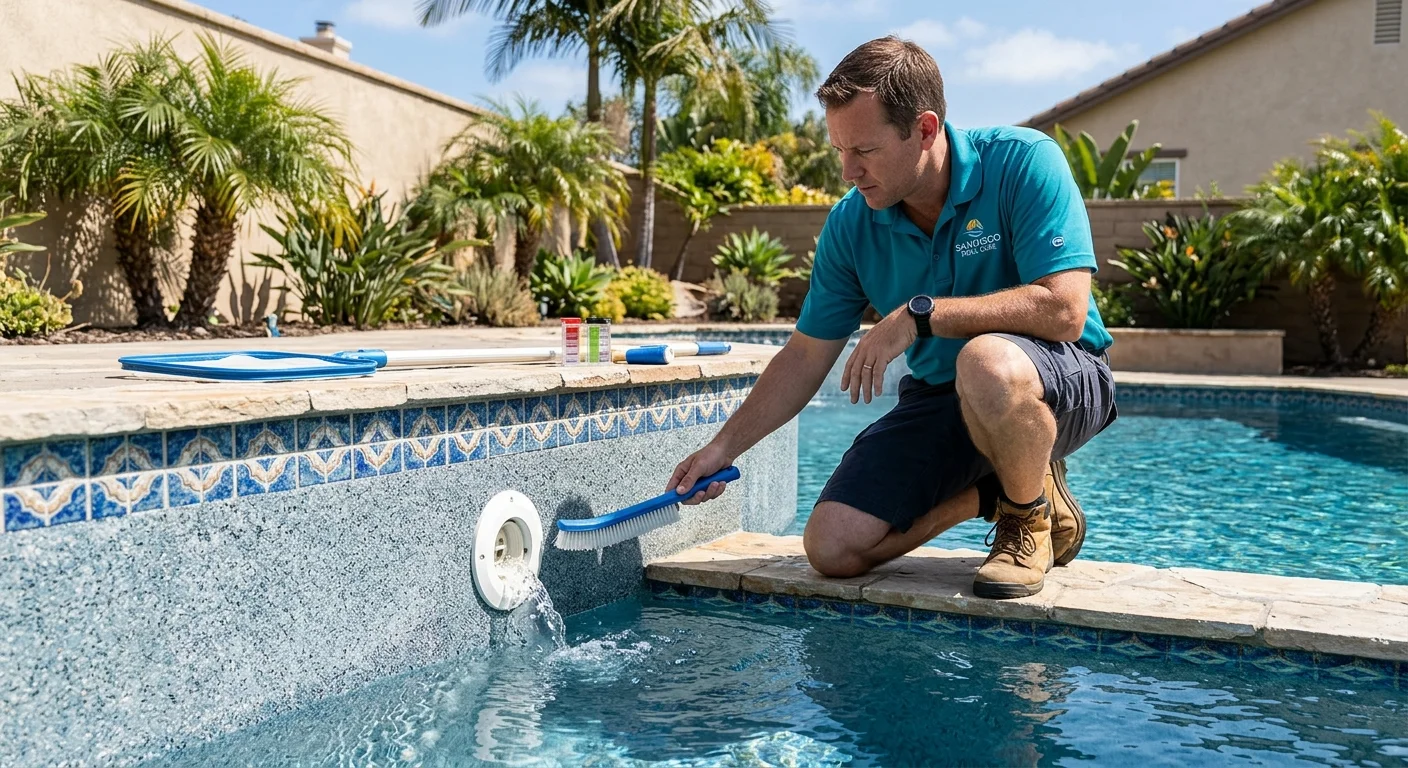
The deep-end return should throw a firm stream across the water. When it fades to a trickle, the far corner goes still, the eyeball spins, and the surface looks dull after a full filter cycle. In a San Diego backyard that is often a clogged pool jet nozzle, and sometimes it is the pipe in the shell behind it.
What a return jet does versus a skimmer
A return jet is the fitting in the wall that sends filtered water back into the pool. The pump draws from the skimmer at the waterline and from the main drain on the floor. That water goes through the filter, then out the returns. Suction is inbound. The jet is outbound.
Stand in the shallow end and feel for flow. You should find one, two, or three streams along the walls. Older gunite pools across Clairemont, Allied Gardens, El Cajon, and Chula Vista often have adjustable eyeball returns. The eyeball is the round insert you can aim. Twist it and the stream follows. That is the pool jet nozzle most homeowners mean when the jets are dead.
The skimmer’s job is different. It pulls leaves, oil, and surface dirt into the basket so they never reach the pump. A clogged skimmer or a jammed weir starves the pump. Every return then goes weak together. A single dead jet with the others still pushing hard is almost never the skimmer. It is that return.
Circulation is the whole point. Each stream should sweep the floor and knock debris toward the skimmer. In East County heat, a dead corner grows algae fast. Along the coast in Pacific Beach or Encinitas, the same pocket shows up as film on the tile. CDC healthy swimming guidance is built on treated, moving water. Still pockets fight that.
A licensed pro starts by naming which side failed. Weak everywhere points to the pad: pump, filter, valves, or suction. One silent wall fitting points to that nozzle or the line that feeds it.
Weak flow, spinning eyeballs, and dead zones
A healthy return feels like a firm push against your hand a foot off the wall. Weak flow feels like a leaky hose. You may also see the eyeball rattling or spinning. That usually means the stream is too thin to hold the nozzle, or the eyeball is worn oval from years of grit.
San Diego tap water is hard in much of the county. Scale builds on tile, and it builds inside a small nozzle opening too. A white crust around the fitting is a clue. So is a stream that shoots up instead of across, because calcium has locked the eyeball off-aim. Inland yards in Santee, Lakeside, and El Cajon bake in summer, so a dead zone there clouds faster than a shaded Point Loma pool with the same plumbing.
Watch the waterline. If dirt stacks in one corner while the opposite wall stays clean, that return is not doing its job. Pool cleaners stall in those pockets. Sanitizer still runs, but the chemistry never mixes evenly. You get a clear deep end and a slick shallow step. Pool return jets not working in only one bay of the pool is a pattern, not a mystery.
A spinning eyeball is not a style choice. On many older San Diego gunite pools the eyeball is meant to stay where you set it. If it will not hold, the inner ring is worn, or the nozzle no longer matches the pump’s current output. A variable-speed pump on a low setting can make every jet look lazy. That is a speed and valve check, not a broken fitting. The pro reads those first, before anyone orders a part.
Don’t jam a screwdriver into a frozen eyeball. You can crack the wall fitting, and then the leak is in the plaster. Note which jets are strong, which are weak, and whether the weakness showed up after a filter cleaning or a valve change. That log saves the specialist time on site.
When the problem is the line, not the nozzle
Pull the eyeball if it unscrews by hand. Look into the opening. Leaves, a pebble, or a plug of scale in the throat mean the pool jet nozzle itself was the choke. A clear opening and still no push means the restriction is upstream of that fitting.
Common line-side causes: a return valve at the pad closed or only half open, a three-way valve aimed at the spa instead of the pool, or a clog in that one run. On a pool-spa combo in North County, the spa return can steal the flow if an actuator sticks. The wall jet in the pool then looks dead while the spa boils.
A crushed or collapsed pipe under a slab is a different job. Driveways, new patio pours, and tree roots along older East County lots all sit on top of return lines. The specialist may pressure-test the line or use a camera before anyone recommends opening concrete. That is pool repair on the pressure side, not a suction-line repair and not a skimmer rebuild.
If every return died at once, stay on the pad. A dirty filter, a pump that will not prime, or a clogged main drain will starve the whole loop. The pro treats that as equipment and suction until flow at the pad is normal. Only then does a single quiet jet get its own diagnosis.
Don’t assume a quiet jet is a leak. A return can be blocked and still hold water. Leak work starts when the water level drops and a test isolates the line. Mixing those two problems leads to the wrong repair.
What a pool pro replaces on the return side
Swimming pool return jet repair is usually small on the wall and careful in the shell. The licensed pro may swap the eyeball, the inner nozzle, or the whole threaded wall fitting. Pool eyeball jet replacement is the common call when the insert is cracked, oval, or missing. The replacement has to match the thread and the pipe size in that wall. There is no universal part that fits every San Diego gunite pool.
If the fitting in the plaster is loose, water can travel behind the tile. The pro may need to reset the fitting and patch the surrounding plaster. That is still return-side work. It is not a full replaster. If the leak tracks into the deck, the scope grows, and the specialist will say so before cutting.
At the equipment pad the fix can be a return valve, a check valve, or an actuator that no longer sends water to the pool loop. Those parts sit above ground. They are faster to reach than a line under the coping. The pro tests from the pad first, then moves to the wall.
Refresh Pool Pros matches you with that licensed specialist. The specialist does the physical work. Confirm the license on the CSLB license lookup before work starts. Unlicensed contracting is a misdemeanor unless the job is exempt.
Repair versus a larger plumbing job
An eyeball you can hold in your palm is a repair. A return line that has to be traced under the deck is a plumbing job. The fork is simple. If flow returns after the nozzle is cleared or replaced, you stay on the small repair. If the opening is clear and that run still has no pressure, the pipe is next.
Larger work can mean opening a section of deck, finding the collapse, and tying in new pipe. That is a different conversation from a fitting on the wall. It can also mean rerouting a return so a dead zone in a long rectangular pool finally gets a stream. Older Mid-Century yards in Mission Hills and La Mesa often have two returns on a long axis. One clogged line leaves half the pool still.
Don’t treat a return repair as a suction-line project. Suction lines pull. Returns push. The tests, the fittings, and the risk of draining the pool are not the same. Keep the two jobs separate so the quote matches the actual failure.
A licensed pro will also check whether the pump speed, the filter pressure, and the valve map still match the original layout. A new variable-speed motor on an old gunite pool can change how each jet feels. That does not automatically mean the plumbing failed. It means the system needs to be balanced again.
If the plaster around the fitting is failing, ask whether a patch holds or whether the wall needs a wider repair. That decision belongs on site.
When to call us
Call when one return is dead, the eyeball will not hold aim, or a corner of the pool stays cloudy after the rest of the water clears. A licensed local specialist traces the pool jet nozzle, the wall fitting, and the line behind it. Call us at (858) 400-4598 and we’ll connect you with a licensed local pool specialist.
Frequently asked questions
Why is one pool return jet weaker than the others?
A single weak jet usually points to that pool jet nozzle, an eyeball packed with scale or debris, or a restriction in that one return line. If every return is weak, a licensed pro starts at the pump, the filter, and the suction side instead.
Can I unscrew a pool eyeball jet myself?
A loose eyeball can often be twisted out so you can look for leaves or scale in the opening. Stop if the wall fitting is cracked, leaking, or will not turn. Line work and a leaking return in the plaster belong with a licensed local pro. Confirm the license at the CSLB lookup before you hire.
What is the difference between a return jet and a skimmer?
The skimmer pulls surface water into the plumbing. The return jet pushes filtered water back into the pool. One is suction. The other is pressure. A dead jet is a return-side problem until a pro proves otherwise.
When does a dead return mean a plumbing problem?
When the eyeball is clear, the other returns are strong, and that one wall fitting still has little or no flow. That pattern often means a clog, a crushed pipe, or a closed valve on that line. A licensed pro tests the run before anyone opens the deck.
Do older San Diego gunite pools use a different return fitting?
Many older gunite pools in the county have adjustable eyeball returns set in the plaster. Newer builds may use a similar eyeball or a directional nozzle. The idea is the same: aim the stream so water moves across the pool. Fitting size and thread vary, so the pro matches the part on site.
Need professional help in San Diego County?
Refresh Pool Pros connects you with a licensed specialist for any service in this post.