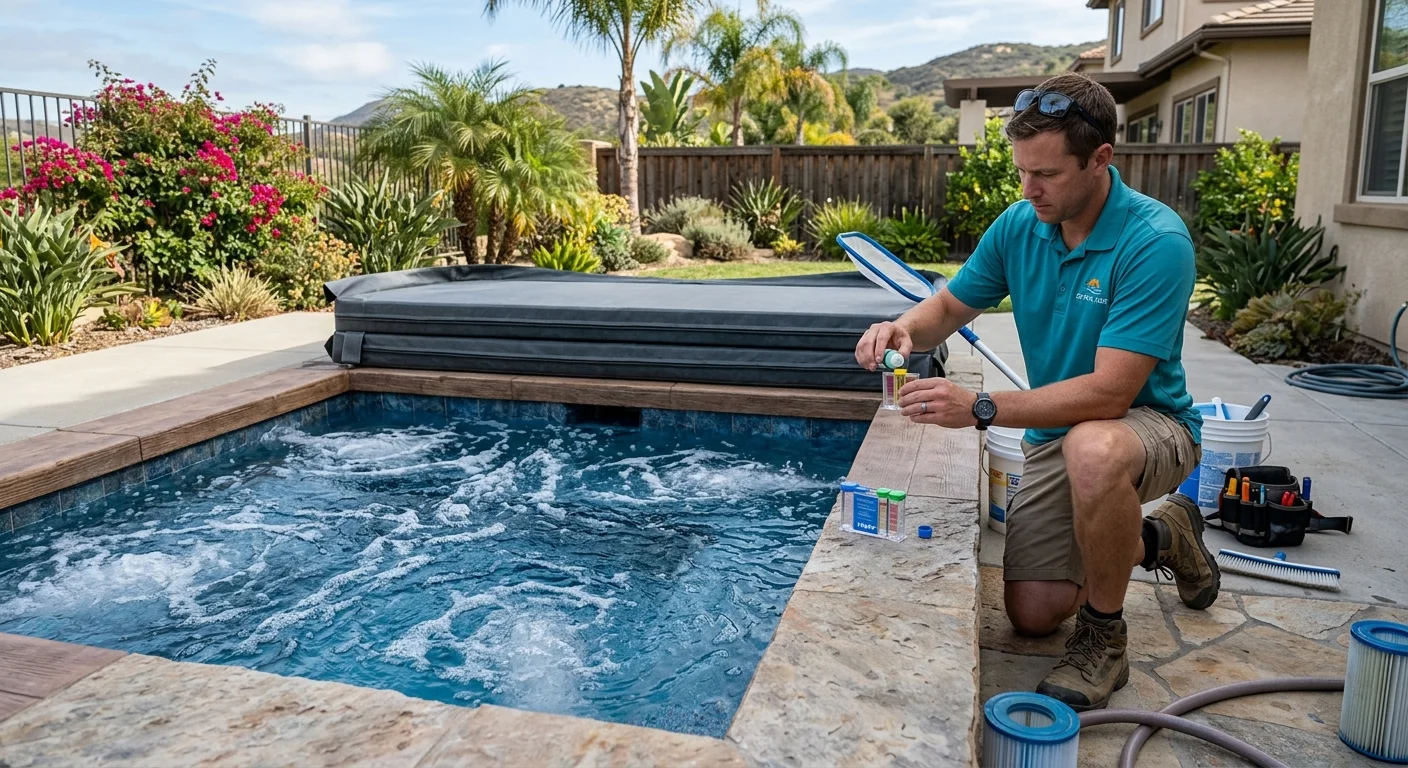
You drop into the spa and the seats stay still. Heat may be fine. Water may look clear. The massage is the part that quit. In San Diego County that shows up two ways: a portable hot tub on a patio, or a gunite spa tied to the pool pad. Both can leave you with spa jets not working. The cause is usually air in the lines, a diverter sending flow somewhere else, scale in a face, or a pump that is not moving water. A spa repair specialist traces that chain instead of swapping the first insert that looks stuck.
Air, water, and the diverter: three different failures
A spa jet is a mix, not a single part.
Water pressure comes from a jet pump, or from a shared pool pump on an attached spa. That water travels a manifold, then a jet body, then the face you see in the seat. Starve any step and the lounge goes quiet.
Air is a separate path. Most rims have a small air-control knob. Turning it lets a venturi pull air into the stream. Some portable spas also use a dedicated air blower. If the water still shoots and the bubbles are gone, you are looking at the air path or the blower, not a dead water pump.
The diverter is the third failure. It is a valve that steers volume from one lounge to another. Left hard to one side, half the spa looks broken. Scaled or cracked, it leaks pressure even when you park it in the middle.
Jet faces add a local twist. Many inserts rotate to throttle or shut off. After a party, or after a cover presses on a half-open face, a whole row can sit closed. Open them by hand before anyone blames the equipment.
Low water is the San Diego version of an air problem. Afternoon heat in Escondido, El Cajon, and the inland valleys drops an uncovered spa fast. Once the level sits near the highest jet, the pump gulps air. Flow surges, then fades. Top to the fill line on the shell, then test again.
A true air lock is more common after a drain and refill. The motor runs. The jets sputter or stay dead. Some manuals describe pulling the filter and running Jets in short bursts, or cracking a pump union a little to bleed the pocket. Power off at the breaker first. Do not run a dry pump to clear it. If you cannot tell which fitting is the discharge union, leave it alone. A licensed specialist bleeds that line without burning the wet end.
To turn the water jets on, fill to the mark, open the faces, set the diverter toward that seat or to the center, then press Jets on the topside. Air knobs do not replace that button. If the button does nothing on every seat, the control or the pump circuit is next, not the inserts.
Clogged jets versus a weak spa pump
One silent jet is almost always local. Hair, grit, and calcium park in the insert. Inland North County and East County water runs hard. Scale narrows the orifice until that face crawls. Coastal yards collect sand, salt film, and windblown dust on an uncovered shell.
A packed filter can mimic a dying pump. Sunscreen, body oil, and pollen load a cartridge. After dry winds or a smoky week, a portable spa filter cakes faster than a monthly habit. The motor still sounds busy. Hot tub jets weak on every seat is the tell. Clean or swap the filter, then retest.
A weak spa pump looks different. Every outlet on that pump’s manifold is soft. One speed may die while the other still moves a little water. The motor may hum, click, or heat up and drop out. That path is spa pump repair in San Diego, not a bag of new faces.
A wet cabinet is another split. A weeping union, a failed shaft seal, or a cracked jet body drops the water line and steals pressure. You can chase inserts for a week and never fix a leak.
The blower sits beside this, not on top of it. Normal water pressure with no bubbles points at closed air controls, a blocked air line, or a blower that no longer spins. No water at the faces means the water pump, the valves, or a clog. Chasing the blower first wastes the visit.
Do not pry a stuck insert with a screwdriver. You can crack the body in the shell and turn a clog into a leak. Kill power before anyone pulls a face. Replacement faces have to match the original jet family. Mixing styles on one manifold leaves one seat forever weaker than the rest.
For the rest of what fails on these units, read spa and hot tub repair in San Diego. Jets are one slice. Heat, leaks, and controls are the others.
What a pro checks inside the cabinet
Guessing ends when the side panel comes off. A licensed specialist shuts power at the breaker, not only at the topside, before that happens. Wiring, capacitors, and the control pack are electrical work. Refresh Pool Pros does not open the cabinet. The matched pro does.
The chain inside is short. Filter and unions. Wet end and impeller. Motor and capacitor. Control pack and the Jets relay. Diverter plumbing. Air blower, if the spa has one. The heater only as it ties to flow switches.
A pump that will not start is often not a burned motor. A GFCI or breaker that will not hold. A topside that never signals the relay. A high-limit or dry-fire lockout. A low-water cutoff. An impeller packed solid. The specialist checks those in that order because a new motor does not reset a tripped GFCI.
Air locks show as a dry volute and a motor that spins with little load. Clogs show as a packed impeller or a collapsed suction hose. Scale shows as crust at the wet-end throat.
Coastal North County cabinets pick up salt air and irrigation overspray on terminals. Inland cabinets cook capacitors in closed heat. Both present as spa jets not working. Neither starts at the jet face.
If the bay is wet, treat it as a leak until proven otherwise. Confirm the person doing the work is licensed on the CSLB license lookup before a motor comes out.
Attached spas that share the pool pad
A gunite spa off a Chula Vista or El Cajon pool is not a plug-in portable in Encinitas. The jets often live on the pool equipment pad. Valves on that pad decide whether the pump pushes to the pool returns, the spa jets, or both.
Quiet spa, strong pool returns: the spa valves may still sit in pool mode. A slipped handle, a failed actuator, or a diverter left mid-stroke starves the spa while the pool looks healthy. That pattern is closer to pool return jets not working than to a portable-spa insert.
Some attached spas have their own jet pump. Some borrow the pool pump, sometimes with a booster. The pro maps which motor feeds which manifold before anyone orders faces. A clean pool filter next to a packed spa filter is a real split on older pads.
After a resurface, plaster dust loads spa jets. Inland yards see more mineral scale. South Bay and coastal pads see more corrosion, and salt systems leave a different film on fittings. Same county, different wear. The San Diego County Water Authority is the regional wholesaler. Local districts set what actually comes out of the tap, and it runs hard enough in much of the inland county to mark jet orifices over time.
Water level on an attached spa is the pool’s water level. Wind along the coast drops both. A low pool makes spa jets gulp air even when every valve is right.
Spa and hot tub service covers both shells: the portable in the side yard and the gunite seat off the shallow end.
Repair versus replace, without a price
Start with the smallest true fix. Open the faces. Center the diverter. Raise the water. Clean the filter. If the seats come back, you did not need parts.
A removable insert that is clogged or worn can come out and be replaced with a matching piece. A cracked jet body behind acrylic or plaster is a larger job. Portables often need cabinet access or a cut in foam. On gunite, the body sits in the shell.
Pumps get repaired when the wet end, seal, or capacitor is the failure and the motor is otherwise sound. They get replaced when the motor is burned, the wet end is obsolete, or the housing is cracked. This site publishes no price list for either path. The licensed pro prices the actual spa after seeing the cabinet, the model, and which parts are still made for it.
Do not jump to a whole-spa replacement because one lounge is dead. Dead jets on one seat are not a dead spa. A humming pump with no flow is not a cluster of bad faces. Get the chain right, then decide.
When to call us
When the pump hums and the seats stay still, the cabinet is wet, or the Jets button does nothing, stop swapping inserts. Call us at (858) 400-4598 and we’ll connect you with a licensed local pool specialist.
Frequently asked questions
How do I get air out of hot tub lines?
After a drain and refill, air can sit in the pump and starve the jets. Fill to the mark on the shell, reseat the filter, and run Jets only in short bursts if the manual allows it. A licensed pro can bleed a pump union with power off at the breaker. Do not run the pump dry to clear the lines.
How do I activate the water jets on a spa?
Fill to the fill line, twist the jet faces open, set the diverter toward that seat or to the center, then press Jets on the topside. Air knobs only add bubbles. They do not start the water pump. If the button does nothing on every seat, the control or pump circuit is next.
Why isn't my hot tub pump turning on?
A tripped GFCI or breaker, a topside that never sends the Jets relay, a high-limit or low-water lockout, or a seized impeller can all look like a dead pump. A licensed specialist checks those before anyone replaces the motor. Kill power at the breaker before the cabinet panel comes off.
Why is my spa blower not working?
The blower is the air side. If water still shoots and the bubbles are gone, the air controls, air line, or blower motor is the suspect. If there is no water at the faces, fix the water-pump path first. Many San Diego spas mix air with a venturi knob and have no blower at all.
Why are only some spa jets weak?
A closed face, a clogged insert, or a diverter sending volume to the other lounge usually explains one dead zone. Weak flow on every seat points at a dirty filter, an air lock, low water, or the pump. On a gunite spa tied to the pool pad, check the spa valves before anyone orders new faces.
Need professional help in San Diego County?
Refresh Pool Pros connects you with a licensed specialist for any service in this post.