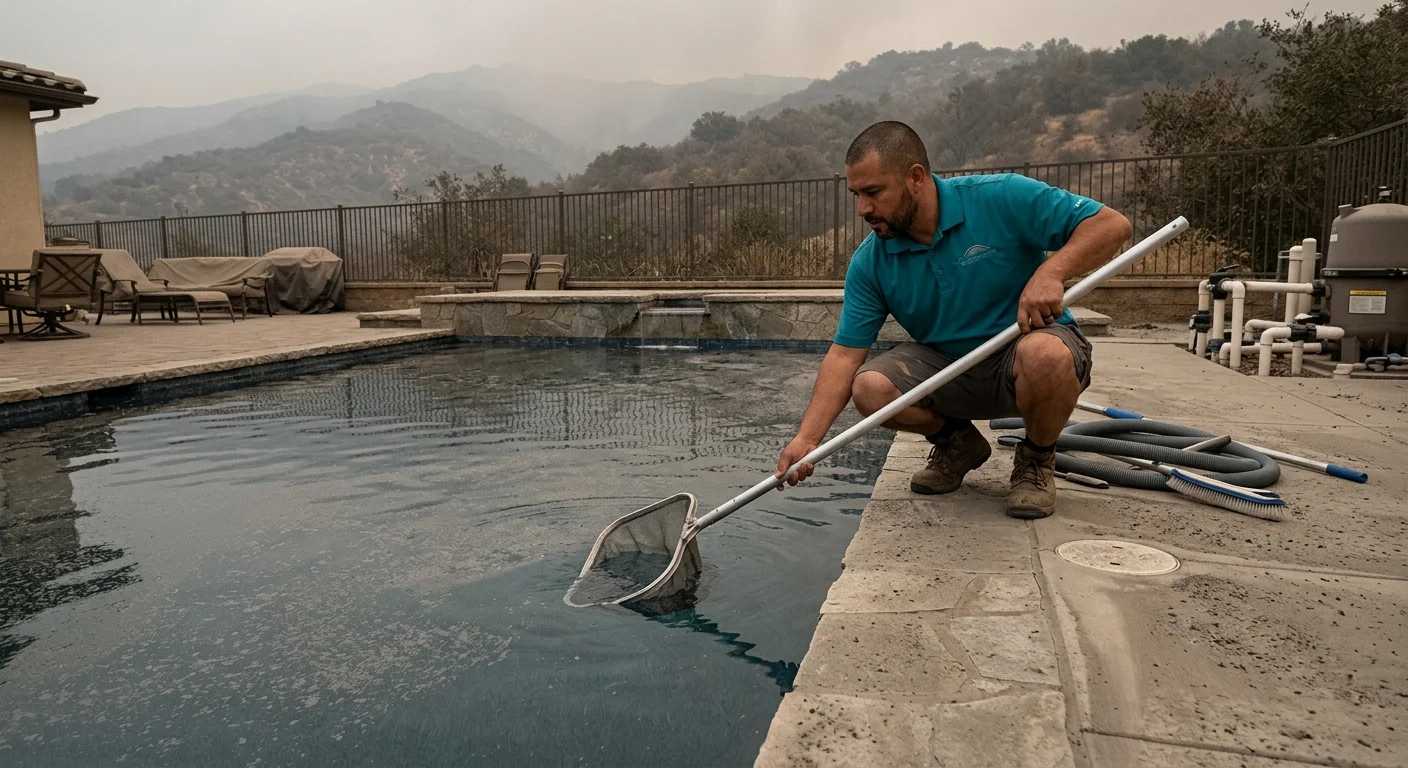
Gray silt on the water after a San Diego smoke day is not ordinary dust. Wildfire ash in a pool is fine, wet, and stubborn. It clings to the waterline, packs the skimmer, and can dull plaster before anyone has run a test strip.
September is fire-and-ash season here. Inland yards often wake up to a film. Coastal yards may only see haze. Either way, the job is physical first. Chemistry comes after the grit is out. A licensed local pool specialist handles the cleanup. Refresh Pool Pros matches you with that pro. We do not work on the pool ourselves.
How wildfire ash behaves in a San Diego pool
Wildfire ash starts as a gray skin. Then it waterlogs and sinks. You see it first on the surface, in the skimmer throat, and along the tile line. Steps and tanning ledges collect it because the water is shallow and slow there. Corners with weak returns hold a ring that looks like dirt and feels like silt.
It is not the same as a normal leaf load. Eucalyptus bark and palm fiber sit in a net. Ash slips through ordinary mesh. Some owners slip a clean cotton rag over the leaf net so the fine stuff stays in the bag. That is a homeowner skim, not a full cleanup. Stop if you are stirring a cloud down to the floor. Stirring fine ash into plaster is how a one-day film becomes a stain.
Once it sinks, it behaves like silt. Brushing too hard can drive it into porous plaster. Vacuuming on a setting that sends water through the filter can pack the media in one pass. If you do not know which vacuum setting your system uses, leave the hose in the shed and wait for the specialist. A robot cleaner will grind the same grit into the pump if you leave it running through the fallout.
Ash on the deck is still in play. Wind off a canyon, or a kid running to the gate, puts it back in the water. Do not hose the deck to the street. In San Diego County, streets and gutters feed the storm system, not a pool drain. Lightly mist so dust stays down, then sweep into a bag. Confirm your city’s stormwater rules if you are unsure. A specific county ordinance number was not confirmed for this page.
Stay out of the water while it is cloudy. The CDC’s healthy swimming guidance is built around water you can actually see through. If you cannot see the main drain or the floor of the shallow end, nobody should be in there, including dogs.
Soot and char can ride in with the ash. You do not need the lab names. You need the grit out of the pool. Fire retardant is a different mess. Pink or red slurry on the water or the deck is not ordinary ash. Do not treat it like a weekend brush-down. Photograph it and get a licensed specialist on the match.
Inland valleys vs the coast after a smoke day
San Diego County is not one backyard. After the same smoke day, a pool in Ramona and a pool in Pacific Beach will not look the same.
East County and the inland valleys sit closer to dry chaparral and canyon wind. Alpine, Lakeside, El Cajon, Santee, Spring Valley, Jamul, and the back country toward the Cleveland National Forest catch more fallout when the wind is offshore. North County inland is the same story in a different bowl. Escondido, San Marcos, Valley Center, Fallbrook, Poway, and the hills above Escondido collect fine ash overnight on covers, coping, and the water. Stucco dust from a Santa Ana is tan. Wildfire ash is gray. If your water looks like wet cement, you are not dealing with ordinary wind dirt.
The coast still gets the event. La Jolla, Pacific Beach, Ocean Beach, Del Mar, Encinitas, Carlsbad, and Coronado often see haze more than a heavy gray blanket. The marine layer can hold smoke in a band, then peel it inland as the afternoon wind flips. South Bay is not spared. Chula Vista, Bonita, and Otay Mesa sit under east-wind days that push canyon dust toward the bay. A pool two blocks from the sand can still take a fine film. It is usually thinner than what lands in a Ramona cul-de-sac.
If you live in a street that backs to open space, treat your pool like the inland case even if your zip code sounds coastal. Mission Gorge, the El Capitan side of Lakeside, and the Palomar foothills all funnel debris. A cover can help in light fallout. A cover loaded with ash can dump a concentrated mess if you drag it off in one pull. Sweep the cover into a bag first. Do not rinse it into the pool. Mesh covers let the finest dust through. Solid covers hold a pile you have to handle before you roll them.
The point of the geography is simple. Do not copy a coastal neighbor’s extra pump runtime and call it done. An inland plaster pool with a cartridge filter can load in a single afternoon. Record what you see, then get the right specialist for the mess you actually have.
What to shut off and what to record before a pool pro comes
If the power is out, leave the equipment pad off. A pump that ran dry, or a pump that will start into a basket full of grit, is how a cleanup turns into a repair. Do not bump the breaker “just to see.” Wait until a licensed specialist has looked at the strainer, the water level, and the filter.
If power is on and ash is still falling in sheets, pause the automatic cleaner. Robots and suction cleaners grind fine ash into the system. A salt cell that is already complaining about flow should stay off until circulation is clean. You are not diagnosing the cell. You are keeping it from running in dirty water. Leave the heater off too. Ash in a heat exchanger is a specialist problem, not a thermostat tweak.
What to record is more useful than what to dump in the water. Take a photo of the surface and the waterline. Take a photo of both skimmer baskets and the pump basket. Write down the number on the filter pressure gauge, plus what that gauge usually reads when the filter is clean, if you know it. Note whether a cover was on. Note the last product you added, and when. Note any pink or red residue that is not gray ash. Note whether the pump hummed, tripped, or sat silent.
Do not shock a pool that is still full of grit. Chlorine cannot pick up silt. Do not add clarifier on top of a packed filter. Do not drain the pool. Draining is not the first move after a smoke day, and it is often the wrong move for the shell. If a licensed specialist later says a drain is required, stop and check discharge rules with your local water district and the San Diego County Water Authority. A county-wide dump-to-sewer figure was not confirmed here. The district that sells you water is the one that can tell you where pool water is allowed to go.
If you already have a name in mind, look them up on the CSLB license check before they touch the pad.
Filters, pumps, and chemistry after ash fall
The filter takes the beating. Cartridge systems load with fine ash because the media is tight. Sand and DE systems load too. Weak return flow, a rising pressure gauge, or a pump that sounds strained are the tells. None of those numbers is a universal cutoff. Read the gauge you have. Compare it to the clean reading you wrote down. Then let the specialist decide whether to rinse, backwash, or pull the media.
Backwashing is not free water. It drops the level, and the waste has to go somewhere legal. Do not send it to a driveway, a gutter, or a canyon. Confirm the approved discharge with your city or water district before anyone opens a valve. If the filter is a cartridge pack that will not rinse clear, that is a filter repair or replacement conversation, not another garden-hose session.
The pump only helps if it has water and a clear strainer. A clogged basket makes the pump work like it is starving. Empty baskets if you can do it safely with the power off at the timer or breaker. Do not pull a lid on a pressurized filter. That is how people get hurt. Keep the waterline at the middle of the skimmer so the skimmer can actually pick up what is still floating. Too low, and the pump sucks air. Too high, and the skimmer stops skimming.
Chemistry comes after the physical load is down. Ash is not a pool product. It is burned material. Searchers often mix it up with soda ash, which is a pH raiser sold in a bag. They are not the same thing. Soda ash does not clean wildfire ash out of a pool. Wildfire ash can make sanitizer work harder because there is more junk in the water. It can also leave the water looking dull even when a strip still shows chlorine. Do not chase that with guesswork doses. A specific pH or chlorine target for ash days was not confirmed for this page. Test, or better, let the specialist test.
If the pool sits dirty and the sanitizer collapses, you can wake up to algae. That is a different job, and it is covered in our green pool cleaning guide. Ash cleanup and a green pool are not the same service. One can follow the other if the water is ignored. Keep people out until the water is clear enough to see the floor. That is a visibility rule, not a brand promise.
When ash cleanup turns into equipment repair
Most ash days are a heavy clean: skim, brush, vacuum, wash the filter, rebalance. Some are not.
Call it a repair problem when the pump will not prime, the motor hums and stops, the filter will not come back to a normal pressure, or the heater errors after the event. A salt cell coated in gray film belongs on that list. So does plaster that stained because ash sat on a step for days. A DE grid that tears under a sudden dirt load belongs there too.
If a fire was close enough to scorch fencing, melt a cover, or drop debris into the equipment pad, treat it as emergency pool service, not a Saturday tune-up. Enclosure damage around a pool is a safety issue. Do not leave a gap in a fence until it is convenient.
The brand you are reading does not own trucks and does not hold the trade license for the work. We match you with a licensed independent specialist. That person does the cleanup, the filter work, and any repair. Ask to see the license, then confirm it on the CSLB site linked above.
Do not wait for the pool to settle. Fine ash that sits is harder to get off plaster and vinyl. Do not keep running a pump against a packed filter. That is how a cleanup visit becomes a motor visit. No price list belongs on this page. The specialist quotes after they see the water, the pad, and the filter.
If you are in East County or an inland North County valley and the hills are still smeared with smoke, plan on more than one filter wash. Coastal yards with a light film may get off lighter. The geography still wins.
When to call us
When the water is a gray soup, the filter is packed, or the pump sounds wrong after a smoke day, it is time for a licensed pool specialist, not another bottle from the garage. Call us at (858) 400-4598 and we’ll connect you with a licensed local pool specialist.
Frequently asked questions
Is wildfire ash the same as soda ash in a pool?
No. Soda ash is a bagged pH raiser. Wildfire ash is burned debris that landed in the water. They are not interchangeable, and a licensed specialist should test before anyone adds product.
Should you drain a San Diego pool after ash fall?
No. Draining is not the first move, and this page could not confirm a county-wide dump rule. If a licensed specialist later says a drain is needed, check discharge rules with your water district and the San Diego County Water Authority.
Can you swim after wildfire ash lands in the pool?
Stay out while the water is cloudy. If you cannot see the floor or the main drain, nobody should be in the pool, including pets. A licensed specialist should restore clarity and sanitizer before anyone swims.
Does a backyard pool protect you in a wildfire?
No. A San Diego backyard pool is not a wildfire shelter. Follow official evacuation orders. This page is about ash in the water after the smoke, not about riding out a fire.
When does ash in a pool need a licensed specialist?
When the filter is packed, the pump sounds wrong, the heater errors, ash is still falling in sheets, or the water will not clear after a skim. Refresh Pool Pros matches you with a licensed local pro. We do not do the physical work.
Need professional help in San Diego County?
Refresh Pool Pros connects you with a licensed specialist for any service in this post.