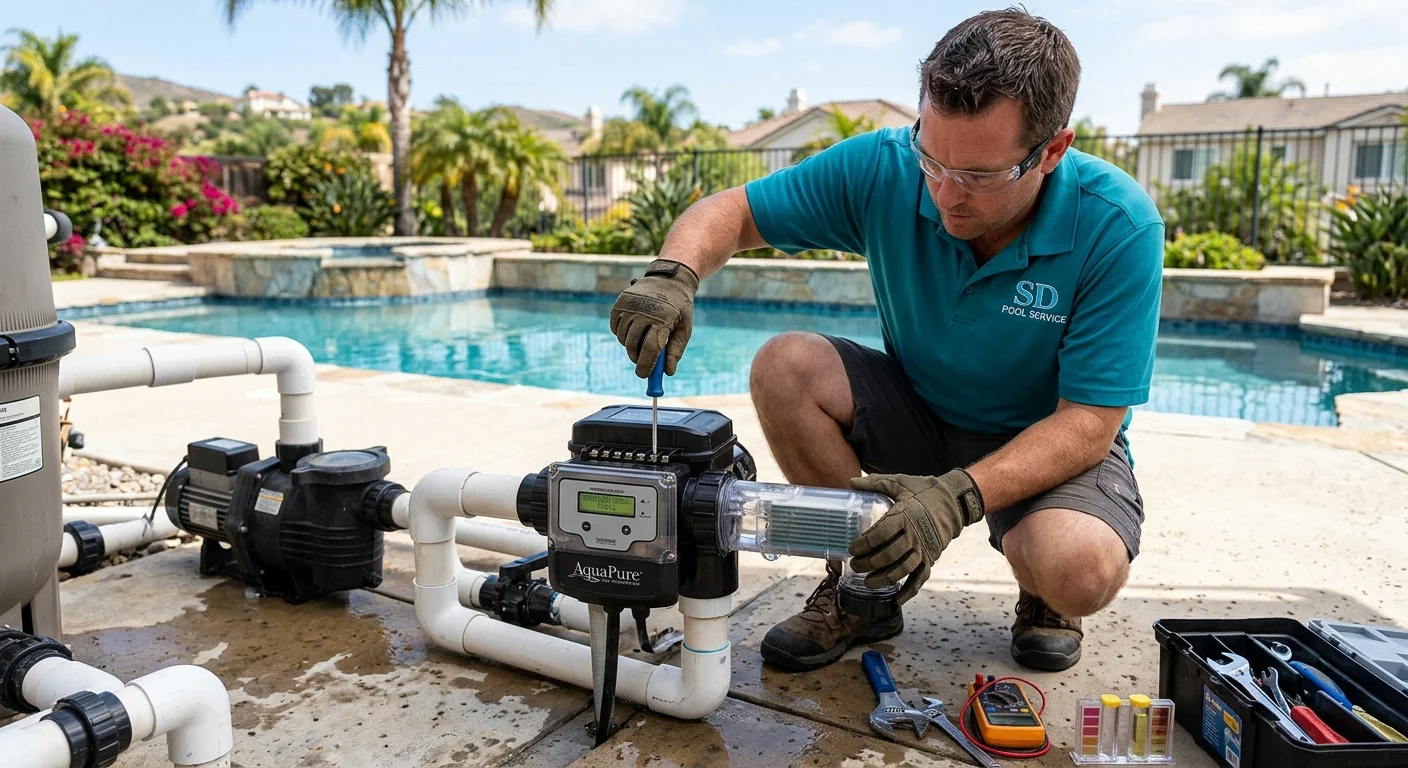
The control box flashes low salt. The test kit shows no free chlorine. The water looks dull, and it feels like the salt system died overnight. On a San Diego equipment pad, that scene is common, and it is often not a failed cell. A salt cell not producing chlorine usually traces to a false salt reading, scale on the plates, weak flow, cool water, or a pool that is burning chlorine faster than the generator can make it.
Readings that look like low salt but are not
A saltwater pool still needs chlorine. The salt is the raw material. The cell turns that salt into sanitizer as water moves across the plates. When your kit reads zero, you are seeing leftover free chlorine after the water has already used what it could. High demand can empty that residual even while the cell is still making some chlorine. The CDC’s healthy swimming guidance is clear on why the residual matters: chlorine and pH have to stay in a range that actually protects swimmers.
The number on the controller is not a lab test. Most salt systems infer salinity from conductivity. Scale on the plates, a tired sensor, warm water, and other dissolved minerals all change that reading. Tap water in much of San Diego County is hard. Inland yards in El Cajon, Santee, and Escondido often pick up more mineral load than a coastal pad in Encinitas or Pacific Beach. Hard water does not always mean the salt is low. It often means the cell is guessing. For the local mineral picture, see hard water and San Diego pools.
Confirm salt with an independent test. Use a salt strip, a drop kit, or a sample a licensed specialist tests. Compare that result to the display. If the water tests in the range your model calls for and the box still says low salt, do not dump more bags in. Extra salt will not clean plates or fix a bad sensor, and it can push the unit into a high-salt lockout. Your owner’s manual lists the salinity window for that cell. Use that window. A single ppm target does not travel across brands, so this page will not invent one.
A check-cell or inspect-cell light is often a reminder, not a death sentence. Many controllers light it after a set number of hours so you look at the plates. Treat it as an inspection cue. Then test the water yourself. If you are still weighing salt against traditional chlorine, the chemistry gap is smaller than the sales pitch. Read chlorine vs salt water pools in San Diego. A salt water conversion still leaves you with chlorine, testing, and a cell that has to stay clean.
Scale, flow, and water temperature
White crust on the plates is the San Diego failure that looks like a dead cell. Calcium from hard fill water plates out when pH and alkalinity run high, and it bridges the gap the current has to jump. Generation drops. The box may report low salt because the scaled plates no longer read conductivity the way the software expects. Coastal north county yards see this after a dry, windy stretch. East County yards see it faster in summer, when heat and evaporation concentrate minerals. The San Diego County Water Authority is the regional wholesaler behind much of that tap water. District quality still varies, so treat hardness as a local fact, not a number copied from a city page.
Flow is the other quiet shutdown. A salt chlorinator needs water moving through the cell. A packed pump basket, a full skimmer, a dirty cartridge, a sand or DE filter that is overdue, or a valve left partway closed can all trip a low-flow or no-flow light. Variable-speed pumps are common on San Diego pads. A speed that is fine for overnight circulation can sit below the flow switch’s threshold, so the cell never turns on even though the pump is humming. Watch the filter gauge against its normal clean reading. If pressure is climbing, clean or service the filter before you blame the cell.
Water temperature is a third lockout that owners miss in spring and on cool coastal nights. Many systems slow down or stop generating when the water is cold. That is a protective behavior, not a broken box. Inland summer is the opposite problem: hot water, heavy sun, and more scale. If the display cites a temperature fault and the pool is clearly in a normal swimming range, the sensor or the scaled cell may be lying. Do not chase a made-up operating window. Use the range printed in your manual.
Tiny bubbles in a clear cell housing are a useful clue. Cloudy water leaving the cell usually means generation is happening. Clear, still water in the housing, with the pump running and no warnings, is a reason to keep looking. Not every housing is clear. If yours is opaque, skip the guess and test free chlorine at a return after the system has been running.
Controller versus cell versus actual salt
Three different parts can produce the same symptom. The controller is the box on the pad. The cell is the electrode housing in the plumbing. The salt is in the water. A salt water chlorinator not working is often one of those three, not all three at once.
Start with power. Confirm the breaker and any GFCI feeding the pad. A dark controller with no lights is an electrical problem until proven otherwise. Some cabinets also hold a fuse. If you are not comfortable opening that cabinet, stop and have a licensed specialist do it. Feeling the cord for warmth is a weak check. Lights on the box are a better one. After power is restored, many units run a short self-check before they generate. That delay is normal. It is not the same as the hours it may take for free chlorine to show up in the whole pool.
Next, separate the sensor from the plates. The controller can report the wrong salt, the wrong temperature, or a check-cell warning while the plates are still able to work. The reverse is also true: the display can look calm while the coating on the plates is worn and output is weak. An independent salt test is the tie-breaker. If the water’s salt is in range for the model and the box disagrees, you are looking at scale, a sensor, or the board, not a shortage of salt.
A reset belongs here, not at the start. Follow the manufacturer’s steps. A common first move is to cut power at the breaker, wait, and restore it so the controller reboots. Some brands also have a menu item that clears an averaged salt reading after you have actually changed the water. Resetting will not dissolve scale, open a closed valve, or put stabilizer in the pool. If the same warning returns after a clean reboot and a real water test, the hardware still needs eyes on it.
Leave voltage and amp checks to the specialist. Those tests are easy to misread and easy to do on a live circuit. The homeowner job is the water test, the baskets, the filter, the valves, and a visual look at the plates with power off.
Cleaning the cell versus replacing it
Cleaning comes before replacement. Scale is common. A spent cell is less common than a panicked display. With power off, look at the plates. White crust, bridging between blades, and debris caught in the housing are cleaning problems. Dark, crumbling coating, bent blades, or plates that stay dirty after a proper clean are closer to a replacement conversation.
Follow the cell maker’s cleaning instructions. Do not scrape the coating with a screwdriver or a wire brush. That coating is the working surface. Repeated acid soaks when there is no visible scale wear it down. If the manual calls for an acid wash, use the dilution and the time it prints, add acid to water, and wear the protection it calls for. If you do not want that chemical job on the pad, a licensed specialist should do it. A check-cell light that returns right after a careful clean is a different problem than a light that was only a maintenance reminder.
Replacement is the right next step when generation stays flat after power, flow, temperature, independent salt, and a real cleaning have been ruled in. That is the diagnostic this page exists to finish before you buy parts. When the cell is actually done, use the salt cell replacement guide for San Diego and have a licensed specialist confirm the controller, the flow switch, and the cell type before anything is swapped. Cell life in years is not a figure this site can stand behind, because water chemistry, run hours, and cleaning habits change it. Judge the cell by what it is doing now, not by a calendar.
A leaking union at the housing, a cracked cell body, or terminals that look like a corroded battery post also belong in that visit. Terminal corrosion can starve the cell of current even when the plates look decent. Do not treat that as a DIY wiring project if you are not equipped for it.
Habits that starve chlorine output
A salt system not making chlorine is sometimes making it, then losing it. San Diego sun is hard on free chlorine. Stabilizer (cyanuric acid) is what slows that burn in an outdoor pool. If stabilizer is too low, new chlorine can vanish as fast as the cell produces it, and the kit still reads zero. If it is too high, chlorine gets sluggish. Test it. Do not guess a ppm range from a forum. Use the range your test kit and the specialist call for on that water.
Output setting and pump run time are the other quiet misses. A cell left at a low percentage for a short daily cycle will not keep up with a July weekend in Mission Valley, a party in Chula Vista, or a Santa Ana that dumps dust across East County. Raise output and run the pump long enough for the cell to work while people are using the pool. A generator is built to maintain a clean pool. It is not a recovery machine for water that is already green or cloudy. If algae has a head start, the cell will look dead because demand is winning.
pH matters too. High pH makes chlorine less effective. Low pH can make it work faster and disappear faster. Phosphates, pollen, leaves, and a dirty filter all add demand. Shock is still part of salt-pool care when bather load or weather spikes. Adding salt will not fix demand. Adding salt on a false low reading can create a new lockout.
If the pool is already at zero, a licensed specialist may add chlorine by hand to catch up while the cell, flow, and chemistry are sorted. That is how you increase free chlorine in a salt pool when the generator is behind. Then you fix the reason it fell behind, or the same zero reading returns in a day.
When to call us
Call when the lights persist after an independent salt test, when the plates are scaled and you do not want an acid wash on the pad, or when the pool is losing chlorine and heading dull or green. Confirm the specialist is licensed on the CSLB license lookup. Call us at (858) 400-4598 and we’ll connect you with a licensed local pool specialist.
Frequently asked questions
Why is my saltwater pool showing no chlorine?
A zero free-chlorine test means the leftover sanitizer is gone. The cell may be scaled, starved of flow, sitting on a false salt reading, or the pool may be using chlorine faster than the generator can make it. Confirm salt with an independent test, then inspect flow and the plates before you assume the cell is dead.
How long does it take for a salt cell to start producing chlorine?
Many controllers run a short self-check after the pump starts, then generate while water is moving. The time until a kit shows free chlorine in the pool depends on output, pump run time, sun, and demand. Use your model's manual for start-up behavior. A cell that is generating can still leave the bulk water at zero if demand is already high.
How do you reset a salt chlorinator?
Follow the manufacturer's reset steps. A common first move is to cut power at the breaker, wait, and restore power so the controller reboots. Some brands also have a menu item that clears an averaged salt reading. A reset is not a substitute for testing the water and inspecting the cell.
How do you increase free chlorine in a salt pool?
Raise the output setting and run the pump long enough for the cell to work. If the pool is already at zero, a licensed specialist may add chlorine by hand to catch up while you fix flow, scale, or chemistry. Low stabilizer lets San Diego sun burn new chlorine off as fast as it is made. A salt cell is built to maintain a clean pool, not to recover a green one by itself.
Can a dirty salt cell cause low chlorine?
Yes. Scale on the plates can block generation, fake a low-salt reading, and trip a check-cell light even when an independent salt test looks fine. Inspect the cell. Clean it only as the manual allows. If cleaning does not restore generation, a licensed specialist can confirm whether the cell or the controller is the real fault.
Need professional help in San Diego County?
Refresh Pool Pros connects you with a licensed specialist for any service in this post.