The waterline on an El Cajon pool can fall fast in September heat, even when every fitting is tight. Dry inland air, valley sun, and afternoon wind off the Cuyamaca foothills pull water off the surface. A cracked skimmer, a loose return, or a buried line does the same thing, only the water is going into the dirt. Pool leak detection in El Cajon is how a licensed specialist separates weather from a real leak on this yard, not a coastal one.
Inland heat, evaporation, and a real leak
El Cajon sits in a valley east of the coastal hills. The marine layer that cools La Jolla and Encinitas often dies before it gets here. Summer and early fall afternoons run hotter and drier than the beach cities. A bucket test on a still Fletcher Hills morning can look like weather. The same drop under a cover, on a calm night, is a different story.
Splash-out, a running auto-fill, and a spa left uncovered all muddy the picture. So does a heater that drips condensate at the pad. None of that replaces a pressure test. Inland evaporation is the setup in East County. It is not the diagnosis.
Start with a few days of notes, not a guess. Mark the waterline on the tile at the same hour. Pause the auto-fill if you can do it safely. Set a bucket on a step, fill it to the pool level, and compare the two drops. Wind and sun take water from both. A pool that keeps losing after the bucket has not is pointing at an El Cajon pool leak.
Our county guide on pool leak or evaporation in San Diego walks through that home check. Use it as a screen. If you are refilling every few days, or the waterline falls when the air is still, it is time for a licensed specialist to isolate the plumbing and the shell.
Watch the pad and the deck while you wait. Air in the pump basket, a wet spot that never dries, a hollow paver, or algae that returns after a proper shock all belong on the notes you hand the pro. Those clues do not name the hole. They tell the specialist where to start pool leak testing in El Cajon.
Where East County pools usually lose water
El Cajon yards are not short coastal decks with new PVC in a tight run. A lot of the stock is postwar gunite, later plaster or pebble, with plumbing that has sat in the dirt for decades. Heat cycles are larger here than in Del Mar. The shell, the tile line, and the buried pipe expand and shrink more.
Swimming pool leak detection in East County usually works through the same short list, in an order that matches how water actually leaves these pools.
Skimmer throats and the joint at the tile. The bond between plaster, tile, and the skimmer face takes a beating when the waterline sits in the same course all summer. Hairline gaps at the throat pull water behind the beam. You may only see a faint stain, or nothing at all.
Return fittings and suction lines. A loose or cracked fitting at the wall can weep for months. The wet mark, if there is one, may show up two bays over, under a patio that faces Fletcher Parkway or a planter on the Granite Hills side of the lot.
Lights and niches. The cord tube and the niche gasket are small, wet, and easy to miss on a walk-around.
Equipment pad unions, valves, and the pump lid. These are the easy finds. Standing water at the pad is not always a shell leak, but it is still water you are paying for.
Underground pressure and suction runs. On a typical El Cajon layout the lines leave the pad, pass under a concrete deck, and hit the shell. A leak there can wet soil far from the break. Water follows the trench, not a straight line back to the hole.
The spa spillway, if you have a raised spa. The spillway, the spa shell, and the shared plumbing are their own test zones. Bostonia and Rancho San Diego yards with older raised spas see this a lot.
None of that list is a diagnosis for your yard. It is the order a careful specialist usually walks. Shell cracks are less common than fittings, but they stay on the list when dye and pressure do not close the case. Open or hollow plaster is a different conversation, which is why we also cover pool resurfacing in El Cajon.
What a leak detection visit actually includes
The matched specialist does the work. Refresh Pool Pros does not. A typical visit is a set of isolation tests, not a glance from the fence.
The pro starts with your notes and a visual pass: waterline, tile, coping, deck joints, the pad, and any soft soil. They check whether the auto-fill is masking the loss. They look for air on the suction side and for obvious weeps at unions.
Then they close off sections. Pressure testing a closed line is the core of how pool leak detection works. The specialist isolates a run, puts a gauge on it, and watches whether the pressure holds. A drop means that section is open. A hold means they move to the next run. That is how an underground leak gets named without opening the whole deck.
Dye at a fitting, a light niche, or a skimmer throat is the visual check once the area is narrowed. Dye is not a full-system test. It confirms a spot the pressure work already pointed at.
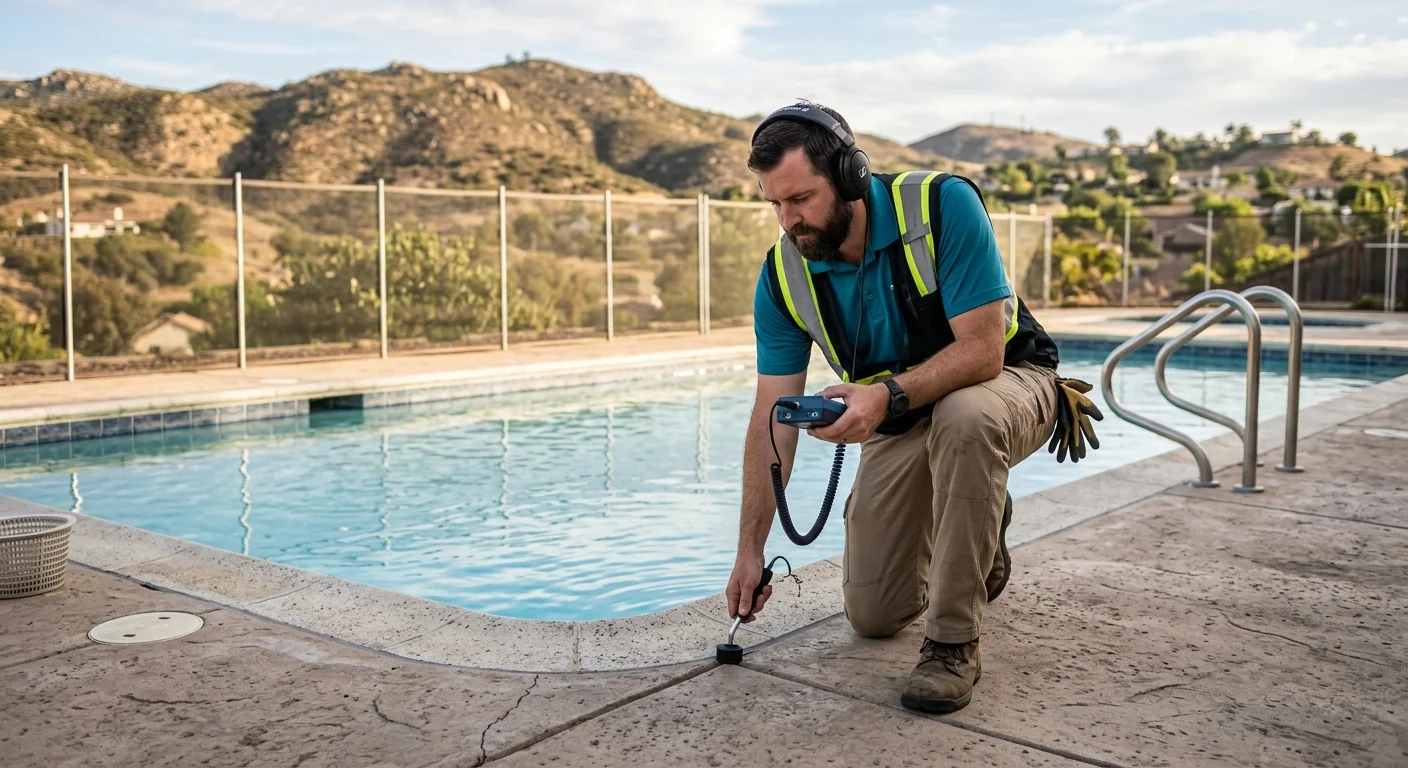
Listening gear along the deck is the other common tool. Water moving through a crack or a broken fitting makes a sound. A trained ear with a probe can follow it under concrete. That does not replace the gauge. It helps the pro decide where not to break the slab.
What you should get at the end is a location, or a short list of remaining suspects, in plain language. Shell versus plumbing. Suction versus return. Pad versus underground. A good visit also tells you what they did not find.
They may not finish a repair on that visit. Finding and fixing are separate jobs. Ask them to show you the gauge, the isolated valve, and the wet evidence. You are paying for a location you can act on.
Do not treat a backyard dye squirt as a substitute for that process. Home dye can hint at a skimmer. It cannot pressure-test a buried return under an East County patio.
Soil movement and underground lines in El Cajon
East County dirt moves. The valley floor is fill and alluvium in a lot of older tracts. The rise toward Granite Hills and Crest brings decomposed granite. Expansive clay shows up in pockets across the basin. None of that is a soil report for your lot. It is why a line that was true in 1975 can open at a joint after a wet winter and a hard summer.
Buried pool lines sit in that soil, often in a narrow trench under a slab. When the ground swells and shrinks, the pipe can pull at a fitting, oval at a glue joint, or crack at a 90 where it turns up into the shell. A leak there may never wet the grass next to the wall. It can travel along the pipe bedding and show up as a damp expansion joint, a settled paver, or a cold patch on the deck.
That is why digging where it looks wet is a poor plan. The wet mark is the exit, not always the hole. Isolation and a pressure hold tell the specialist which run is open. Then they decide how small a cut they can make.
If the shell itself has moved, you will sometimes see a crack at the beam, a tile course that has stepped, or a deck that has lifted off the coping. Those signs belong in the notes. They are not proof of a structural failure on their own. A licensed specialist has to separate a surface crack from a leaking structural crack.
Before anyone cuts a deck or a trench, California’s one-call rules for buried utilities still apply on the public side of the property. Your matched pro should handle that part of a dig. The pool lines themselves are private. The City of El Cajon and your water district do not map them for you.
Many El Cajon bills come from Helix Water District. Some East County streets sit in a different district. Read the name on the bill. A leak on the street side of the meter is theirs to hear about. A leak on the pool side is yours. The San Diego County Water Authority is the regional wholesaler, not the crew that will find a return line under your spa.
A specific City of El Cajon rule for draining a residential pool to the street or storm drain could not be confirmed for this page. Do not assume you can dump the pool. Call the City of El Cajon and the water district on your bill before you drain for a repair. They set the rule. This page does not.
Repair after the leak is found, without a price
Once the leak has a name, the repair is a separate conversation with the licensed pro who will do the work. Refresh Pool Pros does not quote a job and does not open the ground. The specialist looks at access, the material in the ground, whether a fitting can be replaced from the inside, and whether a section of pipe has to come out.
A wall fitting or a pump lid is a small close. An underground return under a poured deck is not. A skimmer throat rebuild is its own scope. A shell crack can stay a crack repair, or it can turn into a plaster discussion. None of those paths has a price on this page, because the quote has to follow the hole they actually found.
California contractor law still sits over the hire. Work that needs a permit, or that runs $1,000 or more in labor and materials together, is not casual handywork. Both conditions matter: under $1,000 and no permit. Splitting a job to stay under that line does not make it exempt. Unlicensed contracting is a misdemeanor under Business and Professions Code section 7028. Check the person in front of you on the CSLB license lookup. Our guide on how to check a pool contractor license in California walks through that page.
On a home improvement contract, the down payment cannot exceed $1,000 or 10 percent of the contract amount, whichever is less. That is Business and Professions Code section 7159.5. On a large plumbing repair the cap is $1,000, not ten percent of the whole job.
If the repair needs a permit, the City of El Cajon is the agency to ask. A permit issued for construction or remodel of a pool at a private single-family home can bring California’s drowning-prevention rule: at least two of seven safety features, one of which is an enclosure. That rule attaches when the permit is issued. It is not a blanket retrofit on every existing El Cajon pool, and it is not a reason to skip a leak repair.
Ask the pro, in writing, what they found, what they will replace, and what they will warrant. Ask whether they will pressure-test the repaired section before they close the trench. For buried pipe, see our notes on underground pool plumbing repair.
When to call us
Call when the waterline keeps dropping after you have accounted for East County heat, or when the deck, the pad, or the soil is staying wet. Pool leak detection in El Cajon is a licensed specialist’s test, not a guess from the fence line. Call us at (858) 400-4598 and we’ll connect you with a licensed local pool specialist.
Frequently asked questions
How do you find a leak in underground pool plumbing in El Cajon?
A licensed specialist isolates each run, pressure-tests the closed line, then uses listening gear and dye once the gauge points to a section. Digging at the first wet spot skips that work and often opens the wrong slab.
What should I do if I suspect an El Cajon pool leak?
Mark the waterline at the same hour, pause the auto-fill if you can do it safely, and run a bucket test for a few days. Note wet soil, air in the pump, or a deck that stays damp. Inland heat is the setup, not the diagnosis. Have a licensed specialist pressure-test if the pool keeps dropping.
How do I report a water leak in El Cajon?
A leak in the street or on the district side of the meter goes to the water district named on your bill. Helix Water District serves much of El Cajon, but confirm the name on the bill. A pool leak is private. Call a licensed pool specialist for the shell and the pool lines.
Can I do pool leak testing in El Cajon myself?
You can screen for evaporation with a marked waterline and a bucket. You cannot pressure-test a buried return from the coping. Leave isolation testing to a licensed pro. Home dye may hint at a skimmer. It does not prove the rest of the system.
Does leak detection include the repair?
Usually not. Finding the leak and fixing it are separate scopes. Ask what the visit covers before anyone arrives, then get a written repair plan once the leak has a location. Check the pro on the CSLB license lookup before you sign.
Need professional help in San Diego County?
Refresh Pool Pros connects you with a licensed specialist for any service in this post.