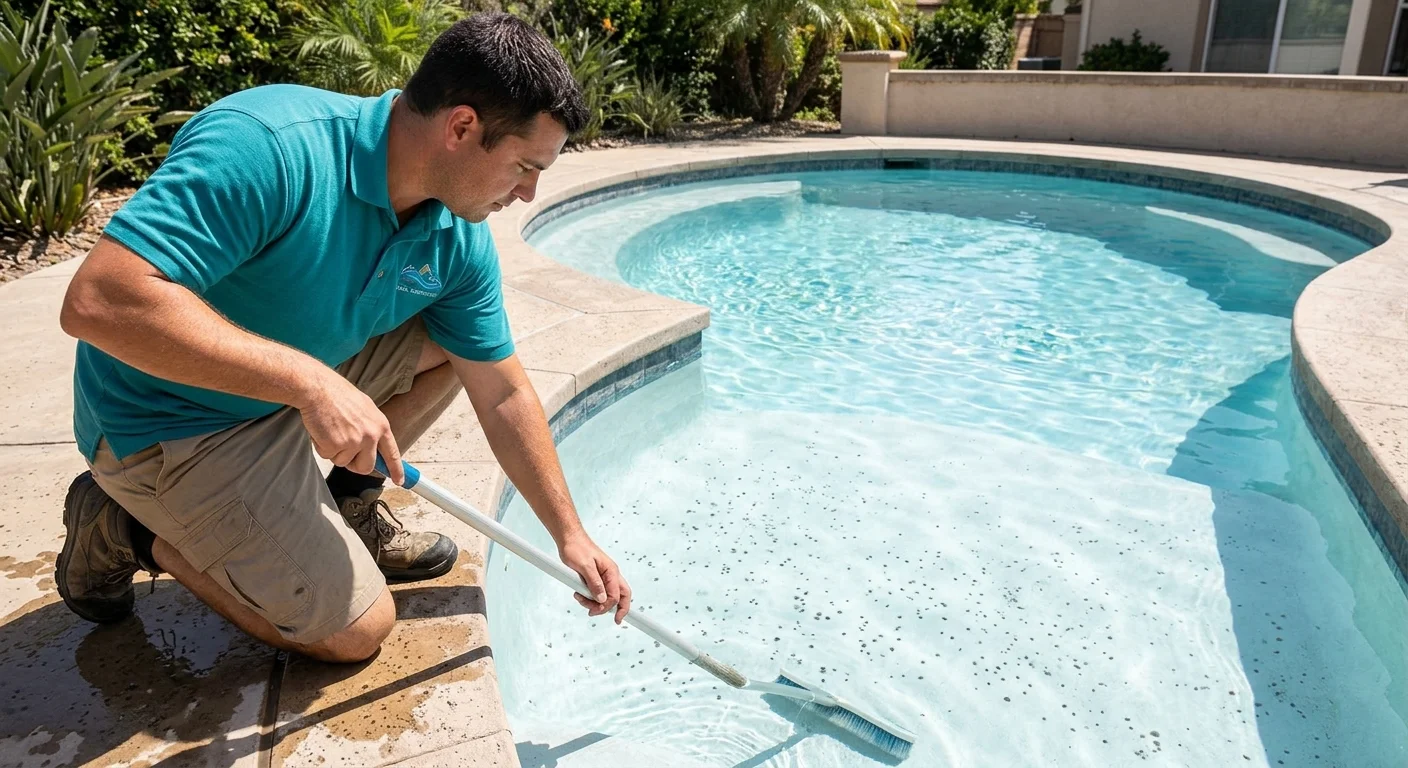
Those dark pinhead dots on the plaster are not leftover dirt from the last party. In a San Diego backyard they often sit on the floor and steps while the water still looks clear enough to swim. That pattern is black algae in a pool, and it is a different problem from a green bloom or a mustard film.
How black algae looks different from green and mustard
Green algae usually takes the water with it. You see a tint, then a cloud, then a full color change after a hot stretch or a missed sanitizer window. The patio view tells you. That is the job described in our green pool cleaning guide.
Mustard algae is paler. It shows as a yellow or tan dusting on walls, in shade, and along tile. A brush often moves it, then it reforms in the same corners. It can pass for pollen until it comes back. Details live on our mustard algae in San Diego pools page.
Black algae looks like a stain map. The water can stay fairly clear. The marks are dark, tight, and local: pinheads, then small coins, then clusters. They favor the deep end, gunite step treads, the shadow behind a ladder, the underside of a bench, and any corner the returns do not wash.
Run a finger across a spot. Dirt smears. Mustard often lifts. Black algae tends to stay. The colony lives in the pores of the finish, so the dot you see is only the top. On older plaster those pores are already open. That is why the same dots return in the same places after you brush.
Inland and East County gunite shows this more than a tight, newer shell along the coast. El Cajon, Santee, Lakeside, Ramona, and Alpine sit hotter, and many yards still carry original plaster from earlier decades. Encinitas, Carlsbad, and Del Mar see more marine air and a different mix of finishes. The organism does not care about the city limit. It cares about a rough, wet pore and weak sanitizer in that pocket.
Some owners scrape a bit onto a white towel and look for a green-black smear. That can hint. It is not a lab result. Metal staining and worn plaster fool people all the time. A licensed pool specialist reading the whole vessel is the identification that counts.
Why it roots into plaster in San Diego sun
San Diego County is not one climate. Coastal pools take marine air and a milder daily heat. Inland valleys bake. East County gunite takes that heat on a porous finish. Black algae wants a foothold more than it wants a slogan about warm water. The foothold is the plaster.
Gunite and plaster are mineral. They etch, they scale, they open. Fill water across the county is hard in a qualitative sense, and that shows up as scale in some yards and a rough, hungry surface in others. We do not publish grain-per-gallon figures. District reports do not give one number that holds for every street. What holds at the pad is simpler: older inland plaster is more likely to hold a colony than a tight, newer finish.
Sunlight does two jobs at once. It feeds the colony. It also burns through sanitizer at the surface on a clear afternoon in Mission Valley, Spring Valley, or Escondido. A morning test can look fine. By late day the steps and the shallow end can be a different story. Dead spots make it worse. If a return jet never washes the deep corner, that corner lives on its own chemistry.
Circulation fails in layouts you see all over this county. A kidney pool with a spa spill. A bench under a fig tree in North Park. A ladder that never gets a return aimed at it. Each one is a pocket where sanitizer and moving water thin out.
Spores arrive on swimsuits, toys, wind, and dust. The live question is whether they find a pore and a sanitizer gap. On plaster that has started to sugar, they find both.
Most backyard pools here are plaster, pebble, or fiberglass. Fiberglass is smoother, so dark spots there often sit in tile grout or in a scratch. The licensed pro matches the tool to the finish. A stiff brush that is right for rough plaster can scar the wrong shell.
Brushing and shocking that usually fail
Owners do the reasonable thing. They brush. They shock. The water sparkles. A week later the same black dots sit on the third step.
Brushing that does not break the colony’s hold only polishes the top. Shocking the water treats what is floating. Black algae in pool plaster is not floating. It is seated. If sanitizer never reaches the pore, the colony waits.
There is no dose chart on this page. Volume, stabilizer, pH, and the condition of the plaster all change the plan. A licensed specialist sets treatment from a test, not from a blog. Start with real pool water testing, then let the reading drive the next step.
A single shock also fails when the filter is loaded or a return is aimed wrong. You can add sanitizer to a pool that still has a dead corner. The corner wins. If a valve is set so water bypasses the filter, spores recirculate.
Timing advice online is noisy. Treat at noon. Treat at night. Sunlight, stabilizer, and the product in the pump room all interact. The specialist on your deck knows whether the pool is salt or liquid chlorine and which product is actually on site. Follow the label they use. Do not mix acids and chlorine as a home experiment.
Algaecide as a standing insurance policy is a common national pitch. Some specialists use a supporting product after the surface is opened and the water is balanced. Some do not. It is not a substitute for circulation and a sound finish.
If you have been brushing the same map of spots for weeks, stop escalating chemicals on your own. You can etch or stain plaster while the colony sits deeper. That is a pool repair visit, not another weekend of the same routine.
What a pool pro does when spots keep coming back
The specialist is not there to run a ritual. They are there to name the problem.
First they look. Clear water with a constellation of dark dots is a different job than a green pool. They check the steps, the floor around the main drain, behind ladders, and the tile line. They feel whether the finish is tight or sugaring.
Then they test. Chemistry comes from the sample. If sanitizer is weak, they correct it on a plan that fits that water. If pH is off, chlorine will not work the way you expect, and they will say so from the reading.
They check circulation. A dirty filter. A closed valve. A return that never moves the deep end. A cleaner that never climbs the wall where the spots live. On a salt system they look at whether the cell is actually producing. None of that is a promise about when someone arrives. It is the work once a licensed pro is on the deck.
When the diagnosis is algae, treatment is physical and chemical together. The pro uses a brush matched to the surface, opens the colony, and applies sanitizer at the levels the test supports. They may vacuum to waste so dead material does not load the filter. They may need a second pass. Black algae that has sat in East County plaster for a season rarely yields in one afternoon.
They also look at the gear that let it start. A pump that hums but does not move water. A filter that needs a real clean or a replacement decision. Returns that need aiming. Those are repair conversations, and they belong with a licensed contractor you can verify on the CSLB license lookup. Refresh Pool Pros matches you with that licensed local specialist. We do not hold the brush.
If the spots are not algae, they will say that too.
When black spots are plaster failure, not algae
Not every black mark is alive. San Diego plaster fails in public ways. It etches. It flakes. It exposes dark aggregate. Metal from old equipment or from fill water can stain. A black smear that never changes shape, never goes green on a towel, and sits in a field of rough, worn plaster may be the finish, not a colony.
Clues it may be the surface: the marks follow cracks or a worn band at the waterline. The plaster feels like sandpaper or sugar. Brushing makes dust, not a smear. The pattern has been stable for months while the water tests decent.
Clues it may still be algae: new dots appear next to old ones. A spot has a slightly raised, slick feel. The same corner reseeds after chemistry looks acceptable.
When the finish is the problem, chemistry will not save it. You are looking at repair or pool resurfacing. The related questions sit in our notes on cracked pool plaster and signs your pool needs resurfacing. A licensed pro should make that call on the deck. Guessing from a phone photo is how people acid-wash a stain that needed a chip-out, or ignore a colony until it maps the whole floor.
Public health is a separate issue from cosmetics. The CDC’s healthy swimming guidance is about germs in recreational water, not a field guide to black spots. If the pool is out of sanitizer, stay out until a specialist brings the water back in range. That holds for a green pool and for a clear pool with no residual.
South Bay plaster in Chula Vista and National City, mid-century gunite in the College Area, and 1990s pebble in Carmel Valley all age differently. The common thread is the pore. If the surface is open, something will live in it, or the mineral itself will show through.
When to call us
When the same black spots return after brushing and shocking, or when you cannot tell algae from worn plaster, you need a licensed pool specialist on site. Call us at (858) 400-4598 and we’ll connect you with a licensed local pool specialist.
Frequently asked questions
How do you remove black algae from a pool?
A licensed pool specialist tests the water, checks circulation and the plaster, then sets treatment from those results. Brushing and a single shock often leave the colony in the pores, so the spots come back. There is no one chemical dose that fits every San Diego pool.
Will shocking a pool get rid of black algae?
Shocking can knock down algae in the water, but black spots rooted in plaster often survive a single shock. If the water looks clearer and the dots return in the same places, the colony is still in the surface. A licensed pro reads a test and treats the finish and the chemistry together.
Why does algae keep coming back in my pool?
Dead spots behind steps, a dirty filter, plaster that has opened up, and San Diego sun that burns through sanitizer all give algae a window. Black algae is especially stubborn on older inland and East County gunite. Fixing only the water leaves the pores loaded.
How can I tell black algae from green or mustard algae?
Green algae usually tints the water. Mustard algae is yellowish and often brushes off. Black algae shows as dark pinhead or coin-sized spots on plaster that do not wipe away with a finger, even when the water looks fairly clear.
Are black spots in pool plaster always algae?
No. Metal staining, worn plaster, and exposed aggregate can look similar. If the mark does not smear, does not spread, and sits in a pattern of etching or flaking, it may be the finish failing. A licensed pro can tell the difference on site.
Need professional help in San Diego County?
Refresh Pool Pros connects you with a licensed specialist for any service in this post.